
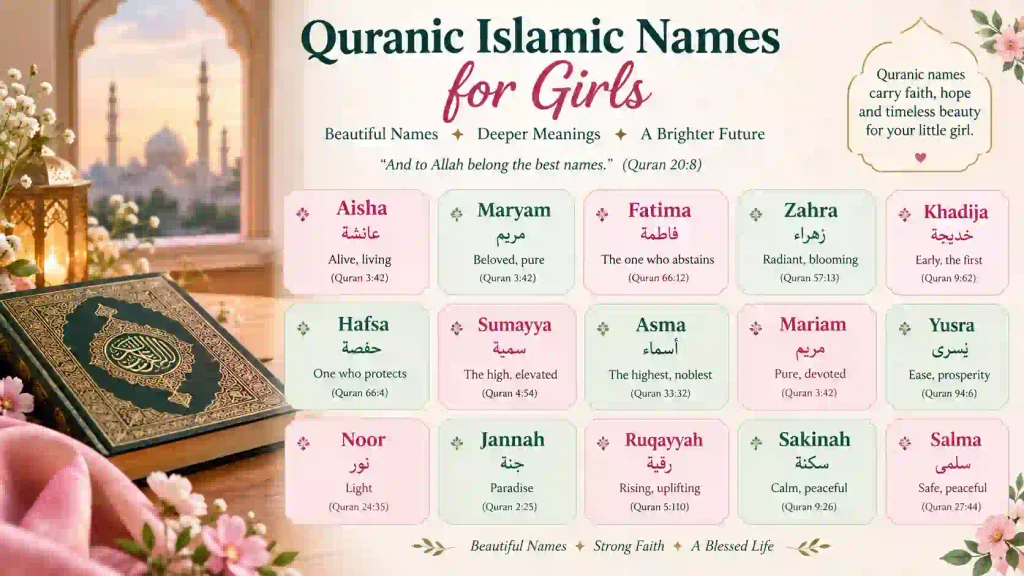
If you are searching for Quran Islamic names for girls, it helps to know that “Quranic” and “Islamic” do not always mean the same thing. Maryam is the clearest example of a female personal name directly mentioned in the Qur’an. Many other popular choices, such as Huda, Afnan, Bushra, Yusra, Sidra, Tasnim, and Salsabil, are Arabic words or terms found in the Qur’an and used as personal names.
Other beautiful names, including Aisha, Khadijah, Fatimah, and Zaynab, are important Islamic names but are not female personal names found in the Qur’anic text.
This guide keeps those categories separate. That makes it easier to understand not only what a name means, but also why it is considered Qur’anic, where it appears, how to pronounce it, and whether its connection comes from the Qur’an itself or from later Islamic tradition.
What Counts as a Quranic Girl Name?
A Quranic girl name can mean different things on baby-name websites, so a little care is needed.
The strongest category is a female personal name actually appearing in the Qur’an. Maryam belongs here. The Qur’an repeatedly names Maryam and dedicates an entire surah to her.
A second category contains Qur’anic Arabic words that are used as personal names, such as Huda, Ayah, Bushra and Yusra. These are genuine Arabic words with Qur’anic usage, but they are not necessarily the names of women in the Qur’an.
A third category contains Islamic historical names. Aisha, Khadijah, Fatimah and Zaynab are important Muslim names, but they should not be presented as female names directly mentioned in the Qur’an.
That distinction is the foundation of this list.
1. Maryam: The Clearest Direct Quranic Girl Name
Maryam (مريم)
Meaning: The exact original etymology is uncertain and has been explained in different ways.
Origin: Arabic form of the older Maryam/Miriam name tradition
Pronunciation: MAR-yam
Gender: Girl
Name type: Direct Qur’anic personal name
Qur’anic connection: Maryam is explicitly named in the Qur’an.
Maryam is the strongest answer to the question, “What girl’s name is directly mentioned in the Qur’an?”
She is the mother of Isa (Jesus), and the Qur’an gives her an unusually prominent place. Surah 19 is called Surah Maryam, and the text repeatedly refers to her and her son.
The exact etymology of Maryam is not settled. For that reason, it is better to avoid confidently claiming that the name literally means “pure,” “pious,” or another single English word. Those descriptions may reflect religious associations or particular etymological interpretations rather than an undisputed literal meaning.
Best for: Parents wanting the strongest direct Qur’anic connection.
2. Huda
Huda (هدى)
Meaning: Guidance
Origin: Arabic
Pronunciation: HOO-da
Gender: Girl
Name type: Qur’anic word used as a given name
Huda is one of the clearest choices if you want a short name with a strong spiritual meaning. The Arabic word hudā refers to guidance and appears throughout the Qur’an.
Unlike Maryam, Huda is not the name of a woman in the Qur’anic narrative. Its connection comes from the Qur’anic vocabulary itself.
Vibe: Short, calm and strongly spiritual.
3. Ayah
Ayah (آية)
Meaning: Sign, sign of God, verse
Origin: Arabic
Pronunciation: EYE-ah
Gender: Girl
Name type: Qur’anic word name
Ayah is a particularly interesting choice because the Arabic word has more than one closely related use. In the Qur’an, āyah can refer to a sign or indication, while it is also used for a verse of scripture.
As a girl’s name, Ayah uses this established Arabic word. It should not be described as the personal name of a Qur’anic woman.
Best for: Parents wanting a short name with a direct connection to Qur’anic language.
4. Afnan
Afnan (أفنان)
Meaning: Spreading branches
Origin: Arabic
Pronunciation: AF-nan
Gender: Usage varies
Name type: Qur’anic nature-related word name
Afnan appears in Surah Ar-Rahman in the description of the gardens. The word refers to spreading branches.
This gives Afnan a stronger basis than many modern “nature names” that simply borrow an attractive English translation. Its Qur’anic context is clearly documented.
Vibe: Natural and distinctive.
5. Bushra
Bushra (بشرى)
Meaning: Good news, glad tidings
Origin: Arabic
Pronunciation: BUSH-ra
Gender: Girl
Name type: Qur’anic word name
Bushra comes from the Arabic word for good news or glad tidings. The Qur’an uses the term in contexts involving good news.
As a name, Bushra has a warm and positive meaning without requiring a complicated interpretation.
Best for: Parents who want a name connected with happiness and good news.
6. Yusra
Yusra (يسرى)
Meaning: Ease, facility
Origin: Arabic
Pronunciation: YOOS-ra
Gender: Girl
Name type: Qur’anic word name
Yusra is associated with ease and the removal of difficulty. It is especially familiar to Muslim families because of its Qur’anic usage.
It is also practical for everyday use because it is short and relatively easy to pronounce in both South Asian and English-speaking settings.
Vibe: Gentle, hopeful and elegant.
7. Amani
Amani (أماني)
Meaning: Hopes, wishes
Origin: Arabic
Pronunciation: ah-MA-nee
Gender: Girl
Name type: Qur’anic word name
Amani is the plural form related to hopes or wishes and occurs in the Qur’an. It is also an established feminine given name.
The name works particularly well if you want something that sounds modern while retaining a clear Arabic linguistic foundation.
8. Sidra
Sidra (سدرة)
Meaning: Lote tree
Origin: Arabic
Pronunciation: SID-ra
Gender: Girl
Name type: Qur’anic nature name
Sidra comes from sidrah, the Arabic term for a lote tree. Its Islamic significance is especially associated with Sidrat al-Muntaha, mentioned in Surah An-Najm.
It is therefore better described as a Qur’anic nature-related name with religious significance rather than simply translating it as “heavenly tree.”
Vibe: Natural, graceful and distinctive.
9. Tasnim
Tasnim (تسنيم)
Meaning: Tasnim, a heavenly drink or fountain associated with Paradise
Origin: Arabic
Pronunciation: TAS-neem
Gender: Girl
Name type: Qur’anic Paradise-associated name
The Qur’an mentions Tasnim in 83:27, saying that the drink of the righteous is mixed with Tasnim. The term is therefore directly present in the Qur’anic text.
It is better to preserve this Qur’anic context than to reduce the name to a generic definition such as “beautiful fountain.”
Best for: A distinctive Muslim girl name with a clear Qur’anic association.
10. Salsabil
Salsabil (سلسبيل)
Meaning: A fountain or spring in Paradise
Origin: Qur’anic Arabic
Pronunciation: SAL-sa-beel
Gender: Girl in modern naming usage
Name type: Qur’anic proper noun
Salsabil is unusually strong from a textual perspective. Qur’an 76:18 says that there is a spring in Paradise called Salsabil. The Qur’anic Arabic Corpus classifies the term as a proper noun in that verse.
That makes Salsabil different from a word that merely shares an Arabic root with something in the Qur’an.
Vibe: Distinctive, lyrical and strongly religious.
11. Shifa
Shifa (شفاء)
Meaning: Healing, cure
Origin: Arabic
Pronunciation: SHI-fa
Gender: Girl or usage varies by culture
Name type: Qur’anic word name
Shifa comes from an Arabic word associated with healing and cure. The Qur’an uses the word in contexts connected with healing.
As a personal name, Shifa is especially familiar in South Asian Muslim communities.
Best for: Parents who value a name connected with healing.
12. Rahma
Rahma (رحمة)
Meaning: Mercy, compassion
Origin: Arabic
Pronunciation: RAH-ma
Gender: Girl
Name type: Virtue name with Qur’anic vocabulary
Rahma is based on the Arabic word for mercy and compassion. Mercy is one of the major recurring themes in Islamic scripture, giving the name a strong religious association.
The name is also easy to explain because its basic meaning is clear.
13. Iman
Iman (إيمان)
Meaning: Faith, belief
Origin: Arabic
Pronunciation: ee-MAAN
Gender: Usage varies by culture
Name type: Islamic virtue name
Iman is one of the most recognizable Islamic virtue names. It comes from the Arabic word for faith or belief.
It is better described as a Qur’anic Arabic and Islamic virtue name than as the name of a Qur’anic woman.
14. Taqwa
Taqwa (تقوى)
Meaning: God-consciousness, piety, righteousness
Origin: Arabic
Pronunciation: TAK-wa
Gender: Usage varies
Name type: Islamic virtue name
Taqwa represents an important Islamic concept. It is commonly translated with ideas such as piety, reverence and God-consciousness.
Because it is a theological concept rather than a female character’s name, it belongs in the Qur’anic vocabulary category.
15. Noor
Noor (نور)
Meaning: Light
Origin: Arabic
Pronunciation: NOOR
Gender: Unisex in many communities
Name type: Qur’anic word name
Noor is one of the most familiar Muslim names in this group. It means “light” in Arabic and has an important Qur’anic association through the famous verse of light in Surah An-Nur.
It can be used for girls or boys depending on the culture, so calling Noor exclusively feminine would be unnecessarily restrictive.
Best for: Parents wanting a short, internationally usable Muslim name.
16. Salwa
Salwa (سلوى)
Meaning: Quail in its Qur’anic context
Origin: Arabic
Pronunciation: SAL-wa
Gender: Girl
Name type: Qur’anic word name
In the Qur’an, al-salwa refers to quail and appears alongside manna in passages concerning the Children of Israel.
This is a good example of why a name should be explained from its actual Qur’anic context rather than given an invented romantic meaning.
17. Najwa
Najwa (نجوى)
Meaning: Private conversation, secret counsel
Origin: Arabic
Pronunciation: NAJ-wa
Gender: Girl
Name type: Qur’anic word name
Najwa is a genuine Arabic word found in the Qur’an. It refers to private or secret conversation.
Its meaning is more nuanced than many baby-name websites suggest. The Qur’anic contexts should be considered before describing it simply as a positive “beautiful Islamic meaning.”
18. Alaa
Alaa (آلاء)
Meaning: Blessings, favors
Origin: Arabic
Pronunciation: ah-LAA
Gender: Girl
Name type: Qur’anic word name
Alaa is especially recognizable from Surah Ar-Rahman, where the repeated question about the favors of Allah is central to the surah.
It is a strong choice for parents who want a name associated with blessings.
19. Duha
Duha (ضحى)
Meaning: Morning brightness, forenoon
Origin: Arabic
Pronunciation: DOO-ha
Gender: Girl
Name type: Qur’anic word name
Duha is also the name of Surah 93. The word refers to the bright part of the morning.
Vibe: Bright, simple and peaceful.
20. Fajr
Fajr (فجر)
Meaning: Dawn, daybreak
Origin: Arabic
Pronunciation: FAJ-r
Gender: Usage varies
Name type: Qur’anic word name
Fajr means dawn or daybreak and is also the name of Surah 89.
Although it is used as a personal name in Muslim communities, it is more accurately described as a Qur’anic word name than as a female character name.
21. Isra
Isra (إسراء)
Meaning: Night journey
Origin: Arabic
Pronunciation: is-RAA
Gender: Girl
Name type: Islamic/Qur’anic word name
Isra is associated with the night journey described at the opening of Surah Al-Isra.
The name is therefore strongly connected with Islamic religious history and Qur’anic language, although it is not the personal name of a woman in the Qur’an.
22. Safa
Safa (صفا)
Meaning: As-Safa, the sacred hill in Makkah
Origin: Arabic
Pronunciation: SA-fa
Gender: Girl
Name type: Sacred geographic name
Safa has a direct Qur’anic connection through the sacred site in Makkah. Qur’an 2:158 names As-Safa together with Al-Marwah and describes both as among the symbols of Allah.
For a baby-name article, it is more accurate to call Safa a sacred place-associated name than to force it into a simple “means purity” definition.
23. Marwa
Marwa (مروة)
Meaning: Al-Marwah, the sacred site in Makkah
Origin: Arabic
Pronunciation: MAR-wa
Gender: Girl
Name type: Sacred geographic name
Marwa is the companion name to Safa in Qur’an 2:158. Both places are associated with the pilgrimage rite of Sa’i.
Best for: Families who want a personal name with a direct connection to Islamic sacred geography.
24. Kawthar
Kawthar (كوثر)
Meaning: Abundant goodness, abundance
Origin: Arabic
Pronunciation: KOW-thar
Gender: Usage varies
Name type: Qur’anic religious name
Al-Kawthar is the name of Surah 108. The first verse says that Allah granted the Prophet Muhammad Al-Kawthar. Translations and explanations vary in how they describe the term, so “abundance” or “plentiful goodness” is safer than claiming one single English definition.
25. Jannah
Jannah (جنة)
Meaning: Garden; Paradise in Islamic usage
Origin: Arabic
Pronunciation: JAN-na
Gender: Girl in modern usage
Name type: Arabic religious word name
Jannah is a genuine Arabic word with major Islamic significance. In Qur’anic contexts it can refer to a garden, while in Islamic religious usage it commonly refers to Paradise.
This is therefore a religious vocabulary name rather than a female personal name from the Qur’an.
26. Ahd
Ahd (عهد)
Meaning: Covenant, pledge, promise
Origin: Arabic
Pronunciation: AHD
Gender: Usage varies
Name type: Qur’anic word name
Ahd is a concise Arabic word associated with a covenant, pledge or promise. It has Qur’anic usage and can work for parents who prefer very short names.
27. Amanah
Amanah (أمانة)
Meaning: Trust, responsibility, entrusted duty
Origin: Arabic
Pronunciation: ah-MA-na
Gender: Girl
Name type: Islamic virtue name
Amanah represents the idea of something entrusted to a person and the responsibility that comes with it.
It has strong Islamic significance, but it should not be confused with the name of a woman mentioned in the Qur’an.
28. Amal
Amal (أمل)
Meaning: Hope, expectation
Origin: Arabic
Pronunciation: AH-mal
Gender: Girl or unisex depending on culture
Name type: Arabic word name
Amal is a familiar Arabic personal name. The word also occurs in the Qur’an in contexts involving hope or expectation.
It is particularly attractive if you want something short and easy to pronounce.
29. Amaal
Amaal (آمال)
Meaning: Hopes, aspirations
Origin: Arabic
Pronunciation: ah-MAAL
Gender: Girl
Name type: Arabic word name
Amaal is related to Amal and represents the plural idea of hopes or aspirations.
It is a useful alternative for parents who like Amal but want a slightly longer form.
30. Abrar
Abrar (أبرار)
Meaning: Righteous people, virtuous people
Origin: Arabic
Pronunciation: AB-raar
Gender: Usage varies
Name type: Qur’anic word name
Abrar is a Qur’anic term referring to righteous people. It is also used as a personal name in Muslim communities.
Because the Arabic form is grammatically plural, it is better to explain the original word rather than inventing a singular English meaning.
31. Iqra
Iqra (اقرأ)
Meaning: Read or recite
Origin: Arabic
Pronunciation: iq-RA
Gender: Girl in modern naming usage
Name type: Qur’anic word/command used as a given name
Iqra is associated with the opening command of the first Qur’anic revelation in Islamic tradition.
For accuracy, however, it should be called a Qur’anic word used as a name, not a woman named Iqra in the Qur’an.
32. Anhar
Anhar (أنهار)
Meaning: Rivers
Origin: Arabic
Pronunciation: an-HAAR
Gender: Usage varies
Name type: Qur’anic word name
Anhar is the plural of nahr, meaning river. Rivers are frequently mentioned in Qur’anic descriptions of gardens and Paradise.
This gives Anhar a strong nature and Paradise association, but its literal Arabic meaning remains “rivers.”
33. Areej
Areej (أريج)
Meaning: Fragrance, pleasant scent
Origin: Arabic
Pronunciation: ah-REEJ
Gender: Girl
Name type: Arabic personal name
Areej is an established Arabic feminine name. It is sometimes included on broad “Quranic name” lists, but it is better treated as an Arabic Islamic-style name unless a specific Qur’anic textual occurrence is being claimed.
This distinction prevents a common SEO-name mistake: assuming every attractive Arabic name is automatically Qur’anic.
34. Aisha
Aisha (عائشة)
Meaning: Living, alive
Origin: Arabic
Pronunciation: EYE-sha
Gender: Girl
Name type: Islamic historical name
Aisha is one of the most important female names in Islamic history because of Aisha bint Abi Bakr, wife of Prophet Muhammad.
However, Aisha should not be presented as a female personal name directly mentioned in the Qur’an. Its importance comes from Islamic history and hadith tradition.
35. Khadijah
Khadijah (خديجة)
Meaning: Traditional Arabic personal name with an etymology connected in Arabic lexicography with a prematurely born child
Origin: Arabic
Pronunciation: kha-DEE-ja
Gender: Girl
Name type: Islamic historical name
Khadijah is the name of the Prophet Muhammad’s first wife and an exceptionally important woman in early Islamic history.
She is not named directly in the Qur’an. This is exactly why Khadijah belongs in an Islamic names section rather than the direct Qur’anic names section.
36. Fatimah
Fatimah (فاطمة)
Meaning: Traditionally connected with weaning or abstaining
Origin: Arabic
Pronunciation: FA-ti-mah
Gender: Girl
Name type: Islamic historical name
Fatimah is the name of the daughter of Prophet Muhammad and is one of the most respected female names in Islamic tradition.
Like Aisha and Khadijah, Fatimah is an Islamic historical name, not a female personal name directly mentioned in the Qur’an.
37. Zaynab
Zaynab (زينب)
Meaning: The name has established Arabic usage, while precise lexical explanations vary
Origin: Arabic
Pronunciation: ZAY-nab
Gender: Girl
Name type: Islamic historical name
Zaynab was born to several important women in early Islam, including members of the Prophet Muhammad’s family.
Because its detailed etymology is sometimes explained differently by naming sources, it is better not to attach an invented single meaning to it.
38. Hafsah
Hafsah (حفصة)
Meaning: Traditional Arabic name; often connected in lexical sources with a young female lion
Origin: Arabic
Pronunciation: HAF-sa
Gender: Girl
Name type: Islamic historical name
Hafsah is best known as one of the wives of Prophet Muhammad and as a historical figure associated with the preservation of the written Qur’anic material.
She should be categorized as an Islamic historical name rather than a direct Qur’anic female name.
39. Safiyyah
Safiyyah (صفية)
Meaning: Pure or chosen, depending on lexical interpretation
Origin: Arabic
Pronunciation: sa-FEE-yah
Gender: Girl
Name type: Islamic historical name
Safiyyah is associated with Safiyyah bint Huyayy, one of the wives of Prophet Muhammad.
The name has a long Arabic history and strong Islamic significance, but the personal name is not a female name directly mentioned in the Qur’an.
40. Asma
Asma (أسماء)
Meaning: A traditional Arabic personal name with several lexical explanations
Origin: Arabic
Pronunciation: AS-ma
Gender: Girl
Name type: Islamic historical name
Asma is strongly associated with Asma bint Abi Bakr, an important woman in early Islamic history.
It is another useful reminder that a name can be deeply Islamic without being directly Qur’anic.
The Most Useful Way to Classify These Names
If your main goal is a name directly appearing as a woman’s name in the Qur’an, choose Maryam.
If you want a Qur’anic Arabic word used as a personal name, consider:
- Huda
- Ayah
- Afnan
- Bushra
- Yusra
- Amani
- Sidra
- Tasnim
- Salsabil
- Shifa
- Rahma
- Noor
- Salwa
- Najwa
- Alaa
- Duha
- Fajr
- Isra
- Safa
- Marwa
- Kawthar
- Jannah
- Ahd
- Amanah
- Amal
- Amaal
- Abrar
- Iqra
- Anhar
If you want an important Islamic historical name, consider:
- Aisha
- Khadijah
- Fatimah
- Zaynab
- Hafsah
- Safiyyah
- Asma
This three-part system is more useful than putting every Arabic or Muslim name under the single label “Quranic.”
15 Best Quran Islamic Names for Girls
1. Best Direct Quranic Name: Maryam
The strongest choice of direct Qur’anic female-name status matters most.
2. Best Short Spiritual Name: Huda
Simple, feminine and connected with guidance.
3. Best Nature Name: Afnan
A Qur’anic name associated with spreading branches.
4. Best Paradise-Associated Name: Tasnim
Directly connected with the Qur’anic description of Tasnim.
5. Best Distinctive Name: Salsabil
A Qur’anic proper name for a fountain or spring in Paradise.
6. Best Meaning “Light”: Noor
Short, familiar and widely usable.
7. Best Meaning “Good News”: Bushra
Positive and easy to understand.
8. Best Meaning “Ease”: Yusra
Soft-sounding with a hopeful meaning.
9. Best Sacred Place Name: Safa
Directly connected with one of the sacred sites mentioned in Qur’an 2:158.
10. Best Companion Sacred Place Name: Marwa
A strong Islamic geographical association.
11. Best Healing-Related Name: Shifa
A meaningful choice connected with healing.
12. Best Hope-Related Name: Amani
A feminine name associated with hopes and wishes.
13. Best Virtue Name: Rahma
Simple and strongly connected with mercy.
14. Best Historical Islamic Name: Khadijah
A deeply respected name from early Islamic history.
15. Best Short Modern-Friendly Name: Ayah
Easy to remember and directly connected with Qur’anic vocabulary.
How to Choose Between the Best Names
Choose Maryam if direct Qur’anic female-name status is your priority.
Choose Huda if you want the meaning of guidance.
Choose Noor if you want something short and broadly familiar.
Choose Yusra if you prefer a name associated with ease.
Choose Afnan if nature and Qur’anic imagery appeal to you.
Choose Sidra if you want a tree-related Islamic name.
Choose Tasnim if you like a distinctive Paradise-associated name.
Choose Salsabil if you want something uncommon with an especially clear Qur’anic textual reference.
Choose Safa or Marwa if sacred Islamic geography matters to your family.
Choose Khadijah, Aisha or Fatimah if your priority is an important woman from Islamic history rather than a name appearing directly in the Qur’an.
There is no need to choose a name simply because a website calls it “rare” or “modern.” A documented meaning, comfortable pronunciation and meaningful cultural connection are more useful criteria.
Quranic vs Islamic Girl Names: The Difference
| Category | Example | Why it belongs |
| Direct female personal name | Maryam | A woman explicitly named in the Qur’an |
| Qur’anic word used as a name | Huda | Arabic word meaning guidance and found in the Qur’an |
| Qur’anic proper noun | Salsabil | Name of a fountain/spring in Paradise |
| Sacred geographic name | Safa | Sacred site named in Qur’an 2:158 |
| Islamic historical name | Aisha | Important woman in Islamic history, not named in Qur’an |
| Islamic historical name | Khadijah | Wife of Prophet Muhammad, not named in Qur’an |
| Islamic historical name | Fatimah | Daughter of Prophet Muhammad, not named in Qur’an |
This distinction is one of the easiest ways to avoid inaccurate baby-name information.
Frequently Asked Questions
Question: What is the only woman’s personal name mentioned in the Quran?
Answer: Maryam is the only woman whose personal name is explicitly given in the Qur’anic text. She is the mother of Isa, and Surah 19 is named Maryam. Other women appear in Qur’anic narratives but are generally identified through relationships or titles rather than personal names.
Question: Is Aisha a Quranic girl name?
Answer: Aisha is an important Islamic name, but it should not be described as a female personal name directly mentioned in the Qur’an. Its importance comes from Islamic history and hadith tradition, especially Aisha bint Abi Bakr, wife of Prophet Muhammad.
Question: Is Fatimah a Quranic name?
Answer: Fatimah is an important Muslim and Arabic name, especially because of Fatimah, daughter of Prophet Muhammad. However, Fatimah is not a female personal name explicitly mentioned in the Qur’anic text. It is therefore more accurate to call it an Islamic historical name.
Question: Is Maryam a Quranic name?
Answer: Yes. Maryam is explicitly mentioned in the Qur’an and is the mother of Isa. The Qur’an refers to her by name in multiple verses, and Surah 19 is called Surah Maryam.
Question: Is Salsabil mentioned in the Quran?
Answer: Yes. Qur’an 76:18 says that there is a spring in Paradise called Salsabil. The Qur’anic Arabic Corpus classifies Salsabil as a proper noun in that verse, making its Qur’anic connection especially clear.
Question: Are Safa and Marwa Quranic names?
Answer: Safa and Marwa are names of sacred places associated with Hajj and Umrah. Qur’an 2:158 explicitly names both and describes them as among the symbols of Allah. They are also used as personal names, particularly among Muslim communities.
Question: What is a beautiful short Quranic girl name?
Answer: Huda, Ayah, Noor and Yusra are strong short choices. Huda means guidance, Ayah means sign or verse, Noor means light, and Yusra is associated with ease. Their exact Qur’anic status differs, so they are best described as Qur’anic word names rather than names of Qur’anic women.
Question: What is a unique Quranic girl name?
Answer: Salsabil and Tasnim are two distinctive choices with particularly clear Qur’anic connections. Salsabil is the name of a fountain or spring in Paradise in Qur’an 76:18, while Tasnim appears in Qur’an 83:27 in connection with the drink of the righteous.
Related Name Ideas
For a names website, this topic naturally connects with:
- Arabic girl names
- Muslim girl names
- Islamic girl names
- Girl names from the Quran
- Quranic names with meanings
- Beautiful Muslim girl names
- Unique Islamic girl names
- Muslim girl names with Arabic meanings
- Islamic names of Sahabiyat
- Names of women in Islamic history
- Arabic names meaning light
- Islamic names meaning mercy
- Muslim names connected with Paradise
Conclusion
The best Quran Islamic names for girls are not necessarily the names that appear most often on large baby-name lists. Accuracy matters. Maryam is the clearest direct female personal name in the Qur’an, while names such as Huda, Ayah, Afnan, Bushra, Yusra, Sidra, Tasnim and Salsabil come from Qur’anic Arabic words and terms used as personal names. Names such as Aisha, Khadijah and Fatimah have deep Islamic importance but belong to Islamic history rather than the Qur’anic text itself.
When choosing a name, look beyond a simple English translation. Check the Arabic form, original meaning, Qur’anic context and cultural usage. A name becomes much more meaningful when you understand where it comes from and why Muslim families have valued it. For parents seeking a name with both linguistic depth and religious significance, a carefully verified Qur’anic name can be a beautiful choice.

PressoraMedia is a content platform dedicated to helping readers find the right words, names, meanings, and ideas for everyday use. Our content focuses on names, name meanings, naming inspiration, and useful language-related information in a simple and easy-to-understand format. At Pressora Media, we believe that choosing a name is more than simply finding a word. A name can carry meaning, personality, culture, and a special story. That is why we research names carefully and create helpful guides designed to make the naming process easier. Our authors and contributors focus on providing clear explanations, useful name suggestions, meanings, origins, pronunciations, and practical naming ideas. We aim to keep our content informative, reader-friendly, and genuinely useful. Whether you are searching for a meaningful name, exploring the origin of a name, looking for unique naming ideas, or simply curious about the meaning behind a word or name, Pressora Media is here to help.
Pressora Media Team
Helping you find the right name, meaning, and words.