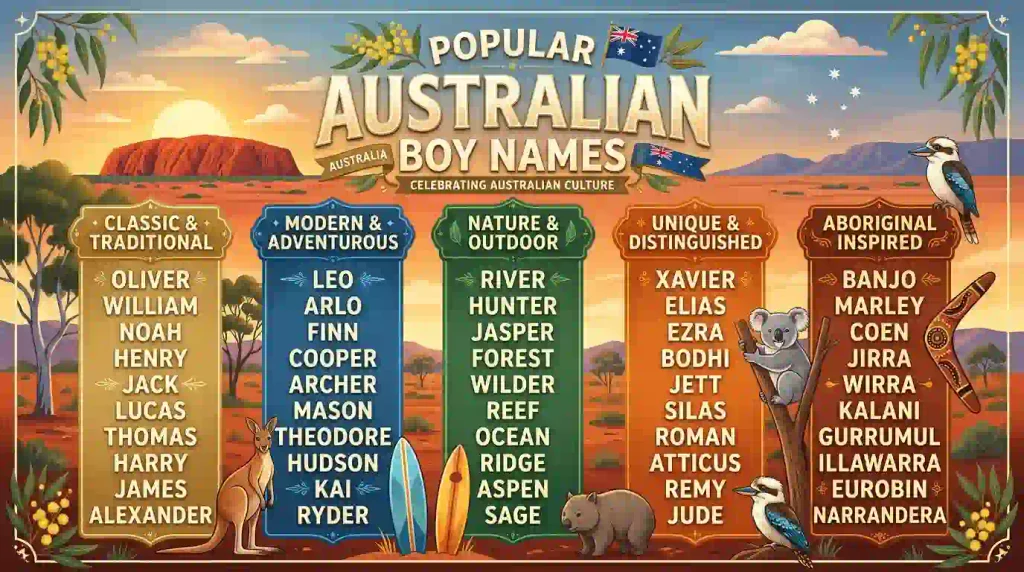

Australian names for boys include popular choices such as Noah, Oliver and Henry, traditional names such as Lachlan and Angus, and distinctive options such as Banjo and Jarrah. Some are popular in Australia without being Australian in origin, while others have documented connections to Australian history, landscapes or First Nations languages.
The right choice depends on what you want the name to represent. You might prefer a familiar name that is easy to spell, a traditional name with Scottish or Irish roots, or a less common name with a meaningful connection to Australia.
This guide brings together boy names used in Australia, explains their documented meanings and origins, and separates cultural associations from literal meanings. It also includes recent popularity data, pronunciation help and practical advice for comparing your favorites.
One important distinction: Australia does not have a single government-issued national baby-name ranking. State and territory registries publish their own lists, so popularity claims below identify their geographic scope whenever possible.
1. Most Popular Australian Boy Names
These names appear in recent Australian registration lists. The following examples are drawn from official 2025 state rankings and are not presented as a single national top ten. Noah ranked first in New South Wales, while Oliver ranked first in Queensland.
1. Noah
Meaning: Rest or repose.
Origin: Hebrew. Pronunciation: NOH-uh.
A biblical name with broad international recognition. It is a good choice if you want something familiar, gentle-sounding and easy to use in different countries.
2. Oliver
Meaning: Its exact etymology is debated; the traditional association with the olive tree should not be treated as a settled literal meaning.
Origin: Medieval European name history. Pronunciation: OL-ih-ver.
Oliver is a long-standing Australian favorite. It suits families who like classic names with the familiar nickname Ollie.
3. Theodore
Meaning: Gift of God.
Origin: Greek. Pronunciation: THEE-uh-dor.
A traditional name with a formal feel. Theo and Teddy are established shorter forms.
4. Henry
Meaning: Home ruler.
Origin: Germanic. Pronunciation: HEN-ree.
Henry combines a long history with a simple spelling and pronunciation. It works well for parents who want a classic name that does not feel overly formal.
5. Luca
Meaning: Associated with Lucania, an ancient region of southern Italy.
Origin: Italian and related European naming traditions. Pronunciation: LOO kah.
Luca has a short, international style. Its use in Australia reflects the country’s varied naming traditions, rather than an Australian linguistic origin.
6. Leo
Meaning: Lion.
Origin: Latin. Pronunciation: LEE-oh.
Leo is a concise option with a clear meaning. It suits parents who want a familiar name that is easy to pronounce.
7. Hudson
Meaning: Son of Hudde.
Origin: English surname-derived name. Pronunciation: HUD-sən.
Hudson fits the modern surname-as-first-name style and is well established in recent Australian rankings.
8. Charlie
Meaning: Related to Charles, traditionally meaning free man.
Origin: English. Pronunciation: CHAR-lee.
Charlie can stand alone as a given name or serve as a nickname for Charles. Its casual style suits many different family naming preferences.
9. Jack
Meaning: An English form of John, ultimately associated with the Hebrew meaning “Yahweh is gracious.”
Origin: English. Pronunciation: JAK.
Jack is a short, traditional choice with a long history in English-speaking countries, including Australia.
William name signs – Etsy México
10. William
Meaning: Traditionally interpreted as resolute protector.
Origin: Germanic, through Norman and English usage. Pronunciation: WIL-yum.
William is a classic choice with established short forms such as Will and Billy.
For parents who want a name that is currently familiar in Australia, other names to investigate include Levi, Elijah, Oscar, Archie, Lucas, James, Thomas, George, Alexander and Liam. Check the latest registry for the relevant state before calling any of them a top-ranked name.
2. Traditional Australian Boy Names
Many established names used in Australia have British, Scottish, Irish or Welsh roots. These are traditional choices for Australian families, but their origins should not be mistaken for uniquely Australian origins.
11. Lachlan: Scottish Gaelic name with historical links to Scandinavia and Norse people. Pronunciation: LOCK-lən.
12. Angus: Scottish Gaelic name traditionally interpreted as “one strength” or “unique strength.” Pronunciation: ANG-gəs.
13. Hamish: Scottish form of James. Pronunciation: HAY-mish.
14. Callum: Scottish name associated with the Latin word columba, meaning dove. Pronunciation: KAL-um.
15. Thomas: Aramaic origin, meaning twin. Pronunciation: TOM-əs.
16. George: Greek origin, meaning farmer or earthworker. Pronunciation: JORJ.
17. Edward: Old English origin, traditionally interpreted as wealthy guardian. Pronunciation: ED-werd.
18. Arthur: A historic British and European name with a debated etymology. Pronunciation: AR-thər.
19. James: English form of a name that developed through Greek and Latin from Hebrew Jacob. Pronunciation: JAYMZ.
20. Charles: Germanic origin, traditionally associated with “free man.” Pronunciation: CHARLZ.
These names are especially useful if you want something with a long-established history rather than a recently fashionable word name.
3. Unique Australian Boy Names
The following choices stand out because of their Australian associations, surname histories or distinctive style. They are not all rare, and the cultural connection differs from name to name.
21. Banjo: A distinctive name associated with Australian poet Andrew Barton “Banjo” Paterson. The literary nickname is a cultural association, not a traditional personal-name meaning.
22. Jarrah: Associated with an Australian eucalyptus tree and derived from the Noongar word djarraly. It has a documented Western Australian language connection.
SBS NITV
23. Flynn: Irish surname-derived name from Ó Floinn, meaning descendant of Flann. Pronunciation: FLIN.
24. Riley: A given name derived from surnames with more than one possible Irish or English origin. Pronunciation: RYE-lee.
25. Darcy: A given name associated with a French surname and place-name tradition. Pronunciation: DAR-see.
26. Reid: Scottish and English surname-derived name associated with red hair or a ruddy complexion. Pronunciation: REED.
27. Cooper: English occupational surname referring to someone who makes or repairs barrels. Pronunciation: KOO-per.
28. Mackenzie: Scottish surname-derived given name with Gaelic history. It is used for children. Pronunciation: mə-KEN-zee.
29. Lawson: English surname-derived name. Its Australian association includes writer Henry Lawson.
30. Archer: English occupational surname referring to a person who uses a bow. Pronunciation: AR-cher.
If your priority is a strong Australian connection, Banjo and Jarrah are more directly linked to Australian culture or landscape than generic English surname names such as Cooper and Archer.
4. Modern Australian Boy Names
These names offer a contemporary style while retaining documented name histories.
31. Arlo: A modern given name with a debated etymology. Pronunciation: AR-loh.
32. Levi: Hebrew biblical name traditionally associated with joining or attachment. Pronunciation: LEE-vye or LEE-vee, depending on language and family preference.
33. Elijah: Hebrew biblical name meaning “my God is Yahweh.” Pronunciation: ih-LYE-juh.
34. Asher: Hebrew name meaning happy or blessed. Pronunciation: ASH-er.
35. Oscar: A European name with Germanic and Irish historical connections whose precise etymology is debated. Pronunciation: OSS-kər.
36. Lucas: A Latin-derived name related to Luke. Pronunciation: LOO-kəs.
37. Max: Commonly a short form of Maximilian or Maxwell. Pronunciation: MAKS.
38. Finn: Irish name associated with Finn or Fionn, often interpreted as fair or white. Pronunciation: FIN.
39. Harrison: English surname-derived name meaning son of Harry. Pronunciation: HAIR-ih-sən.
40. Ethan: Hebrew name traditionally associated with firmness or endurance. Pronunciation: EE-thən.
Modern style does not necessarily mean recent origin. Elijah, Levi and Ethan have long histories, while their current use reflects contemporary naming preferences.
5. Short Australian Boy Names
Short names can be useful if you prefer a simple spelling or want a compact first name with a longer surname.
41. Ari: Has several independent origins, so the intended language should determine its meaning.
42. Ben: Short form of Benjamin, a Hebrew name traditionally interpreted as son of the right hand.
43. Eli: Hebrew biblical name with interpretations including “my God.”
44. Hugo: Germanic name related to mind or spirit. Pronunciation: HYOO-goh.
45. Jude: English form of a biblical name related to Judah. Pronunciation: JOOD.
46. Liam: Irish short form of William. Pronunciation: LEE-əm.
47. Ned: Traditional English nickname for Edward. Pronunciation: NED.
48. Zac: Common short form of Zachary, related to Hebrew Zechariah, meaning “Yahweh remembers.” Pronunciation: ZAK.
49. Rory: Irish and Scottish Gaelic name associated with “red king.” Pronunciation: ROR-ee.
50. Owen: Welsh name with a complex history linked to older Celtic and Latinized forms. Pronunciation: OH-ən.
For short names, also consider how the name sounds with the surname and whether you want the short form to stand alone or serve as a nickname.
6. Australian First Nations Names for Boys
First Nations names deserve a more careful approach than a standard baby-name list. Aboriginal and Torres Strait Islander peoples have diverse languages, histories and naming practices. A name connected to one language is not automatically appropriate or meaningful in another community.
The examples below are documented in reporting by Australia’s Indigenous media service NITV. They are starting points for research, not a blanket list of names endorsed for use by everyone.
SBS NITV
51. Birrani: Reported as a Wiradjuri name meaning boy. Pronunciation should be confirmed with a knowledgeable speaker.
52. Daku: Reported as a Diyari name meaning sand hill. Its geographic and linguistic context is South Australia.
53. Jarli: Reported as a Jiwarli name meaning barn owl. The language’s history and contemporary community context are important.
54. Maliyan: Reported as a Gamilaroi name for the wedge-tailed eagle.
55. Jiemba: Reported as a Wiradjuri name meaning laughing star, associated with Venus.
56. Tau: Reported as a Kaurna name meaning dusk or twilight.
57. Koa: Has multiple cultural histories. NITV reports a Kaurna connection meaning crow, while the name also has Hawaiian usage. These are separate origins, not one shared meaning.
58. Jarrah: Derived from a Noongar word associated with the eucalyptus tree native to southwestern Western Australia.
These examples are included because their linguistic connections have been reported by an Indigenous media source, not because they are interchangeable or universally appropriate. Before using one, consult community-led language resources and, where relevant, ask the relevant community about pronunciation, context and cultural protocols.
7. Nature Inspired Boy Names
Nature names can appeal to families who love Australia’s coastline, forests, wildlife or open landscapes. The entries below distinguish English word names from names associated with Australian plants and places.
59. Heath: English word name connected with heathland, an area of low-growing shrubs.
60. River: English word name for a flowing watercourse.
61. Ocean: English word name referring to a vast body of salt water.
62. Ash: An established short name that can also refer to an ash tree.
63. Rowan: An established personal name associated with the rowan tree and with Celtic and Gaelic name history.
64. Forest: English word name referring to a large area of trees.
65. Banks: Surname-derived name. It may evoke the botanist Joseph Banks and his historical connection with Australian botanical exploration, but it does not literally mean nature.
66. Beau: French origin, meaning handsome or beautiful. It is an established masculine given name used in Australia.
67. Kai: A name with multiple independent origins and meanings. Confirm the intended language rather than assuming a universal meaning.
68. Flynn: An Irish surname-derived name that can suit families who want a short, established choice with a Celtic connection.
Of these, Jarrah has the clearest direct connection to an Australian tree, while River, Ocean and Heath are broader nature-related English names.
8. International and Biblical Boy Names Used in Australia
Australia’s naming traditions include names from many religious, linguistic and cultural backgrounds. These choices are not uniquely Australian, but they are useful options for families looking for established names with international histories.
69. Muhammad: Arabic name meaning praised or praiseworthy. It has major significance in Muslim naming traditions.
70. Isaac: Hebrew biblical name traditionally interpreted as “he laughs.”
71. Samuel: Hebrew biblical name commonly interpreted as “God has heard.”
72. Daniel: Hebrew origin, meaning “God is my judge.”
73. Adam: Hebrew origin associated with humankind and earth.
74. Joseph: Hebrew origin, traditionally interpreted as “he will add.”
75. Gabriel: Hebrew biblical name meaning “God is my strength.”
76. Matthew: Hebrew origin transmitted through Greek and Latin, meaning “gift of God.”
77. Nathan: Hebrew name meaning “he gave.”
78. Patrick: Latin origin, associated with patricius, meaning noble or patrician.
79. Matteo: Italian form related to Matthew, meaning “gift of God.”
80. Rafael: A form of Raphael, from Hebrew, meaning “God has healed.”
When a religious or cultural background matters to your family, consider how the name is pronounced in that tradition and whether you prefer its original form or an established English-language form.
9. Australian Surname-Style Boy Names
Surname-derived names are a familiar option in modern English-speaking naming traditions. Their meanings often reflect family relationships, occupations or older descriptions rather than a symbolic personality trait.
81. Mason: English occupational surname meaning stoneworker.
82. Parker: English occupational surname associated with a park keeper.
83. Taylor: English occupational surname referring to a tailor.
84. Fletcher: English occupational surname for a maker of arrows.
85. Spencer: English occupational surname historically associated with a steward or dispenser of provisions.
86. Hunter: English occupational surname referring to a person who hunts.
87. Campbell: Scottish surname traditionally connected with a Gaelic phrase often interpreted as crooked mouth.
88. Blake: English surname and given name with debated historical origins.
89. Nash: English surname-derived name connected with the historical phrase “at the ash tree.”
90. Cooper: English occupational surname for a maker or repairer of barrels.
These names are best understood as surname-style given names. Their use in Australia does not make them Australian in origin, and some are also common in other English-speaking countries.
10. More Classic Boy Names to Complete Your Shortlist
The final group adds more familiar names without relying on invented meanings or claiming unsupported Australian origins.
91. Alexander: Greek origin, traditionally interpreted as defender of men.
92. Andrew: Greek origin, historically associated with manliness or bravery.
93. Victor: Latin origin, meaning conqueror.
94. Maximus: Latin origin, meaning greatest. Max is an established short form.
95. Christopher: Greek origin, traditionally interpreted as Christ-bearer.
96. Peter: Greek origin, meaning rock or stone.
97. Benjamin: Hebrew origin, traditionally interpreted as son of the right hand.
98. Declan: Irish name with an established history in Ireland; its precise etymology is uncertain.
99. Finnian: Irish name related to the Finn and Fionn name tradition.
100. Charles: Germanic origin, traditionally associated with free man.
This final group offers a range of styles, from biblical and classical names to Irish choices. For any name whose exact origin is debated, avoid choosing it solely on the basis of a simplified meaning published on a general name website.
11. The 15 Best Australian Names for Boys
These are the strongest picks from the guide, selected for their documented history, style, cultural connection or usefulness to parents. This is an editorial shortlist, not an official popularity ranking.
| Name | Best for | Why it stands out |
| Noah | Best overall | Familiar, biblical and internationally recognized |
| Oliver | Best classic | Long-standing favorite in Australian rankings |
| Lachlan | Scottish heritage | Established Scottish name used in Australia |
| Banjo | Australian association | Memorable connection to Australian literature |
| Jarrah | Australian nature | Direct connection to a native eucalyptus tree |
| Leo | Best short name | Means lion and is easy to pronounce |
| Henry | Traditional style | Historic and familiar |
| Flynn | Irish heritage | Short name with an established surname history |
| Theodore | Formal name | Traditional roots and familiar short forms |
| Angus | Scottish tradition | Strong historical and linguistic background |
| Ethan | Meaning-focused choice | Associated with firmness and endurance |
| Gabriel | Biblical choice | Clear Hebrew meaning and religious history |
| Beau | Simple, stylish choice | French origin and straightforward pronunciation |
| Heath | Nature-inspired choice | Connected to heathland |
| Hugo | International style | Compact name with Germanic roots |
How to choose between the top names
- Choose Noah or Oliver if you want a name familiar to many Australian families.
- Choose Lachlan or Angus if Scottish heritage matters to you.
- Choose Jarrah if you want an Australian botanical connection and have researched its Noongar-language context.
- Choose Banjo if you like distinctive names associated with Australian literature.
- Choose Leo or Hugo if you prefer short, internationally recognizable names.
- Choose Gabriel or Ethan if a documented meaning is a major factor in your decision.
Frequently Asked Questions
1. What are the most popular Australian names for boys?
Noah and Oliver are among Australia’s leading boys’ names. In the 2025 data, Noah ranked first in New South Wales and Western Australia, while Oliver ranked first in Queensland. Rankings differ by jurisdiction, so always check the state or territory relevant to your family.
NSW Government+2
2. What are some traditional Australian boy names?
Lachlan, Angus, Hamish, Jack, Thomas and William are traditional choices used by Australian families. Many have Scottish, Irish or English roots rather than Australian linguistic origins. Their connection to Australia is their use within the country’s broader naming traditions.
3. What are some unique Australian boy names?
Banjo and Jarrah are distinctive options with Australian connections. Banjo is associated with poet Banjo Paterson, while Jarrah is linked to a native eucalyptus tree and the Noongar language. These connections differ, so neither should be described simply as a name that originated in modern Australian English.
4. Which Australian boy names have nature-related meanings?
Leo means lion, Heath refers to heathland, and River is an English word name for a flowing watercourse. Jarrah is associated with an Australian eucalyptus tree. The first three have broader linguistic histories, while Jarrah has a specific Western Australian language and botanical connection.
5. Are Australian boy names different from names in other English speaking countries?
There is considerable overlap. Names such as Noah, Oliver, Jack and Henry are used across several English-speaking countries. Australia’s naming patterns also reflect local history, migration and regional preferences. A name that is popular in Australia is not necessarily Australian in origin.
6. Are Aboriginal Australian names suitable for baby boys?
Some names from Aboriginal languages are used as personal names, but Australia’s First Nations communities have diverse languages and cultural practices. Meanings and naming protocols cannot be generalized. If you are considering a name from a specific language, consult community-led resources and seek guidance from the relevant community where appropriate.
7. How can I verify an Australian boy’s name’s popularity?
Use official birth-registration statistics. The NSW Government’s popular baby names resource provides rankings and historical data, while Western Australia’s registry provides state-level rankings and regional information. Always include the year and geographic area when quoting a rank.
NSW Government+1
8. What should I consider before choosing a name?
Consider the name’s pronunciation, spelling, documented meaning, cultural background and fit with the family surname. If the name is culturally specific, investigate its context rather than relying on a simplified internet definition. You should also decide whether you prefer a popular name, a traditional name or a distinctive choice.
Related Name Ideas
For more naming inspiration, explore these related topics on your names website:
- Scottish boy names
- Irish boy names
- Unique boy names
- Nature names for boys
- Strong boy names
- Modern baby boy names
- Short boy names
- Traditional boy names
Conclusion
Australian names for boys offer a wide range of choices, from familiar favorites such as Noah and Oliver to traditional names such as Lachlan and Angus. If you want something with a more direct Australian connection, Banjo and Jarrah offer different links to the country’s literary history and natural landscape.
The most useful way to choose is to look beyond popularity. Check the name’s linguistic origin, learn its documented meaning, consider how it sounds with your surname and understand any cultural significance it carries. If a name comes from a First Nations language, seek reliable community led information before deciding.
There is no single best name for every family. A familiar classic, a short international name or a distinctive choice can all work well. Take your time, compare your favorites and choose a name whose history and sound feel right for your family.

PressoraMedia is a content platform dedicated to helping readers find the right words, names, meanings, and ideas for everyday use. Our content focuses on names, name meanings, naming inspiration, and useful language-related information in a simple and easy-to-understand format. At Pressora Media, we believe that choosing a name is more than simply finding a word. A name can carry meaning, personality, culture, and a special story. That is why we research names carefully and create helpful guides designed to make the naming process easier. Our authors and contributors focus on providing clear explanations, useful name suggestions, meanings, origins, pronunciations, and practical naming ideas. We aim to keep our content informative, reader-friendly, and genuinely useful. Whether you are searching for a meaningful name, exploring the origin of a name, looking for unique naming ideas, or simply curious about the meaning behind a word or name, Pressora Media is here to help.
Pressora Media Team
Helping you find the right name, meaning, and words.