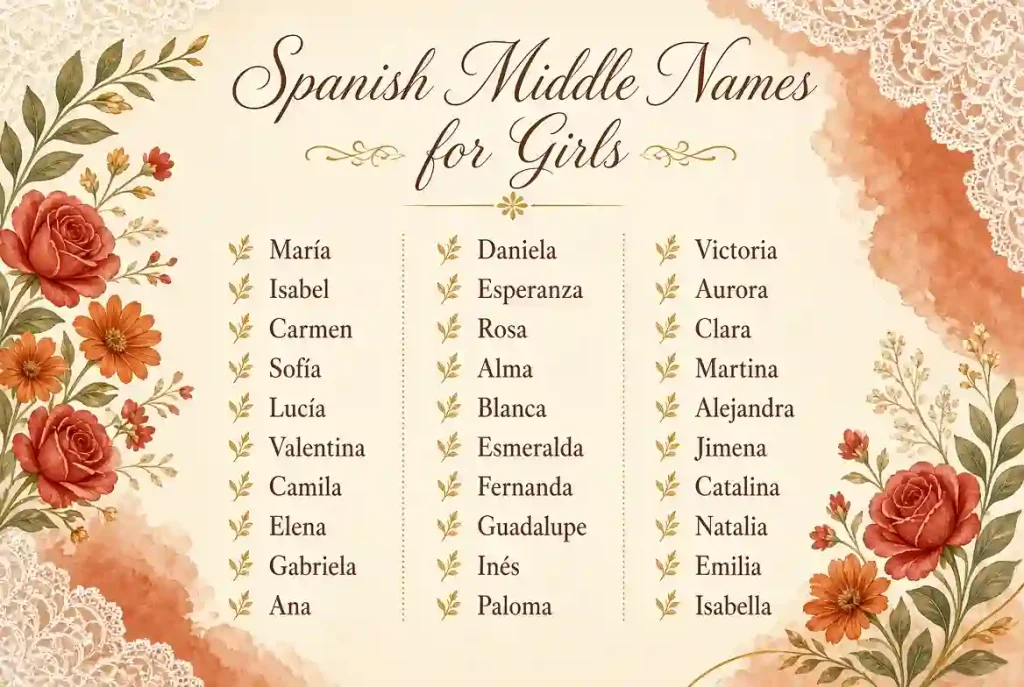

Spanish middle names for girls include elegant classics such as Isabel, Carmen, and Lucía, short choices such as Luz and Paz, and meaningful names such as Esperanza and Paloma. You can choose a name because of its sound, meaning, family connection, or cultural background.
One important detail: traditional Spanish naming customs do not always follow the English first-name, middle-name, and last-name structure. Spanish-speaking families may give a child one or more given names followed by family surnames. Combinations such as María José and Ana Belén are examples of compound given names.
If you are choosing a Spanish name as a middle name in an English-speaking country, you have plenty of options. This guide explores 50 established names, explains their meanings or documented associations, and offers practical combinations to help you choose a name that fits your family.
1. Classic Spanish Middle Names for Girls
Classic names suit parents who want a familiar name with a long history of use. Some have roots in Hebrew, Greek, or Latin, even though their Spanish forms are well established.
| Name | Meaning or origin | Pronunciation |
| María | Spanish form of Mary; its deeper etymology is uncertain | mah-REE-ah |
| Isabel | Spanish form of Elizabeth, ultimately from Hebrew | ee-sah-BEL |
| Carmen | Associated with Our Lady of Mount Carmel | KAR-men |
| Ana | Spanish form of Anna, a name of Hebrew origin associated with grace | AH-nah |
| Catalina | Spanish form of Katherine; its ancient meaning is disputed | kah-tah-LEE-nah |
| Teresa | Traditional Spanish feminine name with an uncertain original meaning | teh-REH-sah |
| Beatriz | Spanish form of Beatrice, traditionally associated with happiness or blessedness | beh-ah-TREES |
| Rosa | Spanish form of a name associated with the rose | ROH-sah |
These names work well if you value familiarity and traditional usage. Isabel can balance a longer first name, while Ana is a simple option for a first name with several syllables.
2. Elegant Spanish Middle Names
If you prefer a flowing, graceful sound, these established names offer a range of styles. Their descriptions are suggestions about naming style, not predictions about personality.
| Name | Meaning or origin | Pronunciation |
| Sofía | Spanish form of Sophia, from Greek sophia, meaning wisdom | soh-FEE-ah |
| Lucía | Spanish form of Lucia, associated with Latin lux, meaning light | loo-SEE-ah |
| Elena | Spanish form of Helen; its ancient etymology is uncertain | eh-LEH-nah |
| Valentina | Feminine form of Valentinus, associated with strength and health | bah-len-TEE-nah |
| Gabriela | Feminine form of Gabriel, a Hebrew-origin name traditionally interpreted as “God is my strength” | gah-bree-EH-lah |
| Clara | From Latin clarus, meaning clear or bright | KLAH-rah |
| Victoria | From Latin victoria, meaning victory | beek-TOH-ree-ah |
| Natalia | From a Latin name associated with birth and Christmas | nah-TAH-lee-ah |
Pairing ideas: Emma Lucía, Ava Isabel, Nora Valentina, and Lily Sofía combine familiar first names with established Spanish forms. These are suggested combinations rather than claims about traditional Spanish compound names.
3. Short Spanish Middle Names
Short names can balance a long first name or surname. They also offer a straightforward way to include a Spanish word-name or traditional given name.
| Name | Meaning or connection | Pronunciation |
| Luz | Light in Spanish; also used as a feminine given name | loos |
| Paz | Peace in Spanish; also a given name | pahs |
| Sol | Sun in Spanish; also used as a given name | sohl |
| Mar | Sea in Spanish; also used as a given name | mar |
| Eva | Spanish form of Eve | EH-bah |
| Alba | Dawn in Spanish; also a feminine given name | AHL-bah |
| Alma | Soul in Spanish; also a given name with a broader linguistic history | AHL-mah |
| Inés | Spanish form of Agnes | ee-NES |
Try Olivia Paz, Amelia Luz, Clara Sol, or Isabel Mar. Say each combination aloud with the surname to check the rhythm.
A vocabulary word is not automatically a traditional personal name. In this group, the names listed are documented as given names as well as having recognizable Spanish-language meanings.
4. Spanish Middle Names Inspired by Nature
Nature-inspired names can connect a child’s name with flowers, the sky, or the natural world. Some have direct meanings in Spanish; others have different linguistic origins.
| Name | Meaning or connection | Pronunciation |
| Paloma | Dove in Spanish | pah-LOH-mah |
| Estrella | Star in Spanish | es-TREH-yah |
| Luna | Moon; from Latin | LOO-nah |
| Violeta | Violet, the flower | bee-oh-LEH-tah |
| Rocío | Dew in Spanish | roh-SEE-oh |
| Perla | Pearl in Spanish | PEHR-lah |
| Aurora | Dawn; from Latin | ow-ROH-rah |
| Azucena | Spanish word for a lily, also used as a feminine given name | ah-soo-SEH-nah |
Paloma and Rocío are especially distinctive options if you want a connection to nature without choosing an invented name. Estrella may appeal to families who love celestial imagery.
5. Spanish Middle Names With Meaningful Messages
Some names are appealing because their meanings express a hope, value, or feeling. The meaning of a name is separate from what it may symbolize to an individual family.
| Name | Meaning or connection | Pronunciation |
| Esperanza | Hope in Spanish | es-peh-RAHN-sah |
| Felicidad | Happiness in Spanish; also a feminine given name | feh-lee-see-DAHD |
| Consuelo | Consolation or comfort; also a traditional given name | kon-SWEH-loh |
| Amparo | Protection or shelter; also a traditional feminine name | ahm-PAH-roh |
| Caridad | Charity or charitable love; also a feminine given name | kah-ree-DAHD |
| Milagros | Miracles; also a traditional feminine name | mee-LAH-gros |
| Victoria | Victory, from Latin | beek-TOH-ree-ah |
| Valeria | Feminine form of Valerius, associated with strength and health | bah-LEH-ree-ah |
Esperanza is a clear choice for someone who wants a name that directly means hope. Victoria expresses victory, while Consuelo carries the idea of comfort or consolation.
Felicidad and Caridad are also Spanish vocabulary words, but they should not be confused with newly invented names simply because their meanings are easy to understand.
6. Traditional Religious and Marian Names
Religious naming traditions have influenced many Spanish feminine names. Several are connected with titles or devotions associated with the Virgin Mary.
| Name | Meaning or religious connection | Pronunciation |
| Pilar | Pillar; associated with Our Lady of the Pillar | pee-LAHR |
| Guadalupe | A place name associated with Our Lady of Guadalupe | gwah-dah-LOO-peh |
| Mercedes | Mercies; associated with a Marian title | mer-SEH-des |
| Dolores | Sorrows; associated with María de los Dolores | doh-LOH-res |
| Nieves | Snows; associated with Our Lady of the Snows | NYEH-bes |
| Belén | Bethlehem in Spanish; also a feminine given name | beh-LEN |
| Rosario | Rosary; used as a feminine given name in Spanish-speaking communities | roh-SAH-ree-oh |
These names have specific religious and historical contexts. For example, Dolores should not be described simply as a negative name because its traditional religious association is more important than a surface-level interpretation.
If you are choosing a name for religious reasons, learn about the particular title or tradition behind it.
7. Distinctive Spanish and Regional Names
Some names are associated with particular regions or linguistic traditions within Spain. They can be useful choices when you want more than a general Spanish-language name.
| Name | Meaning or background | Pronunciation |
| Laia | Catalan short form of Eulàlia | LIE-ah |
| Leire | Basque feminine name associated with the place and monastery of Leyre | LAY-reh |
| Begoña | Basque name associated with Begoña in Bilbao | beh-GOH-nyah |
| Arantxa | Basque feminine name associated with Arantzazu | ah-RAHN-chah |
| Aitana | Established contemporary Spanish given name; its deeper etymology is uncertain | eye-TAH-nah |
| Triana | Spanish given name associated with the Triana district of Seville | tree-AH-nah |
| Jimena | Established Spanish feminine name with a debated etymology | hee-MEH-nah |
| Araceli | From Latin ara coeli, commonly interpreted as “altar of heaven” | ah-rah-SEH-lee |
These names should not all be treated as originating in the Spanish language. Laia and several names in this section have specific Catalan or Basque connections. Acknowledging those connections makes the guide more accurate and respectful.
8. Spanish Compound Names for Girls
Compound given names are particularly important when researching Spanish middle names. In many Spanish-speaking communities, two given names can be used together as a single established name.
| Compound name | Explanation |
| María José | A familiar Spanish compound given name |
| Ana María | A traditional combination of two given names |
| Ana Belén | An established Spanish compound name |
| María Isabel | A combination of María and Isabel |
| María Teresa | A traditional combination of given names |
| María del Carmen | A compound name associated with Marian devotion |
| María del Pilar | A name connected with Our Lady of the Pillar |
| María Victoria | A combination of María and Victoria |
Usage differs by country, region, and family. In an English-speaking naming system, a family may use one of these names as a first-and-middle combination. In a Spanish-speaking family, the same combination may be treated as one compound given name.
It is also important to distinguish given names from surnames. A person’s second surname in a Spanish naming system is not automatically a middle name.
9. Spanish Middle Names for English First Names
If your family uses an English first name, a Spanish middle name can connect different languages or family traditions. These suggestions focus on length, sound, and recognizable meanings.
| First name | Suggested middle name | Why it works |
| Emma | Lucía | A short first name balances a flowing middle name |
| Olivia | Paz | A longer first name pairs with a short middle name |
| Ava | Carmen | The two names have different rhythms |
| Lily | Isabel | A short first name balances a classic name |
| Grace | Paloma | The sounds contrast without being difficult to say |
| Charlotte | Sol | A compact middle name balances a longer first name |
| Nora | Valentina | The short first name contrasts with a longer middle name |
| Amelia | Luz | A short middle name keeps the full name balanced |
| Sophia | Marisol | Both names have a flowing sound |
| Ella | Esperanza | A longer middle name adds contrast |
These are editorial suggestions, not verified traditional pairings. Pronunciation can also change depending on whether the family uses Spanish or English pronunciation for the first name.
For a Spanish-speaking family, consider whether the first and middle names fit the family’s naming customs. For a bilingual family, it may help to say the full name in both languages before deciding.
10. The 15 Best Spanish Middle Names for Girls
Here are 15 useful choices from the lists above, selected for their meanings, established usage, or cultural background.
- Lucía: A graceful name associated with light.
- Isabel: A classic Spanish form with a long naming history.
- Carmen: A traditional name with Marian associations.
- Sofía: A familiar name associated with wisdom.
- Paloma: A nature-inspired name meaning dove.
- Elena: An established feminine name with an uncertain ancient etymology.
- Luz: A short name meaning light.
- Paz: A concise name meaning peace.
- Valentina: A flowing name associated with strength and health.
- Esperanza: A meaningful choice that directly means hope.
- Alma: A short name meaning soul in Spanish.
- Rocío: A distinctive Spanish name meaning dew.
- Catalina: A traditional Spanish form of Katherine.
- Pilar: A name with a documented Marian connection.
- María José: A familiar compound given name.
For a short option, start with Luz, Paz, or Alma. For a classic choice, consider Isabel, Carmen, or Catalina. If meaning is your priority, Esperanza, Paloma, and Victoria offer clear connections to hope, a dove, and victory.
How to Choose the Right Spanish Middle Name
Before settling on a name, consider these practical points:
- Check the full-name rhythm. Say the first, middle, and last names together. Avoid choosing a combination based only on how the middle name sounds by itself.
- Research the actual origin. A name used in Spain may have Greek, Hebrew, Latin, Basque, or Catalan roots.
- Keep the spelling accurate. Names such as Lucía, Sofía, Inés, and Rocío use accent marks in standard Spanish spelling.
- Separate meaning from association. Esperanza means hope, while Pilar has a religious association with Our Lady of the Pillar.
- Consider regional usage. A name common in one Spanish-speaking country may be less familiar in another.
- Respect family traditions. If the name honors a relative or a religious tradition, learn the background before choosing it.
- Avoid unsupported popularity claims. Check country-specific official statistics if popularity is important to your decision.
A name does not determine a child’s personality or future. Choose one because its sound, history, meaning, or cultural connection matters to your family.
Frequently Asked Questions
What are the best Spanish middle names for girls?
Lucía, Isabel, Carmen, Sofía, Paloma, Luz, Paz, and Valentina are strong options. The best choice depends on the first and last names, the meaning you prefer, and whether you want a classic, short, nature-inspired, or religious name.
Do Spanish people have middle names?
Traditional Spanish naming customs often use one or more given names followed by two surnames, rather than a separate middle-name slot. Compound names such as María José and Ana Belén are common in many Spanish-speaking communities, although practices vary by family and country.
What Spanish girl names mean light?
Luz directly means light in Spanish. Lucía is associated with Latin lux, meaning light. Clara means clear or bright. These names have different linguistic histories, even though they share a similar theme.
What Spanish middle names mean peace or hope?
Paz means peace in Spanish, while Esperanza means hope. Both are also used as feminine given names. They are good options if you want a short name or a name with an immediately understandable meaning.
What are some short Spanish middle names for girls?
Luz, Paz, Sol, Mar, Ana, Eva, Alba, Alma, and Inés are useful options. Check each name’s spelling and pronunciation, especially if it will be used by speakers of both English and Spanish.
Are Spanish and Hispanic names the same?
No. Spanish names may refer to names used in Spain or names from the Spanish language. Hispanic is a broader cultural term, while Latino or Latina generally relates to Latin American heritage. Indigenous-language names from Latin America have their own origins and should not automatically be labeled Spanish.
Can I use a Spanish name as a middle name if my family is not Spanish?
Yes. You can choose a name from another language or culture. Learn its meaning and history, spell it correctly, and avoid making unsupported claims about your own cultural heritage.
Should I keep Spanish accent marks in a middle name?
Use the standard spelling where possible. Accents in names such as Lucía, Sofía, Inés, and Rocío help show the correct written form and stress. If the name is being registered legally, follow the relevant country’s official naming and document rules.
Final Thoughts
Spanish middle names for girls offer options for many preferences, from classic names such as Carmen and Isabel to short choices such as Luz and Paz. Nature-inspired names like Paloma and Rocío provide another style, while Esperanza and Valentina appeal to families who value meaning and history.
The most useful approach is to choose a name that sounds good with the complete name and whose background you understand. Spanish-language names have varied origins and regional traditions, so a little research can help you avoid common mistakes and make a more informed choice. Whether you prefer a traditional compound name or a Spanish name used as a middle name in English, the right choice is one that feels meaningful to your family.
Research references

PressoraMedia is a content platform dedicated to helping readers find the right words, names, meanings, and ideas for everyday use. Our content focuses on names, name meanings, naming inspiration, and useful language-related information in a simple and easy-to-understand format. At Pressora Media, we believe that choosing a name is more than simply finding a word. A name can carry meaning, personality, culture, and a special story. That is why we research names carefully and create helpful guides designed to make the naming process easier. Our authors and contributors focus on providing clear explanations, useful name suggestions, meanings, origins, pronunciations, and practical naming ideas. We aim to keep our content informative, reader-friendly, and genuinely useful. Whether you are searching for a meaningful name, exploring the origin of a name, looking for unique naming ideas, or simply curious about the meaning behind a word or name, Pressora Media is here to help.
Pressora Media Team
Helping you find the right name, meaning, and words.