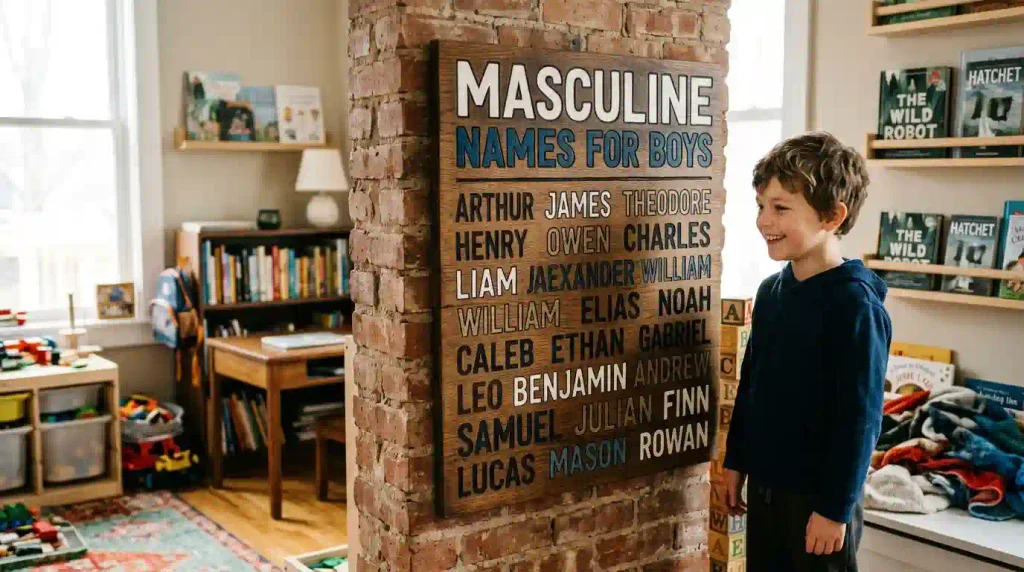
Masculine names for boys come in many styles. Some have meanings connected to strength, courage, protection, or leadership. Others are classic names with a long history, while modern choices may stand out because of their sound or spelling.
Whether you want a traditional name like William, a bold choice like Victor, or a culturally meaningful name like Amir, this guide can help you explore your options.
Below, you will find masculine boy names organized by meaning, style, and origin. Each entry includes a documented meaning or a clearly explained association where possible. The goal is not simply to find a name that sounds strong, but to choose one with a history, meaning, or personal connection that matters to your family.
What Are Masculine Names for Boys?
Masculine names are names traditionally used for boys and men within a particular language or culture. Some are associated with strength and bravery, while others reflect faith, wisdom, family heritage, or leadership.
The term does not mean that every masculine name literally means “manly” or “powerful.” For example, Ethan means strong or firm, while David means beloved. Both are established masculine names, but their meanings are different.
Masculine naming traditions also vary around the world. A name used mainly for boys in one country may have different gender associations elsewhere. Understanding a name’s origin and actual usage can help you make a more informed choice.
1. Strong Masculine Names for Boys
These names have meanings or established linguistic connections to strength, firmness, or protection.
1. Ethan
Meaning: Strong, firm.
Origin: Hebrew.
Pronunciation: EE-thən.
Ethan is a familiar masculine name with a direct connection to strength and firmness. It works well for parents who want a straightforward name with a positive meaning.
2. Adir
Meaning: Strong, mighty.
Origin: Hebrew.
Pronunciation: ah-DEER.
Adir is a distinctive Hebrew masculine name. Its direct meaning makes it a particularly relevant choice for families searching for a name connected to strength.
3. Batu
Meaning: Strong, firm.
Origin: Mongolian.
Pronunciation: Commonly rendered BAH-too.
Batu is an established Mongolian masculine name. It is also associated with Batu Khan, the historical Mongol ruler. The name offers a direct strength-related meaning and a clear cultural background.
4. Ikaika
Meaning: Strong.
Origin: Hawaiian.
Pronunciation: Commonly rendered ee-KY-kah in English-language guides; confirm the preferred Hawaiian pronunciation with a reliable language source.
Ikaika is a Hawaiian name connected directly to strength. Families considering it should learn about Hawaiian pronunciation and naming traditions rather than treating it simply as an unusual English name.
5. Ezekiel
Meaning: God will strengthen.
Origin: Hebrew.
Pronunciation: ih-ZEE-kee-əl.
Ezekiel is a biblical masculine name with a meaning connected to divine strength. It suits parents who prefer a longer traditional name with religious significance.
6. Gabriel
Meaning: Commonly interpreted as God is my strength.
Origin: Hebrew.
Pronunciation: GAY-bree-əl.
Gabriel has a long history in Jewish and Christian traditions. It combines a strength-related interpretation with an established religious and cultural background.
7. William
Meaning: Commonly interpreted as resolute protection.
Origin: Germanic.
Pronunciation: WIL-yəm.
William is a classic name with a long history across English-speaking countries and beyond. It is a good choice for parents who want a traditional masculine name with an association with protection.
8. Alexander
Meaning: Defender of men.
Origin: Greek.
Pronunciation: al-ig-ZAN-dər.
Alexander has a strong historical presence and a meaning connected to defending others. Its established short forms, including Alex, provide flexibility for everyday use.
9. Ethaniel
Meaning: Do not assign a fixed meaning without verifying the intended name and its documented usage.
Origin: Requires verification.
Ethaniel appears in some modern name collections, but its meaning should not automatically be inferred from Ethan or Nathaniel. For an accuracy-focused article, omit it unless a reliable specialist source confirms the exact form and etymology.
10. Victor
Meaning: Conqueror, winner.
Origin: Latin.
Pronunciation: VIK-tər.
Victor has a direct meaning related to victory. It is a classic option for parents who prefer a short, recognizable name with a confident tone.
2. Classic Masculine Boy Names
Classic names often appeal to parents who want a name with a long history and familiar usage.
- Henry: Derived from a Germanic name traditionally interpreted as ruler of the home.
- Charles: Traditionally connected to a Germanic element meaning a free man.
- Edward: Traditionally interpreted as wealthy guardian or prosperous protector.
- George: Derived from Greek, meaning farmer or earthworker.
- Robert: Traditionally interpreted as bright fame.
- Richard: Derived from Germanic elements commonly interpreted as brave or powerful rulers.
- Thomas: Derived from an Aramaic word meaning twin.
- Joseph: From a Hebrew name traditionally interpreted as he will add.
- Daniel: From Hebrew, meaning God is my judge.
- Samuel: A biblical Hebrew name with interpretations commonly connected to God hearing or the name of God.
- David: From Hebrew, meaning beloved.
- Benjamin: From Hebrew, traditionally interpreted as son of the right hand.
- James: An English form in the historical name family of Jacob.
- Frederick: Traditionally interpreted as a peaceful ruler.
- Michael: From Hebrew, meaning who is like God?
These names cover different meanings and traditions. Their masculine status comes from established naming usage, not from a claim that each one means strength.
3. Modern Masculine Names for Boys
Modern-style names can be contemporary in sound without being newly invented. Some are established given names, while others developed from surnames or older forms.
Liam
Meaning: Connected to William and the meaning resolute protection.
Origin: Irish, as a short form of William.
Liam is a compact choice for parents who like a familiar name with a protective meaning.
Mason
Meaning: Stoneworker or mason.
Origin: English occupational surname.
Mason offers a modern surname-derived style. Its connection to a trade is different from a literal meaning of strength.
Wyatt
Meaning: Derived from an Old English personal name; historical interpretations are connected to battle and hardy qualities.
Origin: Old English.
Wyatt has a bold sound and established masculine usage. It is better described through its historical name origin than through an oversimplified “brave in battle” definition.
Nolan
Meaning: Derived from an Irish surname.
Origin: Irish.
Nolan is a familiar modern-style boys’ name. Its surname history is well established, but claims such as “champion” should be verified before being presented as a direct meaning.
Hudson
Meaning: Son of Hudde.
Origin: English surname.
Hudson has a contemporary surname-style feel. It does not literally mean brave ruler, despite that description appearing in some popular name lists.
Everett
Meaning: Derived from Everard, a Germanic name with elements historically associated with a boar and hardy qualities.
Origin: Germanic, through English usage.
Everett offers a traditional root with a contemporary feel. Its exact meaning should be explained through its historical development rather than a simplified slogan.
Caleb
Meaning: Etymology debated; often associated with devotion or wholeheartedness in popular name references.
Origin: Hebrew biblical tradition.
Caleb is a well-established masculine biblical name. Because its etymology is debated, avoid presenting one interpretation as universally settled.
Levi
Meaning: Traditionally associated with joining or attachment.
Origin: Hebrew.
Levi is short and easy to recognize. Its biblical history gives it a traditional background without requiring a strength-related meaning.
Jaxon
Meaning: Son of Jack.
Origin: Modern spelling variant of Jackson.
Jaxon appeals to parents who like contemporary spellings. It is best understood as a variant rather than a separate name with a new meaning.
Felix
Meaning: Happy, fortunate.
Origin: Latin.
Felix is a classic name with a positive meaning. It demonstrates that a masculine name can feel confident without being associated with physical power.
4. Short and Bold Masculine Names
Short names are easy to remember and can pair naturally with longer middle or family names.
| Name | Meaning | Origin |
| Leo | Lion | Latin |
| Max | Short form of names such as Maximus | Latin naming tradition |
| Rex | King | Latin |
| Jack | Historically a form of John | English |
| Paul | Small or humble | Latin |
| Mark | Roman name with uncertain ultimate derivation | Latin |
| Luke | From Loukas, associated with Lucania | Greek |
| Amir | Prince or commander, depending on Arabic context | Arabic |
| Adil | Fair, just | Arabic |
| Aziz | Powerful, dear, or esteemed, depending on context | Arabic |
If you prefer a short name with a clear literal meaning, Leo, Rex, and Amir are worth considering. If cultural heritage matters most, check the name’s original pronunciation and usage before deciding.
5. Masculine Names Connected to Courage and Bravery
Courage-related names can be meaningful for parents who value resilience, determination, and confidence.
Abhay
Meaning: Fearless.
Origin: Sanskrit.
Abhay is used as a masculine given name in South Asian naming traditions. Its direct meaning makes it relevant to families seeking a name connected to fearlessness.
Andrew
Meaning: Associated with manliness.
Origin: Greek.
Andrew is a long-established masculine name. Its history and traditional interpretation make it a familiar choice for parents who prefer a classic style.
Evander
Meaning: Traditionally interpreted as a good man, though historical and mythological usage should be distinguished from etymology.
Origin: Greek.
Evander offers a classical sound and a connection to Greek and Roman traditions. It is a useful alternative for parents who want something less conventional than Alexander.
Victor
Meaning: Conqueror or winner.
Origin: Latin.
Victor directly expresses victory. It is a straightforward choice for families who want a name with an achievement-related meaning.
Hamza
Meaning: An established Arabic masculine name; popular explanations often connect it with firmness or strength, but exact etymological claims should be checked against specialist Arabic references.
Origin: Arabic.
Hamza has a significant place in Islamic history and Arabic naming traditions. Its cultural background is an important part of the name, beyond its modern style.
6. Masculine Names Associated With Leadership
Leadership-related names can reflect responsibility, protection, or historical traditions of rulership.
- Henry: Traditionally interpreted as ruler of the home.
- Frederick: Traditionally interpreted as a peaceful ruler.
- Richard: Commonly interpreted as a brave or powerful ruler.
- William: Associated with resolute protection.
- Alexander: Defender of men.
- Amir: Prince or commander in Arabic, depending on context.
- Rex: Latin for king, also used as a given name.
- Derek: A form related to Theodoric, a Germanic name traditionally interpreted as ruler of the people.
- Eric: Derived from Old Norse Eiríkr; interpretations vary but include ruler-related elements.
- Akbar: An Arabic-derived word meaning greater or greatest, used as a name and title in Persianate and South Asian contexts.
A leadership-related meaning can be a useful way to narrow your list. However, it should not be treated as a prediction of a child’s future personality or achievements.
7. Masculine Names From Different Cultures
A culturally diverse name list should explain where names come from and avoid treating unfamiliar names as interchangeable.
Arabic names
- Amir: Prince or commander.
- Adil: Fair or just.
- Akram: More generous or most generous, depending on grammatical context.
- Aziz: Powerful, dear, or esteemed.
- Mateen: Firm or strong.
- Qadir: Capable or powerful.
- Haider: A form of Haydar, associated with the lion.
- Rayan: A spelling used for Rayyan, an Arabic name connected to being quenched or well-watered.
- Zubair: An established Arabic masculine name with Islamic historical usage; popular etymologies should be checked carefully.
- Abdul Aziz: Servant of the Mighty, from an Arabic compound name.
For Arabic names, verify the Arabic spelling and the intended pronunciation. The meaning of a compound name can differ from the meaning of an individual element.
Hebrew and biblical names
- Ethan: Strong or firm.
- Gabriel: Commonly interpreted as God is my strength.
- Ezekiel: God will strengthen.
- Michael: Who is like God?
- Daniel: God is my judge.
- David: Beloved.
- Benjamin: Son of the right hand.
- Joseph: He will add.
- Abraham: The biblical explanation connects the name with the father of a multitude.
- Samuel: Traditionally associated with God hearing or the name of God.
These names have established histories in Jewish and Christian traditions, and several are also used widely in other communities.
Greek and Latin names
- Alexander: Defender of men.
- Andrew: From Greek Andreas, associated with manliness.
- Leo: Lion.
- Victor: Conqueror or winner.
- Maximus: Greatest.
- Felix: Happy or fortunate.
- Augustus: Venerable or majestic.
- Adrian: From Hadrianus, a Roman name connected to Hadria.
- Lucian: Related to the Latin name family of Lucius, often associated with light.
- Marcus: A Roman name whose ultimate derivation remains uncertain.
These options are useful for families interested in classical history, traditional literature, or names with long records of use.
8. Distinctive Masculine Names for Boys
A distinctive name does not have to be invented. It may be less familiar in your community or come from a different language tradition.
| Name | Meaning or connection | Origin |
| Adir | Strong, mighty | Hebrew |
| Batu | Strong, firm | Mongolian |
| Abhay | Fearless | Sanskrit |
| Ikaika | Strong | Hawaiian |
| Qiang | Strong or powerful when written with the relevant Chinese character | Chinese |
| Tsuyoshi | Can mean strong or rigid when written with 剛 | Japanese |
| Takeshi | Meaning depends on the Japanese characters used | Japanese |
| Suren | Connected with an ancient Iranian word meaning strong or powerful | Parthian and Armenian usage |
| Rostam | Legendary Persian hero; etymology uncertain | Persian tradition |
| Alcaeus | Strong, derived from a Greek root connected with strength | Ancient Greek |
Important: Chinese and Japanese names may have different meanings when written with different characters. A Romanized spelling alone is not always enough to determine the correct meaning.
For Hawaiian and other culturally specific names, research pronunciation and community usage. Do not assume that a name is rare in its original culture simply because it is unfamiliar to English speakers.
9. How to Choose the Right Masculine Name
Choosing a name becomes easier when you decide which qualities matter most to you.
Choose by meaning. If a direct connection to strength matters, consider Ethan, Adir, Batu, or Ikaika. If you prefer courage, Abhay is a relevant choice. If protection matters, William may suit your preferences.
Consider cultural heritage. A name from your family’s language, faith, or history may carry personal significance that a fashionable name cannot replace.
Say it with your surname. Read the complete name aloud. Check its rhythm, pronunciation, and spelling.
Think about everyday use. Consider how the name may work in school, at home, and in professional settings. A longer traditional name may also offer established short forms.
Check the spelling. Names from Arabic, Hebrew, Chinese, Japanese, and other languages may have multiple transliterations. Confirm the intended form before publishing or registering the name.
Check popularity by country and year. Do not label a name popular or rare worldwide based only on US data. Official birth-name statistics can help you understand usage in a specific country.
Keep personal taste separate from meaning. A name may sound bold to you without literally meaning strong. That is a valid reason to like it, provided the article describes it accurately.
10. The 15 Best Masculine Names for Boys
These are editorial recommendations based on documented meaning, established use, and naming style. They are not an official popularity ranking.
- Alexander: A classic choice with the meaning defender of men.
- Ethan: A familiar name with a direct strength-related meaning.
- William: A traditional choice associated with resolute protection.
- Gabriel: A biblical name commonly interpreted in connection with divine strength.
- Amir: A short Arabic name associated with a prince or commander.
- Leo: A concise name meaning lion.
- Victor: A classic name meaning conqueror or winner.
- Henry: A traditional name associated with ruling the home.
- Adir: A distinctive Hebrew name meaning strong or mighty.
- Abhay: A South Asian choice meaning fearless.
- Felix: A classic name meaning happy or fortunate.
- Ezekiel: A longer biblical name meaning God will strengthen.
- Batu: A Mongolian name meaning strong or firm.
- Andrew: A traditional masculine name associated with manliness.
- Mateen: An Arabic name connected with firmness or strength.
The best option depends on your priorities. If you want a familiar English-language name, Ethan or William may suit you. If you prefer a direct strength-related meaning with a different cultural background, Adir or Batu may be worth exploring. For an Arabic name, Amir and Mateen offer different meanings and styles.
Frequently Asked Questions
What are masculine names for boys?
Masculine names for boys are names traditionally used for males within a particular culture or language. Examples include Ethan, Alexander, William, Henry, and Amir. Some are connected to strength or leadership, while others have meanings related to faith, happiness, or family heritage.
What boy names mean strong?
Ethan means strong or firm in Hebrew, Adir means strong or mighty in Hebrew, Batu means strong or firm in Mongolian, and Ikaika means strong in Hawaiian. Check each name’s original language and cultural context before choosing it.
What are the strongest-sounding masculine names?
Names such as Victor, Alexander, Leo, and William may sound bold or authoritative to some readers. This is a matter of personal impression, not a linguistic fact. Their documented meanings differ, so do not assume that every strong-sounding name literally means strong.
What masculine names mean brave or fearless?
Abhay means fearless in Sanskrit. Andrew has a traditional association with manliness, while Wyatt comes from an Old English name with historical elements associated with battle and hardy qualities. These meanings are different and should not be presented as interchangeable.
Are masculine names always used only for boys?
No. Gender usage differs across languages and cultures. A name may be traditionally masculine in one community but used more broadly elsewhere. If gender-specific use is important to you, check how the name is used in your family’s cultural context.
How can I find a masculine name with an accurate meaning?
Start with specialist name references and reputable linguistic sources. Check the original language, spelling, and historical form. Be cautious of lists that assign a powerful meaning to every name without explaining the evidence.
Should I choose a popular or uncommon masculine name?
Neither option is automatically better. A popular name may feel familiar and easy to recognize, while an uncommon name may have a more personal or distinctive appeal. Use reliable statistics for your country if popularity matters, and avoid assuming that unfamiliarity means a name is rare worldwide.
Conclusion
Masculine names for boys can express strength, courage, protection, faith, or family heritage. Ethan, Adir, Batu, and Ikaika have direct connections to strength, while Alexander, William, and Henry offer long-established naming histories. Amir and Abhay provide meaningful options from Arabic and South Asian traditions.
Before choosing a name, look beyond its sound. Verify its meaning, pronunciation, origin, and cultural background. Think about how it fits with your surname and whether it reflects something important to your family.
A name does not determine a child’s character but it can carry a meaningful story. Choose one that feels right to you, and make sure the story attached to it is accurate.

PressoraMedia is a content platform dedicated to helping readers find the right words, names, meanings, and ideas for everyday use. Our content focuses on names, name meanings, naming inspiration, and useful language-related information in a simple and easy-to-understand format. At Pressora Media, we believe that choosing a name is more than simply finding a word. A name can carry meaning, personality, culture, and a special story. That is why we research names carefully and create helpful guides designed to make the naming process easier. Our authors and contributors focus on providing clear explanations, useful name suggestions, meanings, origins, pronunciations, and practical naming ideas. We aim to keep our content informative, reader-friendly, and genuinely useful. Whether you are searching for a meaningful name, exploring the origin of a name, looking for unique naming ideas, or simply curious about the meaning behind a word or name, Pressora Media is here to help.
Pressora Media Team
Helping you find the right name, meaning, and words.