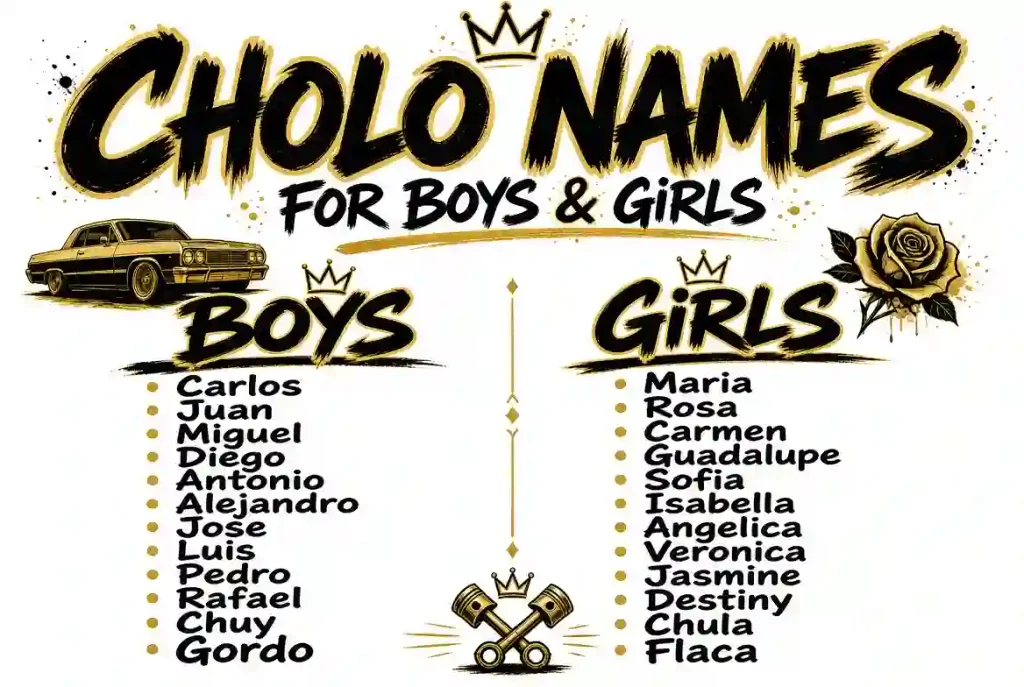

If you are searching for cholo names for boys or girls, you are probably looking for a name with a Mexican-American, Chicano, barrio, old-school, confident, or nickname-style feel. The important thing to know is that “cholo name” is not a formal category of baby names.
The word cholo has different histories and meanings across Latin America and the United States. In Chicano and Mexican-American contexts, it became associated with a particular urban style and identity, especially in the American Southwest and Los Angeles. Historical accounts also connect cholo culture with earlier pachuco culture and later Chicano youth culture.
That means a name such as Carlos is a genuine personal name, while Chuy is a familiar nickname for Jesús, and El Rey is a creative Spanish-language alias meaning “the king.” They should not all be presented as the same kind of name.
This guide separates those categories so you can choose something appropriate for a baby, character, nickname, username, gaming persona, or creative project.
What Does “Cholo Name” Mean?
A cholo name usually refers to an informal nickname, street-style alias, character name, or creative name associated with Mexican-American or Chicano-inspired imagery.
It does not mean that there is an official list of names used by all cholos.
Mexican and Mexican-American naming practices are much broader. People may use formal Spanish names, English names, shortened names, affectionate diminutives, family nicknames, descriptive apodos, or names influenced by local culture. Research into Mexican nicknames shows that apodos can be formed from a person’s name, appearance, personality, relationships, experiences, or other identifying characteristics.
So this article uses four useful categories:
- Established given names: genuine personal names used in Spanish-speaking communities.
- Established nickname forms: recognized short or alternative forms of given names.
- Descriptive nicknames: informal apodos whose meaning comes from a characteristic or relationship.
- Creative cholo-style aliases: fictional or modern combinations that work for characters, usernames, or personas.
This distinction is important because a Spanish word is not automatically a traditional personal name.
Cholo Names for Boys
The strongest masculine choices are often established Mexican or Spanish names paired with familiar nickname forms.
1. Carlos
Origin: Germanic, through Spanish and other European languages.
Meaning: Traditionally connected with “free man.”
Type: Established given name.
Vibe: Classic and confident.
2. Francisco
Origin: Italian/Latin tradition, used extensively in Spanish.
Type: Established given name.
Common nickname: Pancho.
3. Jesús
Origin: Hebrew, through Greek and Latin.
Type: Traditional religious given name.
Common Mexican nickname: Chuy.
4. Alberto
Origin: Germanic.
Type: Established given name.
Common nickname: Beto.
5. Eduardo
Origin: Old English/Germanic.
Type: Established given name.
Common Mexican nickname: Lalo.
6. Ignacio
Origin: Latin.
Type: Established given name.
Common nickname: Nacho.
7. Vicente
Origin: Latin.
Meaning: Traditionally associated with “conquering” or “prevailing.”
Common nickname: Chente.
8. Javier
Origin: Spanish form associated with Xavier, ultimately connected with the Basque place name Etxeberria.
Type: Established given name.
Common nickname: Javi.
9. Rafael
Origin: Hebrew through Spanish and other languages.
Meaning: “God has healed.”
Common nickname: Rafa.
10. Luis
Origin: Germanic, through Romance languages.
Meaning: Traditionally associated with a famous warrior.
Common nickname: Lucho.
11. Ramón
Origin: Germanic, through Spanish.
Type: Traditional given name.
Common nickname: Moncho.
12. Salvador
Origin: Latin/Spanish.
Meaning: “Savior.”
Common nickname: Chava.
13. Guillermo
Origin: Germanic.
Type: Established Spanish given name.
Common nickname: Memo.
14. Antonio
Origin: Latin.
Type: Traditional given name.
Common nicknames: Tony, Toño.
15. Fernando
Origin: Germanic through Spanish.
Type: Traditional given name.
Common nickname: Fer.
16. Alejandro
Origin: Greek through Spanish.
Meaning: Traditionally “defender of men.”
Common nickname: Alex.
17. Ricardo
Origin: Germanic through Spanish.
Meaning: Traditionally associated with a powerful or brave ruler.
Common nickname: Rico.
18. Ernesto
Origin: Germanic through Spanish.
Type: Traditional given name.
Common nickname: Neto.
19. Armando
Origin: Germanic through Romance languages.
Common nickname: Mando.
20. José
Origin: Hebrew through Spanish.
Type: Traditional religious given name.
Nickname forms vary by region, including Pepe and Chepe.
Mexican Nickname, Style Names for Boys
This is one of the most useful sections for anyone searching for a realistic nickname rather than a formal baby name.
Mexican Spanish has a rich tradition of nickname formation. Common forms can involve shortening, changing sounds, using diminutive endings, or creating an unrelated but socially recognized nickname. A person’s nickname may also come from appearance, personality, or an event.
Here are established or well-attested nickname forms:
- Chuy — Jesús
- Pancho — Francisco
- Paco — Francisco
- Pepe — José
- Chepe — José
- Beto — Alberto and related names
- Lalo — Eduardo
- Nacho — Ignacio
- Chente — Vicente
- Javi — Javier
- Rafa — Rafael
- Memo — Guillermo
- Neto — Ernesto
- Mando — Armando
- Chava — Salvador
- Lucho — Luis
- Moncho — Ramón
- Toño — Antonio
- Fer — Fernando
- Alex — Alejandro and other names
- Nico — Nicolás
- Tony — Antonio
- Tacho — Anastasio and some related naming traditions
- Gera — Gerardo
- Migue — Miguel
These forms are much stronger choices when the goal is a realistic Mexican nickname rather than an invented street alias. A large Mexican nickname reference likewise documents many of these name-to-nickname relationships.
Cholo Names for Girls
For girls, you will often see the term chola in discussions of Chicano and Mexican-American culture. However, it should not be treated as simply a female baby-name category.
For an established name, these choices have documented use in Spanish-speaking communities.
21. María
Origin: Hebrew through Greek and Latin, with extensive Spanish and Christian usage.
Type: Traditional given name.
22. Rosa
Meaning: “Rose.”
Origin: Latin/Spanish usage.
Type: Floral given name.
23. Carmen
Origin: Spanish usage with a long Christian and literary history.
Type: Traditional given name.
24. Luz
Meaning: “Light.”
Origin: Spanish.
Type: Word-based personal name.
25. Alma
Meaning: “Soul” in Spanish.
Type: Established personal name, though its naming history is more complicated than simply calling it a Spanish vocabulary-name creation.
26. Esperanza
Meaning: “Hope.”
Origin: Spanish.
Type: Virtue/abstract-noun given name.
27. Guadalupe
Type: Established Spanish given name with major religious and cultural significance in Mexico.
28. Dolores
Origin: Spanish devotional naming tradition.
Type: Religious/devotional given name.
29. Elena
Origin: Greek, through Spanish and other languages.
Type: Traditional given name.
30. Marisol
Origin: Spanish usage.
Type: Established feminine given name with more than one explanation for its development, so simplistic claims such as “it literally means sea and sun” should be avoided.
31. Sofia
Meaning: “Wisdom.”
Origin: Greek.
Type: Established given name.
32. Adriana
Origin: Latin.
Type: Traditional feminine given name.
33. Veronica
Origin: Complex Greek/Latin and Christian naming history.
Type: Traditional given name.
34. Selena
Origin: Greek, related to Selene.
Meaning: Associated with “moon.”
Type: Given name with classical/mythological roots.
35. Teresa
Origin: Uncertain or disputed.
Type: Long-established feminine given name.
Mexican Nicknames and Apodos for Girls
Not every nickname below is a formal name. That is exactly why they are useful in this category.
Examples of recognized Mexican nickname patterns include:
- Lupita — diminutive of Guadalupe
- Rosita — diminutive of Rosa
- Lola — commonly associated with Dolores
- Loli — nickname associated with Dolores
- Caro — Carolina
- Ceci — Cecilia
- Cris — Cristina and related names
- Dani — Daniela
- Fer — Fernanda
- Fany — Estefanía or Stephanie-related usage
- Paca — Francisca
- Pancha — Francisca
- Panchita — affectionate form of Pancha/Francisca
- Chelo — Consuelo
- Ali — Alicia and related names
- Bety — Beatriz
- Coti — Constanza
- Andi — Andrea
- Nena — an affectionate term/nickname whose use depends strongly on context
Mexican nickname references document many of these forms, including Lupita, Rosita, Lola, Caro, Ceci, Dani, Fer, Paca, Pancha, Chelo, and others.
Read Also: Cute Nicknames for Baby Boy: 200+Unique ideas for boys & girls
Cool Cholo, Style Aliases for Boys
The following are creative aliases, not claims that they are traditional cholo given names.
36. El Rey
Literal meaning: “The king.”
Use: Strong fictional alias.
37. El Jefe
Literal meaning: “The boss.”
Use: Character or personal name.
38. Rayo
Meaning: “Ray” or “lightning bolt,” depending on context.
Type: Spanish vocabulary word used creatively.
39. Lobo
Meaning: “Wolf.”
Type: Spanish vocabulary word.
40. Toro
Meaning: “Bull.”
Type: Spanish vocabulary word.
41. Fuego
Meaning: “Fire.”
Type: Creative alias.
42. Trueno
Meaning: “Thunder.”
Type: Creative alias.
43. Sombra
Meaning: “Shadow.”
Type: Creative alias.
44. León
Meaning: “Lion.”
Type: Spanish word and established personal name in some contexts.
45. Coyote
Meaning: “Coyote.”
Type: Animal word used creatively.
46. Bravo
Meaning: Depending on context, “brave,” “fierce,” or “wild.”
Type: Spanish adjective/surname/alias rather than a conventional cholo given name.
47. Valiente
Meaning: “Brave” or “courageous.”
Type: Creative alias.
48. Guerrero
Meaning: “Warrior.”
Type: Spanish occupational word/surname and creative alias.
49. Cazador
Meaning: “Hunter.”
Type: Spanish occupational word and creative alias.
50. Capitán
Meaning: “Captain.”
Type: Title-based alias.
Chola, Inspired Creative Names for Girls
These should be understood as aliases or creative phrases, not traditional female given names.
51. La Jefa
Meaning: “The boss.”
Vibe: Confident and commanding.
52. La Reina
Meaning: “The queen.”
Vibe: Bold and regal.
53. La Rosa
Meaning: “The rose.”
Vibe: Feminine and classic.
54. La Luna
Meaning: “The moon.”
Vibe: Mysterious.
55. La Chispa
Meaning: “The spark.”
Vibe: Energetic.
56. La Guerrera
Meaning: “The female warrior.”
Vibe: Strong.
57. La Estrella
Meaning: “The star.”
Vibe: Bright and glamorous.
58. La Bonita
Meaning: “The pretty one.”
Vibe: Playful.
59. La Valiente
Meaning: “The brave one.”
Vibe: Strong.
60. La Paloma
Meaning: “The dove.”
Vibe: Soft and symbolic.
61. La Brisa
Meaning: “The breeze.”
Vibe: Gentle.
62. La Fortuna
Meaning: “Fortune.”
Vibe: Dramatic.
63. La Muñeca
Meaning: “The doll.”
Use: Affectionate or character-style nickname, depending on context.
64. La Soñadora
Meaning: “The dreamer.”
Vibe: Artistic.
65. La Chispa
Meaning: “The spark.”
Use: Creative nickname.
Funny and Affectionate Mexican, Style Nicknames
Mexican nicknames can also be playful and descriptive. However, context is crucial. A nickname referring to someone’s appearance may be affectionate among close friends but unwelcome from a stranger.
Examples documented in discussions of Mexican nicknaming include:
- Chiquito — “little one”
- Chiquita — feminine form
- Flaco — “thin/slim”
- Flaca — feminine form
- Chino — commonly associated with curly hair in Mexican Spanish nickname usage
- Chaparro — “shorty” or short person
- Pelón — “bald guy”
- Güero — commonly referring to a light-haired or light-complexioned person
- Güera — feminine form
- Panzas — nickname connected with a large belly
- Orejas — “ears,” potentially referring to prominent ears
- Lentes — “glasses,” referring to someone who wears them
Mexican nickname sources emphasize that such names can be humorous, affectionate, ironic, or based on physical characteristics. They should not be treated as universally positive terms.
Gender, Neutral Cholo, Style Names
For a character, username, or creative persona, these can work across genders:
- Rayo
- Sol
- Luz
- Cielo
- Paz
- Estrella
- Azul
- Río
- Sombra
- Chispa
- Fortuna
- Ángel
- Cruz
- Rey
- Amor
There is an important distinction here: some, such as Cruz, Ángel, Luz, and Paz, have genuine personal-name usage, while others are primarily Spanish vocabulary words that can be used creatively.
Indigenous Mexican Names Are a Separate Category
One major gap in many “cholo names” lists is the tendency to put every Mexican or Indigenous name into one large category.
That is not accurate.
Names from Indigenous Mexican languages deserve their own cultural and linguistic context. For example, Xochitl and Cuauhtémoc are associated with Nahuatl naming traditions. They should not simply be labelled “cholo names” because they are Mexican or because they may appeal to someone looking for a Chicano-inspired name.
This distinction matters because Mexican-American naming can involve Spanish names, English names, Indigenous names, family names, and hybrid naming practices. Research on Mexican-American naming has also documented English-language names, altered pronunciations, and spelling adaptations as part of the wider history of Mexican-American identity.
If cultural authenticity is your priority, research the specific language and community behind the name.
How Mexican Nicknames Are Actually Formed
This is one of the most useful differences between a good article and a random name generator.
A Mexican nickname does not always come from simply shortening a person’s first name.
Common patterns include:
Shortening
Guillermo → Memo
Eduardo → Lalo
Francisco → Paco/Pancho
Diminutives
Spanish diminutive forms can communicate affection, familiarity, or other social meanings. Mexican Spanish has particularly rich use of diminutive formations.
Examples include:
Rosa → Rosita
Guadalupe → Lupita
Juan → Juanito
Appearance
A nickname may refer to hair, height, body shape, clothing, or another visible feature.
Personality
A person may receive a nickname because of humor, behavior, confidence, shyness, or a memorable habit.
Life events
Some apodos come from an incident or story that becomes attached to a person.
Social relationships
Nicknames can signal closeness, affection, teasing, respect, or group identity. Modern research into Mexican nicknames describes them as part of how people construct and negotiate identity within communities.
Cholo Names for Characters
If you are naming a fictional character, a formal name + nickname usually feels more natural than an invented “street name.”
Examples:
- Francisco “Pancho” Reyes
- Jesús “Chuy” Morales
- Eduardo “Lalo” Cruz
- Ignacio “Nacho” Torres
- Javier “Javi” Mendoza
- Rafael “Rafa” Santos
- Guillermo “Memo” Vargas
- Vicente “Chente” Reyes
- Salvador “Chava” Cruz
- Fernando “Fer” Morales
For fictional female characters:
- Guadalupe “Lupita” Reyes
- Rosa “Rosita” Cruz
- Dolores “Lola” Morales
- Carolina “Caro” Santos
- Cecilia “Ceci” Reyes
- Daniela “Dani” Torres
- Fernanda “Fer” Cruz
These combinations are useful because they reflect a real naming pattern: a formal given name can coexist with a familiar nickname.
15 Best Cholo Names for Boys or Girls
Rather than choosing the “best” names based only on how tough they sound, these selections are based on authenticity, recognizability, nickname value, and usefulness.
1. Chuy
Best for: Boy nickname
A familiar Mexican nickname for Jesús and one of the strongest choices if you want an authentic nickname rather than an invented alias.
2. Pancho
Best for: Classic boy nickname
A recognizable nickname for Francisco with a distinctly Spanish-speaking cultural feel.
3. Lalo
Best for: Friendly boy nickname
Short, memorable, and strongly associated with Mexican Spanish usage.
4. Nacho
Best for: Playful boy nickname
A well-known nickname for Ignacio.
5. Javi
Best for: Modern boy nickname
Simple and easy to use internationally.
6. Chente
Best for: Old-school style
A distinctive nickname for Vicente.
7. Rafa
Best for: Short classic nickname
Works naturally as a nickname for Rafael.
8. Lupita
Best for: Girl nickname
A familiar diminutive associated with Guadalupe.
9. Lola
Best for: Classic girl nickname
Commonly associated with Dolores.
10. Rosita
Best for: Sweet girl nickname
An affectionate diminutive of Rosa.
11. Cruz
Best for: Compact given name
An established personal name and surname with strong religious and Spanish-language associations.
12. Luz
Best for: Short girl or gender-neutral choice
A genuine personal name meaning “light.”
13. Rayo
Best for: Creative alias
A memorable Spanish word meaning “ray” or “lightning bolt,” but better treated as a creative alias than a conventional baby name.
14. La Jefa
Best for: Female character or username
A creative Spanish phrase meaning “the boss.”
15. El Rey
Best for: Male character or username
A creative alias meaning “the king.”
Which Type Should You Choose?
If you want a real baby name:
Choose Carlos, Javier, Miguel, Rosa, Carmen, Luz, Elena, or Guadalupe.
If you want an authentic Mexican nickname:
Choose Chuy, Pancho, Lalo, Nacho, Chente, Javi, Rafa, Lupita, Lola, or Rosita.
If you want a fictional character name:
Use a formal name with a nickname, such as Jesús “Chuy” Reyes.
If you want a gaming or social-media alias:
Creative options such as Rayo, Lobo, Sombra, La Jefa, or El Rey work better.
If cultural authenticity matters most:
Start with the specific community, region, and language instead of trying to make a generic “cholo” name.
Frequently Asked Questions
Question: What are cholo names?
Answer: Cholo names are an informal naming category rather than an official list of personal names. The term usually refers to nicknames, aliases, character names, or names inspired by Mexican-American and Chicano cultural styles. Because cholo has different historical meanings, it is more accurate to distinguish established names from creative cholo-style aliases.
Question: What are good cholo names for boys?
Answer: For authentic nickname-style choices, Chuy, Pancho, Lalo, Nacho, Chente, Javi, Rafa, Memo, Chava, and Lucho are strong options. These are established nickname forms associated with Spanish or Mexican given names. For a fictional alias, El Rey, El Jefe, Rayo, Lobo, or Toro can work, but they are creative rather than traditional cholo given names.
Question: What are good cholo names for girls?
Answer: For established names or nicknames, consider Luz, Rosa, Carmen, Guadalupe, Lupita, Lola, Rosita, Caro, Ceci, and Dani. For a fictional chola-inspired alias, La Jefa, La Reina, La Luna, La Chispa, and La Rosa can work. The latter should be treated as creative aliases rather than traditional baby names.
Question: Is Cholo a real name?
Answer: Cholo can appear as a personal name or nickname, but it should not automatically be treated as a conventional Spanish baby name. The word has a complex history and has carried different meanings in different regions. In Mexican-American contexts, it can refer to a cultural identity or subculture as well as a person or nickname.
Question: Are Mexican nicknames always shortened versions of names?
Answer: No. Mexican nicknames can come from shortened given names, diminutives, physical characteristics, personality, personal experiences, humor, or relationships. Onomastic research in Mexico has documented hundreds of community nicknames and shows that apodos can reveal identity and social relationships.
Question: Are Rayo, Lobo and Fuego traditional cholo names?
Answer: Not necessarily. They are Spanish words meaning “ray/lightning,” “wolf,” and “fire.” They can make effective creative aliases, but a Spanish vocabulary word should not automatically be presented as an established personal name or traditional cholo name.
Question: What is the difference between a cholo name and a Mexican name?
Answer: Mexican names are a broad category that includes Spanish, Indigenous, religious, family, and international naming traditions used in Mexico. “Cholo name” is a much narrower informal expression usually connected with nicknames, aliases, or a particular Mexican-American/Chicano cultural style. The categories overlap in some cases but are not synonyms.
Question: Can cholo names be used for girls?
Answer: Yes, especially when “cholo name” means a nickname, character name, or creative alias. In discussions of Mexican-American culture, the related term chola is also used. However, chola has its own cultural history and should not be reduced to a simple list of female baby names.
Related Name Ideas
If you are building a names-site content cluster around this topic, these are more precise related topics:
- Mexican boy names
- Mexican girl names
- Mexican nicknames
- Chicano names
- Chicana names
- Spanish nicknames
- Spanish boy names
- Spanish girl names
- Mexican-American names
- Indigenous Mexican names
- Nahuatl names
- Latino nicknames
- Cool character names
- Strong Spanish names
- Unique Mexican names
Conclusion
The best cholo names for boys or girls are not necessarily the names that sound the toughest. A better approach is to decide whether you need a real given name, a Mexican nickname, a descriptive apodo, or a creative character alias. For boys, names such as Chuy, Pancho, Lalo, Nacho, Chente, Javi, and Rafa offer genuine nickname traditions. For girls, Lupita, Lola, Rosita, Luz, and Caro provide established or recognizable choices. If you are creating a fictional persona, names such as Rayo, El Rey, La Jefa, or La Reina can work as creative aliases.
Most importantly, do not treat every Spanish word as a traditional cholo name. Mexican and Chicano naming practices are richer than a simple list of “cool street names.” Nicknames can express family, humor, personality, appearance, relationships, and community identity. A good name should fit the purpose and respect the culture behind it. That makes the final choice feel much more natural than a random generated nickname list.

PressoraMedia is a content platform dedicated to helping readers find the right words, names, meanings, and ideas for everyday use. Our content focuses on names, name meanings, naming inspiration, and useful language-related information in a simple and easy-to-understand format. At Pressora Media, we believe that choosing a name is more than simply finding a word. A name can carry meaning, personality, culture, and a special story. That is why we research names carefully and create helpful guides designed to make the naming process easier. Our authors and contributors focus on providing clear explanations, useful name suggestions, meanings, origins, pronunciations, and practical naming ideas. We aim to keep our content informative, reader-friendly, and genuinely useful. Whether you are searching for a meaningful name, exploring the origin of a name, looking for unique naming ideas, or simply curious about the meaning behind a word or name, Pressora Media is here to help.
Pressora Media Team
Helping you find the right name, meaning, and words.