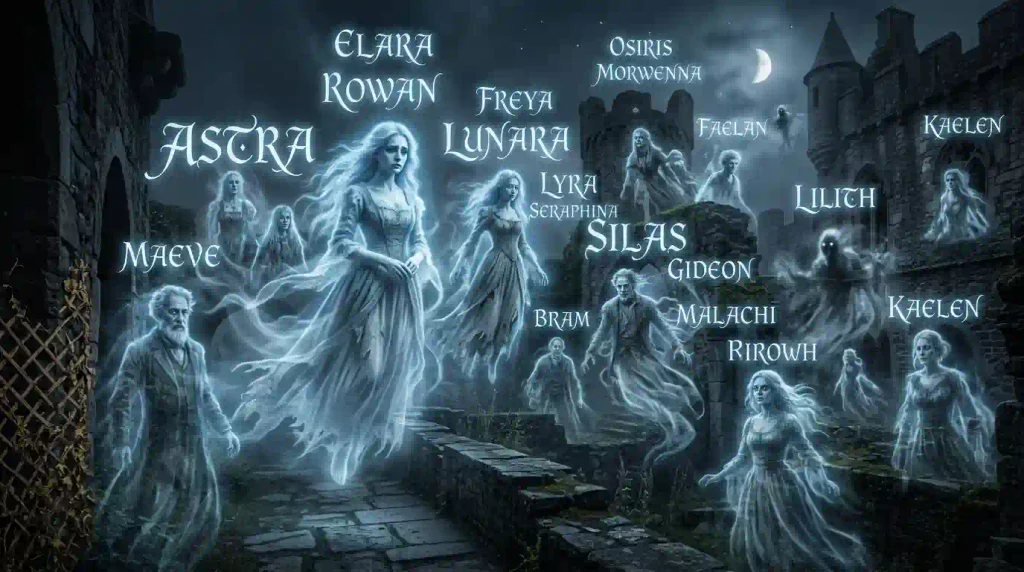
Looking for names for a ghost for a story, game, Halloween character, pet, username, or fantasy world? You have several good directions: use a real ghost-related word such as Wraith, a real personal name with a literary connection such as Lenore, a folklore term such as Yūrei, or an original name such as The Pale Whisper.
The important part is knowing which is which. Wraith is a ghost-related English word, Lenore is a documented given name, Yūrei is a Japanese supernatural term, and The Pale Whisper is a creative character name. They can all work, but they do not have the same linguistic status.
This guide separates those categories so you can choose a name based on meaning, cultural connection, character style, or simply the atmosphere you want.
Quick Answer: What Are Good Names for a Ghost?
Some strong choices are Wraith, Specter, Revenant, Phantom, Shade, Echo, Whisper, Mist, Casper, Lenore, Marley, Dusk, and Yūrei.
If accuracy matters, remember that many popular “ghost names” are actually descriptive words, folklore terms, or fictional character names, rather than personal names that literally mean “ghost.”
1. Ghost-Related Names and Words
These are the most direct choices because their meanings or established usage connect them with ghosts, apparitions, or supernatural beings.
Wraith
Meaning: A ghost or apparition
Type: Ghost-related English word
Pronunciation: RAYTH
Vibe: Dark, threatening, mysterious
Wraith is one of the clearest choices for a supernatural character. It is a word associated directly with a ghost or apparition, so it works naturally as a character title or name.
Specter
Meaning: A ghost or apparition
Type: Ghost-related word
Pronunciation: SPEK-ter
Vibe: Classic and eerie
Spectre is the common British spelling. This is a descriptive word rather than a traditional personal name.
Phantom
Meaning: An apparition or ghost; something that seems to exist but is not physically present
Type: Ghost-related word
Vibe: Dramatic and mysterious
Revenant
Meaning: A person who returns, especially from the dead
Origin: French revenant, related to revenir, “to return”
Type: Supernatural/ghost-related word
Vibe: Ancient and ominous
Shade
Meaning: In literary and older usage, the spirit or ghost of a dead person
Type: Literary ghost term
Vibe: Quiet and haunting
Apparition
Meaning: A ghostly or supernatural appearance
Type: Ghost-related word
Vibe: Elegant and eerie
Phantasm
Meaning: An apparition or something perceived as unreal
Type: Literary/supernatural word
Vibe: Strange and atmospheric
Haunt
Meaning: A place or, in some uses, a ghostly presence associated with a place
Type: Creative word choice
Vibe: Short and unsettling
Spook
Meaning: An informal word for a ghost or frightening supernatural figure
Type: Informal ghost-related word
Vibe: Playful or creepy
Visitant
Meaning: A visitor; in older supernatural usage, a supernatural visitor or apparition
Type: Literary word
Vibe: Old-fashioned and mysterious
These ten are useful when you want the reader to understand the supernatural connection immediately. They should not all be presented as ordinary baby names.
2. Mysterious Ghost Names
These are mostly creative word-name ideas. Their connection to ghosts comes from their imagery, not from a literal etymological meaning of “ghost.”
Echo
A strong choice for a spirit connected with memories, voices, or something that keeps returning.
Whisper
Soft, secretive, and ideal for a ghost that communicates quietly.
Mist
Short and atmospheric. It suggests something difficult to see or hold.
Wisp
A particularly useful choice for a small, floating, or elusive spirit.
Veil
Works well for a ghost associated with the boundary between the living and the dead.
Hush
A good fit for a silent or secretive character.
Dusk
Creates an evening atmosphere without claiming that the word literally means ghost.
Twilight
Longer and more poetic than Dusk.
Shadow
A familiar word with a natural connection to mysterious figures.
Fade
Useful for a spirit that appears and disappears.
Hollow
Works especially well for a lonely or unsettling ghost character.
Still
A minimalist choice for a silent spirit.
Murmur
A good option for a ghost whose voice is barely heard.
Drift
Fits a spirit that moves without clear direction.
Pale
A simple atmospheric choice for a traditional-looking ghost.
Frost
Useful for a ghost associated with cold rooms or winter.
Cinder
Works for a ghost connected with fire, ashes, or a ruined place.
Moon
A softer choice for a peaceful night-time spirit.
Vesper
A real word associated with evening and also an established personal-name form in modern usage, making it more name-like than many purely invented choices.
Nocturne
A literary, night-themed choice. It is better treated as a creative name than as a traditional given name.
3. Cute Ghost Names
A friendly ghost needs a different naming style. These work well for cartoons, Halloween decorations, pets, games, and children’s stories.
- Boo
- Casper
- Wisp
- Misty
- Puff
- Ghostie
- Bubbles
- Mallow
- Pip
- Peep
- Flicker
- Snowy
- Twinkle
- Moonbeam
- Boo-Boo
- Puffin
- Nibbles
- Mochi
- Glow
- Dewdrop
Most of these are playful names rather than historical ghost names. Casper is different because it has a strong established association with the fictional friendly ghost character.
4. Scary Ghost Names
For horror fiction, a name with a hard sound or threatening image can establish the mood immediately.
- Wraith
- Revenant
- Specter
- Phantom
- Dread
- Grave
- Hollow
- Nightfall
- Black Veil
- Cold Shadow
- Pale Watcher
- Silent Grave
- Ashen Wraith
- Dead Bell
- The Last Guest
- The Empty Room
- The Cold One
- The Forgotten
- The Watcher
- The Pale One
The names from Dread onward are creative suggestions. They are not being presented as established personal names or traditional supernatural terms.
5. Real Personal Names With a Ghostly or Gothic Feel
This is where many ghost-name articles become misleading. A real name does not have to mean “ghost” to work beautifully for a ghost character.
Lenore
Gender: Feminine
Usage: English
Pronunciation: luh-NOR
Name type: Established given name
Ghost connection: Literary
Lenore is a short form of Eleanor. It became strongly associated with Edgar Allan Poe’s literary work because Lenore is the name of the narrator’s departed love in The Raven. The ghostly association therefore comes from literature, not from the name’s literal meaning.
Edgar
Gender: Masculine
Usage: English and several other European languages
Pronunciation: ED-gur
Origin: Old English
Meaning: “Wealth/fortune” + “spear”
Ghost connection: Literary
Edgar is a genuine historical given name. Its spooky atmosphere is partly strengthened by the famous writer Edgar Allan Poe, but Edgar does not mean ghost.
Eleanor
A traditional feminine name that can suit an elegant or tragic ghost character.
Agnes
An established name with Greek roots meaning “chaste.” It should not be described as a name meaning ghost merely because it appears in some ghost-related name databases.
Edith
A classic English name that works well for an old-fashioned ghost character.
Clara
Simple, recognizable, and suitable for a gentle or historical spirit.
Violet
A familiar floral name that can create a softer supernatural character.
Beatrice
A traditional name with a literary feel that suits an older or elegant ghost.
Ophelia
A literary name often chosen for tragic character imagery. Its ghost association is cultural and literary, not literal.
Agnes
A historical name that can work for a Victorian or old-house ghost character, but its actual etymology should remain separate from the character’s supernatural role.
6. Male Names for a Ghost Character
If your ghost was once a human being, an ordinary personal name can make the character feel more believable.
- Edgar
- Edmund
- Edwin
- Arthur
- Alfred
- Walter
- Vincent
- Victor
- Silas
- Ambrose
- Jasper
- Julian
- Augustus
- Benedict
- Theodore
- Percival
- Laurence
- Everett
- Oscar
- Felix
These are real personal names, not names that literally mean ghosts. Their value here is their style and suitability for fictional characterization.
7. Female Names for a Ghost Character
For a female ghost, traditional names can create a sense of history.
- Lenore
- Eleanor
- Agnes
- Edith
- Clara
- Violet
- Ophelia
- Beatrice
- Agatha
- Winifred
- Esther
- Mabel
- Margaret
- Helena
- Cordelia
- Sylvia
- Rosalie
- Alice
- Minnie
- Iris
Again, these are established personal names with an editorial ghostly feel. Their actual meanings should not be changed simply to fit the article topic.
8. Ghost Names From Folklore
Folklore terms are useful, but cultural accuracy matters. These are not interchangeable translations of “ghost.”
Yūrei
Tradition: Japanese
Type: Ghost or restless spirit in Japanese folklore
Pronunciation: yoo-RAY
Use this when your character is specifically inspired by Japanese ghost traditions. It is better described as a supernatural term than as an ordinary Japanese first name.
Banshee
Tradition: Irish folklore
Type: Supernatural female figure
Pronunciation: BAN-shee
A banshee is not simply the Irish word for any ghost. The term has a specific place in Irish folklore and is associated with a mournful cry connected with death.
Dybbuk
Tradition: Jewish folklore
Type: Possessing spirit
Pronunciation: DIB-buk
A dybbuk belongs to a specific Jewish folkloric tradition. It should not be used as a generic synonym for every kind of ghost.
Draugr
Tradition: Old Norse/Norse tradition
Type: Supernatural revenant
Pronunciation: roughly DROW-gr
A draugr is a specific supernatural figure in Norse tradition rather than simply another spelling of ghost.
Preta
Traditions: Hindu and Buddhist traditions
Type: Supernatural being associated with an unsatisfied or hungry spirit
Preta has a specific religious and cultural context. It is not simply a personal name meaning “ghost.”
Vetala
Tradition: Sanskrit/Indian literary and religious tradition
Type: Supernatural being associated with the dead
This is a folklore term rather than an everyday given name.
Goryō
Tradition: Japanese
Type: Spirit traditionally associated with powerful or vengeful dead
This is another example of why a cultural ghost list needs explanation rather than a bare list of names.
9. Famous Ghost Names From Literature and Popular Culture
These names are useful when you want an obvious reference.
- Casper — fictional friendly ghost
- Jacob Marley — ghost in Charles Dickens’s A Christmas Carol
- Banquo — ghost in Shakespeare’s Macbeth
- Peeves — poltergeist in the Harry Potter books
- Moaning Myrtle — ghost character in Harry Potter
- Beetlejuice — fictional supernatural character
- Slimer — ghost-like character from Ghostbusters
- Lenore — literary figure associated with Poe’s work
- The Ghost of Christmas Past — Dickens’s A Christmas Carol
- The Ghost of Christmas Yet to Come — Dickens’s A Christmas Carol
These are character references, not traditional names that mean ghost.
10. Funny Ghost Names
If your ghost is supposed to make people laugh rather than scream, try playful combinations.
- Boo Berry
- Boo Bean
- Boo Biscuit
- Ghost Toast
- Spooky Socks
- Mr. Floaty
- Captain Boo
- Boo Noodle
- Phantom Fred
- Wisp Biscuit
- Sir Whispers
- Boo Button
- Tiny Wraith
- Ghost Muffin
- Mister Mist
- Boo Puff
- Spookums
- Floaty
- Boo Pop
- Friendly Phantom
These are intentionally creative. They should not be presented as established names or historical terms.
11. Unique Ghost Names for Stories
For fiction, one of the best approaches is to create a name around the ghost’s story rather than its supernatural status.
Try:
- The Pale Whisper
- The Empty Chair
- The Last Guest
- The Window Watcher
- The Candle Wraith
- The Forgotten Bride
- The Silent Bell
- The Ashen Child
- The Moonlit Stranger
- The Dust Walker
- The Cold Watcher
- The Veiled Guest
- The Wandering Shade
- The White Whisper
- The Locked-Room Ghost
- The Midnight Guest
- The Old Portrait
- The Fading Man
- The Woman in White
- The Hallway Shadow
These are not historical ghost names. They are original character-style constructions. Their strength comes from the story they suggest.
12. How to Create a Better Ghost Name
A useful ghost name usually comes from one of four things:
1. The ghost’s appearance
A pale ghost could become The White Whisper or Pale Watcher.
2. The ghost’s behavior
A spirit that repeats the same sound could be Echo or The Silent Bell.
3. The place it haunts
A ghost living around an abandoned station might be called The Last Passenger.
4. The ghost’s history
A forgotten bride might become The Veiled Bride, while a spirit tied to an old family home could have an ordinary historical name such as Edmund or Agnes.
This method produces more memorable names than simply combining random spooky words.
15 Best Names for a Ghost
These picks cover different purposes rather than claiming that one name is universally better.
- Wraith — Best for a clearly supernatural and frightening character.
- Lenore — Best for a literary and tragic ghost.
- Echo — Best for a mysterious spirit connected with memories.
- Whisper — Best for a quiet, elusive ghost.
- Revenant — Best for a spirit that has returned from death.
- Casper — Best for a friendly pop-culture-inspired ghost.
- Shade — Best for a short, subtle ghost name.
- Specter — Best when you want the supernatural meaning to be obvious.
- Yūrei — Best for a character specifically inspired by Japanese ghost folklore.
- Banshee — Best for an Irish folklore-inspired character.
- Dusk — Best for a simple atmospheric name.
- Misty — Best for a soft and approachable ghost.
- Edgar — Best for a human ghost with a literary or historical feel.
- The Pale Whisper — Best for an original horror character.
- The Empty Chair — Best for a ghost whose story centers on a particular place or memory.
How to Choose Between Them
Choose Wraith if you want a direct supernatural feeling.
Choose Lenore if the ghost is a tragic human character and you want literary depth.
Choose Echo if memory, sound, or repetition is part of the story.
Choose Casper if the character is friendly or playful and a familiar fictional reference is acceptable.
Choose Yūrei when the character specifically draws from Japanese ghost folklore.
Choose a real human name such as Edgar, Agnes, Eleanor, or Edmund when the ghost’s former human identity matters.
Choose a creative title such as The Pale Whisper when you want the name itself to become part of the ghost’s legend.
Frequently Asked Questions
Question: What are good names for a ghost?
Answer: Good options include Wraith, Specter, Revenant, Phantom, Shade, Echo, Whisper, Lenore, Casper, Dusk, and Mist. The best choice depends on whether you want a scary, tragic, cute, literary, folklore-based, or completely fictional ghost.
Question: What name literally means ghost?
Answer: English has several words that directly refer to ghosts, including wraith, specter, phantom, and apparition. However, these are mainly vocabulary words rather than traditional personal names. It is more accurate to call them ghost-related words that can be used as character names.
Question: Is Lenore a ghost name?
Answer: Lenore is a real feminine given name and a short form of Eleanor. Its ghostly association comes from literature, especially Edgar Allan Poe’s The Raven, where Lenore is the narrator’s departed love. The name itself does not literally mean “ghost.”
Question: Is Edgar a name that means ghost?
Answer: No. Edgar is an established Old English name derived from elements associated with wealth or fortune and a spear. Its spooky feel can come from literary associations with Edgar Allan Poe, but its etymology does not mean ghost.
Question: Is Yūrei a personal name?
Answer: Yūrei is better understood as a Japanese term for a type of ghost or restless spirit. It can work as a supernatural designation in fiction, especially when the character is intentionally based on Japanese folklore, but it should not be presented as an ordinary Japanese given name.
Question: What is a cute name for a ghost?
Answer: Try Boo, Casper, Wisp, Misty, Puff, Ghostie, Bubbles, Mallow, Pip, or Moonbeam. These are mostly playful or creative choices rather than names with a literal ghost meaning.
Question: What is a scary name for a ghost?
Answer: Wraith, Revenant, Specter, Phantom, Dread, Hollow, The Pale Whisper, and The Cold Watcher all create a darker atmosphere. The first four have established supernatural meanings, while the later choices are creative character names.
Question: Can I make up a ghost name?
Answer: Yes. For fiction, an original name can be more memorable than a traditional term. Build it around the ghost’s appearance, behavior, location, or history. Just label invented names as creative suggestions rather than presenting them as historical or cultural names.
Related Name Ideas
If you are building a larger names collection, these topics fit naturally with ghost names:
- Names for witches
- Names for vampires
- Names for demons
- Names for mythical creatures
- Names for fantasy characters
- Spooky names
- Halloween names
- Dark names
- Mysterious names
- Names meaning spirit
- Names associated with shadows
- Names associated with night
- Gothic names
- Horror character names
Conclusion
The strongest names for a ghost are not necessarily the names that appear in the longest online lists. A good choice should fit the character and, when a cultural or linguistic claim is made, that claim should be accurate. For a direct supernatural feel, Wraith, Specter, Phantom, and Revenant are clear choices. For a softer character, Boo, Casper, Misty, and Wisp work well. For a human ghost with a history, names such as Lenore or Edgar can add literary depth without pretending that they literally mean ghost.
If your character draws from folklore, use the original tradition carefully. Yūrei, Banshee, Dybbuk, Draugr, and Preta represent different cultural concepts and should not be treated as interchangeable ghost synonyms. For completely original fiction, a descriptive name such as The Pale Whisper or The Empty Chair can give the ghost a memorable identity while leaving room for your own story..

PressoraMedia is a content platform dedicated to helping readers find the right words, names, meanings, and ideas for everyday use. Our content focuses on names, name meanings, naming inspiration, and useful language-related information in a simple and easy-to-understand format. At Pressora Media, we believe that choosing a name is more than simply finding a word. A name can carry meaning, personality, culture, and a special story. That is why we research names carefully and create helpful guides designed to make the naming process easier. Our authors and contributors focus on providing clear explanations, useful name suggestions, meanings, origins, pronunciations, and practical naming ideas. We aim to keep our content informative, reader-friendly, and genuinely useful. Whether you are searching for a meaningful name, exploring the origin of a name, looking for unique naming ideas, or simply curious about the meaning behind a word or name, Pressora Media is here to help.
Pressora Media Team
Helping you find the right name, meaning, and words.