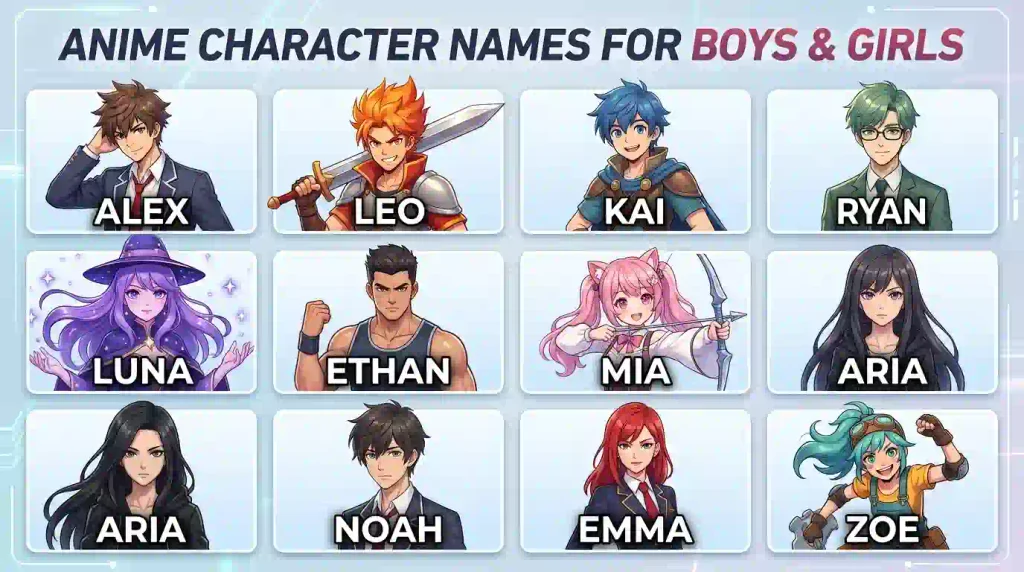

Looking for names for anime characters? The strongest choices are not simply names that sound Japanese. A good anime character name should fit the character’s personality, setting, role, and story.
This guide gives you 150+ anime character name ideas, including real Japanese given names, unisex choices, powerful names, cute names, mysterious options, nature-inspired names, and names suited to original characters. It also explains an important detail that many anime-name lists miss: a Japanese name’s meaning can change depending on the kanji used to write it.
You will also find tips for creating a believable Japanese character name, choosing a surname, understanding Japanese name order, and avoiding names that are simply Japanese vocabulary words presented as traditional personal names.
What Makes a Good Anime Character Name?
A strong anime character name usually does three things:
- It sounds memorable.
- It fits the character and setting.
- It works linguistically and culturally.
Not every anime character has a Japanese name. Anime includes characters with Japanese, Chinese, Korean, European, Middle Eastern, invented, mythological, and fictional names.
So before choosing a name, decide whether your character is:
- Japanese
- From another real-world culture
- From a fantasy world
- From a futuristic setting
- A supernatural character
- An original anime-style character
If your character is Japanese, a documented Japanese name is usually a better starting point than translating an English word into Japanese and assuming the result is a normal given name.
Best Japanese Names for Anime Characters
These are strong starting points for original Japanese characters. The meanings below refer to documented forms. Other kanji can produce different meanings.
1. Akira
Meaning: Bright, clear
Origin: Japanese
Gender: Unisex
Pronunciation: ah-KEE-rah
Akira is one of the most flexible choices on this list. It works for a hero, rival, detective, student, or mysterious character. The exact meaning depends on the kanji. Documented forms include 明 meaning “bright” and 亮 meaning “clear.”
2. Sora
Meaning: Sky
Origin: Japanese
Gender: Unisex
Pronunciation: SOH-rah
Sora is an excellent choice for an adventurous, free-spirited, or optimistic character. The kanji 空 means “sky,” although other written forms can exist.
3. Ren
Meaning: Lotus in one established form
Origin: Japanese
Gender: Commonly masculine, but usage can vary
Pronunciation: REN
Ren is short, memorable, and easy for international readers. When written 蓮, it refers to the lotus.
4. Haru
Meaning: Spring in one established form
Origin: Japanese
Gender: Unisex
Pronunciation: HAH-roo
Haru works especially well for a gentle, optimistic, or youthful character. Other kanji can give the same pronunciation different meanings.
5. Kaede
Meaning: Maple
Origin: Japanese
Gender: Unisex
Pronunciation: KAH-eh-deh
Kaede is a natural choice for a character connected with autumn, forests, traditional Japan, or quiet beauty.
6. Hikaru
Meaning: Light or radiance
Origin: Japanese
Gender: Unisex
Pronunciation: hee-KAH-roo
A strong option for a protagonist, magical character, healer, or optimistic hero.
7. Yuki
Meaning: Snow or happiness, depending on kanji
Origin: Japanese
Gender: Unisex
Pronunciation: YOO-kee
Yuki demonstrates why Japanese names should not be assigned one universal meaning. Different kanji can create different interpretations.
8. Aoi
Meaning: Hollyhock or blue/green, depending on form
Origin: Japanese
Gender: Unisex
Pronunciation: AH-oh-ee
Aoi works especially well for a calm, artistic, nature-focused, or modern character.
9. Kaoru
Meaning: Fragrance/fragrant in one form
Origin: Japanese
Gender: Unisex
Pronunciation: kah-oh-roo
A refined choice for an elegant, intelligent, or mysterious character.
10. Asahi
Meaning: Morning sun
Origin: Japanese
Gender: Unisex
Pronunciation: ah-SAH-hee
Asahi suits an optimistic character, especially one associated with beginnings or hope.
Cool Anime Boy Names
If you want a masculine name for a hero, rival, fighter, student, or adventure character, these are useful starting points.
| Name | Meaning or association | Character fit |
| Kaito | Various kanji meanings | Adventurer |
| Haruto | Several established kanji combinations | Hero |
| Riku | Land in one established form | Fighter |
| Daichi | Great earth/land in one form | Strong hero |
| Kenta | Healthy/strong + great in one form | Athlete |
| Takumi | Skill/craftsmanship associations | Inventor |
| Takeru | Established masculine Japanese name | Warrior |
| Hayato | Falcon/person in one established form | Speed-based hero |
| Naoki | Several established forms | Intelligent hero |
| Shota | Several established forms | Student character |
| Kazuki | Several established forms | Protagonist |
| Kazuto | Several established forms | Gamer/hero |
| Ryota | Several established forms | Friendly hero |
| Yuuto | Several established forms | Modern protagonist |
| Kenji | Multiple established kanji combinations | Traditional character |
| Kenzo | Multiple established forms | Older or powerful character |
| Hiroshi | Several established forms | Mature character |
| Satoshi | Several established forms | Intelligent character |
| Makoto | Sincerity/truth in one form | Honest hero |
| Tatsuya | Multiple established forms | Serious character |
| Shinji | Multiple established forms | Dramatic character |
| Koji | Multiple established forms | Traditional character |
| Junpei | Multiple established forms | Friendly character |
| Issei | Multiple established forms | Competitive character |
| Taichi | Multiple established forms | Energetic hero |
Best choices from this group
For a main hero: Kaito, Haruto, Riku, Yuuto
For a serious fighter: Takeru, Tatsuya, Kenji
For an intelligent character: Satoshi, Naoki, Makoto
For a modern anime setting: Kaito, Kazuki, Yuuto, Ryota
Beautiful Anime Girl Names
These names work well for heroines, magical characters, students, healers, rivals, and elegant characters.
| Name | Meaning or association | Character fit |
| Sakura | Cherry blossom | Heroine |
| Akari | Brightness in some forms | Optimistic girl |
| Akane | Deep red; madder plant | Dramatic character |
| Ayaka | Several kanji combinations | Elegant character |
| Ayame | Iris | Nature character |
| Aiko | Love/affection + child in one form | Gentle character |
| Hina | Several established forms | Cute character |
| Mio | Multiple established forms | Modern heroine |
| Saki | Multiple established forms | Cheerful character |
| Saori | Multiple established forms | Realistic school setting |
| Sayaka | Multiple established forms | Modern heroine |
| Satomi | Multiple established forms | Intelligent character |
| Koharu | Spring-related forms | Warm character |
| Chiharu | Spring-related form | Gentle character |
| Chihiro | Multiple established forms | Adventurous character |
| Emi | Multiple established forms | Friendly character |
| Yuna | Multiple established forms | Modern heroine |
| Rina | Multiple established forms | Contemporary character |
| Natsuki | Multiple established forms | Energetic character |
| Misaki | Multiple established forms | Student character |
| Nanami | Multiple established forms | Friendly heroine |
| Kaori | Fragrance-related forms | Elegant character |
| Mai | Multiple established forms | Short modern name |
| Yui | Multiple established forms | Gentle character |
| Reina | Multiple established forms | Elegant rival |
Sakura is particularly clear as a documented Japanese given name associated with cherry blossoms, while names such as Akira, Haruka, and Sora demonstrate how different kanji can change the meaning attached to a pronunciation.
Best Unisex Anime Names
Unisex names are useful when you want the character’s gender to be less obvious at first glance.
Akira
Bright or clear depending on kanji.
Haru
Can represent spring or other meanings depending on kanji.
Sora
Sky.
Aoi
Several established meanings and written forms.
Hikaru
Light or radiance.
Kaede
Maple.
Kaoru
Fragrance/fragrant in one form.
Yuki
Snow, happiness, or other meanings depending on kanji.
Haruka
Can mean “distant” in one established form, while other kanji combinations create different meanings.
Asahi
Morning sun.
Chiharu
Can involve “thousand” and “spring” in one documented form.
Chiaki
Several established kanji combinations.
Ryo
Several established Japanese forms.
Nagi
Calm in one documented form.
Rei
An established Japanese given name with multiple possible written forms.
Strong Anime Names for Warriors
A warrior’s name does not have to literally mean “warrior.” In fact, a normal personal name can make a character feel more believable.
Here are strong choices:
- Takeru — classic masculine sound
- Katsu — associated with victory
- Chikara — power/capability as a Japanese word and documented name form
- Riki — power/capability
- Kenta — strong/healthy associations in some kanji forms
- Tatsuya — established masculine Japanese name
- Kenshin — established masculine name with multiple kanji possibilities
- Hayato — strong action-oriented sound
- Takumi — skill/craftsmanship association
- Kaito — energetic modern sound
- Daichi — earth/land associations
- Riku — land
- Katsuki — established Japanese name with multiple possible kanji
- Takeru — strong traditional feel
- Kenji — established masculine Japanese name
Character-design tip
For a warrior, avoid the temptation to translate every English concept literally. A character named “Warrior” in Japanese may sound less natural than an ordinary Japanese name with a suitable story behind it.
Mysterious Anime Character Names
For supernatural characters, detectives, antiheroes, rivals, or quiet protagonists, these names have a more restrained feel.
Rin
Short and sharp. One established form can carry a meaning related to dignity or severity.
Rei
Short, flexible, and associated with several possible kanji.
Nagi
Calm.
Ryo
Multiple possible meanings depending on kanji.
Kanata
An established Japanese given name with several possible written forms.
Kaoru
Elegant and slightly ambiguous in tone.
Akira
Bright or clear, which can create an interesting contrast for a morally dark character.
Haruka
Can mean distant or remote in one documented form.
Yuki
Snow or happiness depending on kanji.
Hikaru
Light or radiance, especially effective when used ironically for a darker character.
Cute Anime Character Names
For slice-of-life anime, school stories, comedy, romance, or magical-girl characters, softer names can work particularly well.
- Hana
- Hina
- Momo
- Yui
- Mio
- Saki
- Aiko
- Emi
- Yuna
- Koharu
- Sakura
- Mai
- Rina
- Nao
- Miki
- Koko
- Nana
- Hikari
- Yume
- Miku
A useful warning about cute names
A name sounding cute in English does not automatically make it a common Japanese personal name. Some Japanese vocabulary words can be used creatively in fiction, but they should not be presented as traditional given names without evidence.
Nature-Inspired Anime Names
Nature is one of the easiest themes to use without making a character name feel forced.
Sakura
Cherry blossoms.
Kaede
Maple.
Sora
Sky.
Yuki
Snow in one established form.
Haru
Spring in one established form.
Asahi
Morning sun.
Ayame
Iris.
Akane
Deep red and associated with the madder plant.
Aoi
Associated with hollyhock in one written form and blue/green in another.
Izumi
Associated with a spring or fountain in established Japanese forms.
Natsuki
Can incorporate “summer” in some kanji combinations.
Chiharu
Can incorporate “spring” in one established form.
Koharu
Can incorporate “spring” through its written form.
Hotaru
Associated with “firefly” as a Japanese vocabulary/name form.
Momiji
Associated with autumn foliage/maple leaves and used as a Japanese given name.
These names are especially useful when the character’s appearance, powers, hometown, or storyline has a natural connection.
Anime Names for Villains and Antiheroes
A common mistake is assuming a villain needs a name meaning “dark,” “evil,” or “death.”
It does not.
A villain with an ordinary name can feel more realistic, while a symbolic name can create deliberate contrast.
Consider:
- Akira
- Rin
- Rei
- Kaoru
- Ryo
- Kenshin
- Kanata
- Nagi
- Kaito
- Makoto
- Tatsuya
- Shinji
- Ren
- Hikaru
- Yuki
For a supernatural villain, you can also give the character a normal birth name and a separate alias, title, or codename. That approach often works better than turning an ordinary Japanese vocabulary word into a fake personal name.
Famous Anime Character Names vs Original Character Names
There are two different things people mean when they search for anime names.
1. Existing anime character names
These are names readers already associate with characters such as:
- Naruto
- Ichigo
- Tanjiro
- Goku
- Sasuke
- Kakashi
- Jotaro
- Eren
- Armin
- Edward
- Sakura
These can inspire your character, but copying a famous character’s full name is usually less useful if you are creating your own story.
2. Original anime character names
For an OC, start with a real naming structure.
For example:
Surname + Given name
You might choose a documented Japanese surname and pair it with a documented given name.
The key is not to create a random combination simply because both words sound Japanese.
How to Create a Japanese Anime Character Name
Use this five-step method.
Step 1: Define the character
Write down:
- Age
- Gender
- Personality
- Role
- Location
- Time period
- Family background
- Powers
- Character arc
Step 2: Choose the naming style
Decide whether the name should feel:
- Modern
- Traditional
- Cute
- Serious
- Elegant
- Mysterious
- Strong
- Historical
- Futuristic
Step 3: Pick a documented given name
Choose a real name first.
For example:
Ren, Akira, Haru, Sora, Kaito, Sakura, Kaede
Step 4: Check the kanji
This is where many anime-name lists become unreliable.
The pronunciation alone may not tell you the meaning. A different kanji can change the meaning of the name.
Step 5: Add a suitable surname
If your character is Japanese, choose a documented Japanese surname rather than inventing a string of Japanese-looking syllables.
Japan’s Ministry of Justice also maintains information on kanji permitted for children’s names, and since 2025 the Japanese family-register system has formally incorporated name readings.
For fictional characters, you have more creative freedom, but authentic naming still benefits from understanding real naming conventions.
Japanese Name Order in Anime
In Japanese contexts, the traditional order is generally:
Family name + given name
So a fictional character might be introduced as:
Kurosawa Ren
rather than:
Ren Kurosawa
English-language releases may reverse the order for international audiences.
This distinction matters when you create a full Japanese character identity. Japanese government materials and publications also use the family-name-first convention in Japanese names.
Don’t Turn Japanese Words Into Fake Names
This is one of the biggest gaps in low-quality anime-name articles.
A Japanese word can have a beautiful meaning without being a normal personal name.
For example:
You can mean “night.”
That does not automatically make Yoru a traditional Japanese given name.
Likewise, a creator can intentionally use a word such as “night,” “shadow,” “flame,” or “storm” as:
- A codename
- A title
- A fantasy name
- A villain alias
- A supernatural identity
That is perfectly acceptable in fiction.
The problem comes when a word is presented as a common Japanese personal name without evidence.
For an authentic Japanese character, start with documented names. For fantasy characters, label creative constructions honestly.
Can the Same Anime Name Have Different Meanings?
Yes.
This is one of the most important things to understand about Japanese names.
Consider Sora.
One documented form is:
空 — sky
But other kanji combinations can create other interpretations.
The same principle applies to:
- Akira
- Haru
- Yuki
- Haruka
- Aoi
- Hikaru
- Kaoru
- Ryo
- Ren
This is why the statement “Japanese name X always means Y” is often too absolute.
A better approach is:
Name + exact kanji + documented meaning
That gives the reader a much more accurate picture.
15 Best Names for Anime Characters
If you want a quick shortlist, these are my strongest choices from the article.
Best Overall: Akira
Flexible, memorable, and genuinely Japanese.
Best Short Name: Ren
Simple and easy to remember.
Best Hero Name: Kaito
Energetic and modern.
Best Girl Name: Sakura
Clear nature association and strong Japanese identity.
Best Unisex Name: Sora
Short, recognizable, and sky-related in a documented form.
Best Nature Name: Kaede
Maple gives it a clear natural identity.
Best Mysterious Name: Rei
Short and open to multiple interpretations.
Best Calm Name: Nagi
Excellent for a quiet or controlled character.
Best Light-Themed Name: Hikaru
Works especially well for an optimistic protagonist.
Best Warrior Name: Takeru
Strong traditional feel.
Best Intelligent Character Name: Satoshi
A good fit for a strategist or analytical character.
Best Elegant Name: Kaoru
Refined without being overly dramatic.
Best Winter Name: Yuki
Snow is one established interpretation.
Best Spring Name: Haru
Simple and versatile.
Best Adventure Name: Sora
The sky association gives it a natural sense of freedom.
Quick Anime Character Name Selector
| If your character is… | Try these |
| Main hero | Kaito, Ren, Haruto, Hikaru |
| Main heroine | Sakura, Akari, Mio, Yui |
| Warrior | Takeru, Katsu, Kenji, Tatsuya |
| Rival | Akira, Rin, Ryo, Ren |
| Villain | Rei, Kaoru, Ryo, Kanata |
| Mysterious | Nagi, Rei, Akira, Kanata |
| Cute | Hina, Hana, Momo, Yui |
| Nature-themed | Sakura, Kaede, Sora, Yuki |
| Magical | Hikaru, Akari, Hikari, Sakura |
| Intelligent | Satoshi, Naoki, Makoto |
| Quiet | Nagi, Ren, Rei, Haru |
| Energetic | Kaito, Riku, Hayato, Taichi |
| Unisex | Akira, Sora, Haru, Yuki |
| Traditional | Kenji, Hiroshi, Takeru, Chihiro |
| Modern | Kaito, Haruto, Yuna, Mio |
Anime Name Ideas by Character Role
Protagonist
Choose something memorable but not excessively complicated.
Ren, Kaito, Haruto, Sora, Akira
Rival
A short or sharper name can work well.
Rin, Ryo, Rei, Ren, Akira
Mentor
Traditional or mature-sounding names often fit.
Kenji, Hiroshi, Takeru, Akio
Healer
Gentle names with associations of light, nature, or calm can work.
Hikaru, Akari, Hana, Yuki, Nagi
Comic Relief
Short, friendly names usually feel more approachable.
Kenta, Junpei, Satoshi, Miki, Nana
Princess
Elegant names work better than simply choosing the rarest possible name.
Sakura, Ayame, Kaori, Sayaka, Reina
Villain
Do not force a literal “evil” meaning.
Rei, Ryo, Kaoru, Akira, Kanata
Fantasy Warrior
A traditional Japanese name can work better than an obviously translated English word.
Takeru, Kenshin, Katsu, Hayato, Tatsuya
Common Mistakes When Choosing an Anime Name
Mistake 1: Choosing a name only because it sounds Japanese
Sound is important, but it is not enough.
Mistake 2: Assuming one pronunciation has one meaning
Japanese names can have multiple kanji forms.
Mistake 3: Using a Japanese dictionary word as a normal name
A word can be useful creatively without being a conventional given name.
Mistake 4: Giving every character a symbolic name
Real people do not all have names that perfectly predict their personality.
Mistake 5: Making every villain’s name mean darkness
Contrast can be much more interesting.
Mistake 6: Ignoring the surname
A full character name should feel like a complete identity.
Mistake 7: Copying a famous anime character
Inspiration is useful. A new character deserves a distinct identity.
Mistake 8: Inventing kanji readings without checking them
This can create names that look Japanese on the page but do not make sense linguistically.
15 Fast Picks for an Original Anime Character
If you do not want to read the entire list, start here:
- Akira — versatile and memorable
- Ren — short and clean
- Kaito — energetic
- Sora — sky and freedom
- Haru — spring-related
- Hikaru — light-related
- Kaede — maple
- Yuki — snow/happiness depending on kanji
- Rei — mysterious and concise
- Nagi — calm
- Sakura — cherry blossom
- Takeru — strong masculine option
- Kenshin — warrior-friendly
- Akari — bright and feminine
- Kaoru — elegant and unisex
Frequently Asked Questions
What are good names for anime characters?
Good choices include Akira, Ren, Kaito, Sora, Haru, Hikaru, Sakura, Kaede, Rei, Yuki, Takeru, and Kaoru. For an original Japanese character, choose a documented name and then check the exact kanji and reading. This produces a more credible result than simply translating an English word into Japanese.
What is the best Japanese name for an anime character?
There is no single best name. Akira is one of the most flexible because it can work across several character types and has documented kanji forms meaning “bright” or “clear.” Sora is excellent for a nature or adventure character, while Ren works well when you want something short and memorable.
What are some cool anime names?
Cool options include Akira, Kaito, Ren, Riku, Rei, Ryo, Takeru, Kenshin, Sora, Kanata, Hikaru, and Kaoru. Choose based on the character rather than treating “cool” as a fixed meaning.
What are good anime names for a girl?
Good options include Sakura, Akari, Akane, Ayame, Aiko, Mio, Hina, Saki, Kaori, Sayaka, Yui, Yuna, and Koharu. Remember that some Japanese names can have several kanji forms and different meanings.
What are good unisex anime names?
Akira, Sora, Haru, Yuki, Hikaru, Kaede, Kaoru, Asahi, Haruka, and Ryo are useful unisex options. Usage can vary according to generation, kanji, and cultural context.
Can I use a real Japanese name for an anime character?
Yes. In fact, using a documented Japanese name is often the best choice if your character is Japanese. You can then select an appropriate kanji spelling. Fiction also gives you more freedom to create unusual combinations, but it is useful to label them as fictional rather than claiming they are traditional names.
Do anime character names have meanings?
Some do, but not all. Many anime characters have ordinary real-world names. Others use wordplay, unusual kanji, foreign names, aliases, or names created specifically for fiction. A character’s name should therefore not automatically be assumed to have a hidden symbolic meaning.
Does kanji change the meaning of a Japanese name?
Yes. The same pronunciation can correspond to different kanji and therefore different meanings. This is why names such as Akira, Sora, Haruka, Yuki, and other Japanese names should be explained with their specific written form when a precise meaning matters.
Should I use a Japanese surname with my anime character’s first name?
If the character is Japanese, that can make the full name feel more coherent. Japanese name order traditionally places the family name before the given name. For international English-language presentation, the order may be reversed.
Can I invent an anime name?
Yes. Fictional names can be invented, especially in fantasy, science fiction, supernatural, and alternate-world stories. The important thing is to distinguish an invented character name from an established Japanese personal name.
Final Thoughts
Choosing names for anime characters is easier when you stop looking only for names that sound cool and start thinking about the character behind the name. A protagonist may need something memorable and approachable. A warrior may benefit from a strong traditional name. A mysterious rival may work better with something short and understated. A nature-based character could use a documented name such as Sakura, Kaede, Sora, or Yuki.
If you choose a Japanese name, pay particular attention to kanji, pronunciation, gender usage, and cultural context. The same spoken name can have different meanings when written with different kanji, so a single English translation should not always be treated as the definitive meaning. Most importantly, do not feel pressured to make every name dramatic. Some of the most convincing anime characters have ordinary names. The character’s personality, story, and actions are what ultimately make the name memorable.

PressoraMedia is a content platform dedicated to helping readers find the right words, names, meanings, and ideas for everyday use. Our content focuses on names, name meanings, naming inspiration, and useful language-related information in a simple and easy-to-understand format. At Pressora Media, we believe that choosing a name is more than simply finding a word. A name can carry meaning, personality, culture, and a special story. That is why we research names carefully and create helpful guides designed to make the naming process easier. Our authors and contributors focus on providing clear explanations, useful name suggestions, meanings, origins, pronunciations, and practical naming ideas. We aim to keep our content informative, reader-friendly, and genuinely useful. Whether you are searching for a meaningful name, exploring the origin of a name, looking for unique naming ideas, or simply curious about the meaning behind a word or name, Pressora Media is here to help.
Pressora Media Team
Helping you find the right name, meaning, and words.