
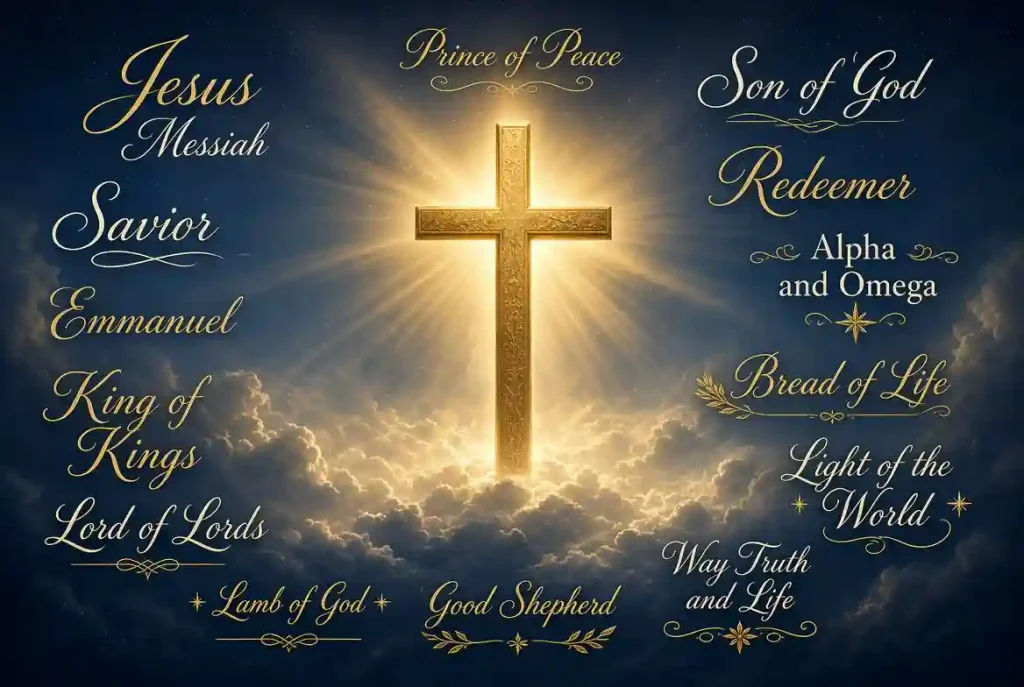
If you are looking for names for Christ, the Bible gives us much more than a long list of alternative names. It gives us a personal name, messianic titles, royal titles, descriptions, metaphors, and names connected with Jesus’ mission.
The central personal name is Jesus. Christ is a title meaning “Anointed One,” equivalent to Messiah. Other expressions, such as Emmanuel, Son of God, Lamb of God, Good Shepherd, Light of the World, Word of God, King of Kings, and Alpha and Omega, describe who Jesus is or what Christians believe he came to do.
That distinction matters. Not every phrase in a list of “names of Jesus” is a personal name in the ordinary sense. Some are titles, some are biblical images, and some are descriptions connected with prophecy or Christian interpretation.
This guide separates those categories so you can understand the meaning, origin, biblical context, and type of each expression without treating every phrase as an ordinary given name.
Jesus vs. Christ: What Is the Difference?
Jesus is the personal name given to Mary and Joseph’s child. Matthew 1:21 explains the name in connection with his saving mission: “you are to give him the name Jesus, because he will save his people from their sins.”
Christ, on the other hand, is a title. The Greek Christos means “Anointed One” and corresponds to the Hebrew Messiah.
So Jesus Christ means, in basic terms, Jesus the Christ, or Jesus the Messiah. Christ was not originally a family surname.
1. The Personal Names of Christ
1. Jesus
Meaning: Associated with “the Lord saves”
Origin: Greek Iēsous, related to Hebrew/Aramaic Yeshua
Type: Personal name
Biblical references: Matthew 1:21; Luke 1:31
Jesus is the primary personal name used for Christ in the New Testament. Matthew explicitly connects the name with salvation. Bible Gateway’s Bible encyclopedia identifies Jesus as the Greek form of the Hebrew name associated with Joshua and the idea “Yahweh saves.”
2. Yeshua
Meaning: Connected with salvation
Origin: Hebrew/Aramaic
Type: Historical linguistic form related to Jesus
Yeshua is the Hebrew-Aramaic form commonly associated with Greek Iēsous, which became “Jesus” in English through Greek and Latin transmission.
It is better described as a historical form of Jesus’ name than as a separate biblical title.
3. Emmanuel / Immanuel
Meaning: “God with us”
Origin: Hebrew
Type: Biblical designation
Reference: Matthew 1:23; Isaiah 7:14
Matthew explains Immanuel directly as “God with us.” The passage connects the expression with Isaiah and applies it within the Gospel’s account of Jesus.
Unlike Jesus, Emmanuel is not presented as the ordinary personal name Joseph gives the child in Matthew 1:25. It functions as a significant biblical designation.
2. Messianic Names and Titles
4. Christ
Meaning: Anointed One
Origin: Greek Christos
Type: Messianic title
References: Matthew 16:16; John 1:41
Christ is the Greek form corresponding to Messiah. The title identifies Jesus with the expected anointed figure of biblical hope.
5. Messiah
Meaning: Anointed One
Origin: Hebrew Mashiach
Type: Messianic title
References: John 1:41; John 4:25–26
Messiah is the Hebrew title behind the Greek Christ. The two terms should not be treated as unrelated names.
6. Anointed One
Meaning: One who is anointed
Type: English translation of Christ/Messiah
“Anointed One” is the clearest English explanation of the word Christ.
7. Son of David
Meaning: A Davidic and messianic designation
Type: Messianic title
References: Matthew 1:1; Matthew 21:9
The title connects Jesus with David and the biblical royal tradition. It appears repeatedly in the Gospel narratives.
8. King of Israel
Meaning: King of Israel
Type: Royal/messianic title
References: John 1:49; John 12:13
This title reflects recognition of Jesus as king within the Gospel narratives.
9. King of the Jews
Meaning: King of the Jews
Type: Royal title
References: Matthew 2:2; Matthew 27:37
The expression occurs both in the birth narrative and in the crucifixion account, with very different narrative settings.
10. Prince of Peace
Meaning: Prince or ruler associated with peace
Origin: Hebrew biblical tradition
Type: Messianic designation
Reference: Isaiah 9:6
Prince of Peace is one of the most familiar Christian titles associated with Jesus. The phrase occurs in Isaiah 9:6. It is important to identify it accurately as an Old Testament messianic designation rather than claim that the exact phrase is a frequent New Testament title.
11. Chosen One
Meaning: Chosen or elect one
Type: Biblical designation
References: Luke 9:35; Luke 23:35
The expression appears in Luke in connection with Jesus’ identity.
3. Names Describing Jesus’ Divine Identity
12. Son of God
Meaning: Son of God
Type: Major New Testament title
References: Matthew 16:16; John 20:31
Son of God is one of the central titles applied to Jesus in the New Testament. Its significance includes his unique relationship with the Father and his identity within Christian theology.
13. Son of Man
Meaning: Son of Man
Type: Biblical title used by Jesus
References: Matthew 8:20; Mark 2:10; Daniel 7:13–14
This is one of Jesus’ most distinctive self-designations in the Gospels. Its meaning is complex because the expression has connections with both ordinary human language and the figure described in Daniel 7.
14. Lord
Meaning: Lord, master
Origin: Greek Kyrios in the New Testament
References: Romans 10:9; Philippians 2:11
Lord can function as a respectful form of address, but in early Christian writing it also carries substantial theological significance.
15. I AM
Meaning: “I am”
Type: Divine and theological designation
Reference: John 8:58
Jesus’ “I am” statement in John 8:58 has a major place in Christian interpretation and is connected by Christian readers with the Old Testament revelation of God’s identity.
16. Holy One of God
Meaning: The Holy One belonging to God
Type: Descriptive title
References: Mark 1:24; John 6:69
The title appears in Gospel passages where Jesus’ identity is recognized.
17. The Amen
Meaning: Amen, associated with certainty and faithfulness
Reference: Revelation 3:14
Revelation calls Jesus the Amen, a distinctive title listed in Bible Gateway’s biblical-theme reference.
18. Image of God
Meaning: The image or exact representation of God
References: 2 Corinthians 4:4; Colossians 1:15; Hebrews 1:3
This is more accurately treated as a theological description than an ordinary personal name.
4. Names Connected With Salvation
19. Savior
Meaning: One who saves or delivers
Type: Title
Reference: John 4:42; Luke 2:11
Savior directly describes Jesus’ saving role. The Samaritans in John 4:42 call him the “Savior of the world.”
20. Savior of the World
Meaning: Savior of the world
Reference: John 4:42
This is a fuller form of the Savior title and emphasizes the broad scope attributed to Jesus in the passage.
21. Redeemer
Meaning: One who redeems
Type: Theological title
Biblical background: Biblical redemption language
Redeemer is a firmly established Christian designation for Jesus, but it should not be confused with a personal name. Christian sources commonly connect the title with biblical redemption themes.
22. Mediator
Meaning: One who mediates between parties
Reference: 1 Timothy 2:5
Paul describes Jesus as the mediator between God and humanity.
23. Advocate
Meaning: One who speaks or acts on behalf of another
Reference: 1 John 2:1
John uses the Greek concept of an advocate or helper when describing Christ’s role for believers.
24. High Priest
Meaning: High priest
Type: Priestly title
References: Hebrews 3:1; Hebrews 4:14
Hebrews presents Jesus as the great high priest, giving this title an important place in the book’s understanding of Christ.
25. Apostle
Meaning: One who is sent
Reference: Hebrews 3:1
Hebrews calls Jesus the apostle and high priest of the Christian confession. Here “apostle” should be understood in its literal sense of one who is sent, not as the same office traditionally associated with Jesus’ twelve disciples.
5. Shepherd Titles for Christ
26. Good Shepherd
Meaning: Shepherd who cares for his sheep
Reference: John 10:11
Jesus describes himself as the Good Shepherd and connects the image with laying down his life for the sheep.
27. Great Shepherd
Meaning: Great shepherd
Reference: Hebrews 13:20
Hebrews calls Jesus the great Shepherd of the sheep. Bible Gateway also includes this among its biblical descriptions of Jesus.
28. Chief Shepherd
Meaning: Chief shepherd
Reference: 1 Peter 5:4
Peter uses this title when discussing Christian shepherding and the appearance of the chief Shepherd.
29. Shepherd
Meaning: Shepherd
References: John 10; 1 Peter 2:25
The shepherd image emphasizes guidance, care, protection, and responsibility.
30. Overseer of Souls
Meaning: One who watches over souls
Reference: 1 Peter 2:25
Peter describes Jesus as the Shepherd and Overseer of souls.
6. Light, Life, and Word Titles
31. Light of the World
Meaning: Light of the world
Reference: John 8:12
Jesus says, “I am the light of the world.” The title presents him as a source of spiritual light and guidance.
32. True Light
Meaning: True or genuine light
Reference: John 1:9
John’s opening chapter describes the Word as the true light coming into the world. Bible Gateway’s biblical-theme reference lists the true light among Christ’s descriptions.
33. Light of Life
Meaning: Light associated with life
Reference: John 8:12
This phrase appears within Jesus’ teaching about following him and having the light of life.
34. Bread of Life
Meaning: Bread of life
Reference: John 6:35
The title comes from one of John’s famous “I am” statements.
35. Living Bread
Meaning: Living bread
Reference: John 6:51
The expression appears in Jesus’ teaching about the bread that gives life.
36. Resurrection and the Life
Meaning: Resurrection and life
Reference: John 11:25
Jesus uses this expression when speaking with Martha before the raising of Lazarus.
37. The Way
Meaning: The Way
Reference: John 14:6
38. The Truth
Meaning: The Truth
Reference: John 14:6
39. The Life
Meaning: The Life
Reference: John 14:6
These three titles appear together in John 14:6 and are among the most recognized expressions associated with Jesus.
40. The Word
Meaning: Word, Greek Logos
Reference: John 1:1–14
John’s Gospel presents the Word as being with God and as God, then describes the Word becoming flesh. This makes “Word” a major theological title rather than an ordinary personal name.
41. Word of God
Meaning: Word of God
References: John 1:1; Revelation 19:13
The expression is particularly important in Johannine theology. Bible Gateway identifies the Word of God among the titles and descriptions associated with Jesus.
7. Royal and Eternal Titles
42. King of Kings
Meaning: King of kings
Reference: Revelation 19:16
This royal title emphasizes Christ’s supreme kingship within the Revelation passage.
43. Lord of Lords
Meaning: Lord of lords
Reference: Revelation 19:16
It appears alongside the King of Kings.
44. Alpha and Omega
Meaning: First and last letters of the Greek alphabet
Reference: Revelation 22:13
Alpha is the first Greek letter and omega is the last. The expression communicates completeness and eternal significance. Bible Gateway lists it among the titles of Christ.
45. First and Last
Meaning: First and last
Reference: Revelation 22:13
This expression appears together with the Alpha and Omega language.
46. Beginning and End
Meaning: Beginning and end
Reference: Revelation 22:13
Some translations phrase the final part of the verse differently, so wording can vary by Bible version.
47. Faithful Witness
Meaning: Faithful witness
Reference: Revelation 1:5
Revelation opens by describing Jesus Christ as the faithful witness.
48. Faithful and True
Meaning: Faithful and true
Reference: Revelation 19:11
The expression appears in Revelation’s vision of the rider called Faithful and True.
49. Bright Morning Star
Meaning: Bright morning star
Reference: Revelation 22:16
Jesus identifies himself with this poetic image near the end of Revelation.
8. Biblical Images and Symbolic Titles
These are especially important to label as images or descriptions, not ordinary personal names.
50. Lamb of God
Meaning: Lamb belonging to God
Reference: John 1:29
John the Baptist calls Jesus the Lamb of God. The expression became central to Christian interpretation of Jesus’ sacrificial role.
51. Lion of the guilde of Judah
Meaning: Lion associated with Judah
Reference: Revelation 5:5
This is a symbolic and messianic image connected with Judah and Davidic kingship.
52. Root of David
Meaning: Root associated with David
Reference: Revelation 5:5; Revelation 22:16
The title connects Jesus with Davidic imagery.
53. Root and Offspring of David
Meaning: Root and descendant associated with David
Reference: Revelation 22:16
This is a particularly rich expression because it presents both sides of the Davidic relationship in one title.
54. Cornerstone
Meaning: Foundational stone
References: Matthew 21:42; Ephesians 2:20
Jesus is associated with the cornerstone image in the New Testament. Bible Gateway lists cornerstone/capstone among the biblical descriptions of Christ.
55. Living Stone
Meaning: Living stone
Reference: 1 Peter 2:4
Peter applies this unusual architectural image to Christ.
56. Rock
Meaning: Rock
Reference: 1 Corinthians 10:4
Paul connects the spiritual rock with Christ in this passage.
57. True Vine
Meaning: True vine
Reference: John 15:1
Jesus describes himself as the true vine, with his followers represented as branches.
58. Door
Meaning: Door or entrance
Reference: John 10:9
Jesus uses the image of a door in describing access to safety and salvation.
59. Gate
Meaning: Gate or entrance
Reference: John 10:7
English translations vary between door and gate, so these expressions should not necessarily be treated as two completely different titles.
60. Bridegroom
Meaning: Bridegroom
References: Matthew 9:15; John 3:29
Jesus uses the bridegroom image in the Gospels, while John the Baptist also speaks of Jesus using wedding imagery.
9. Other Important Biblical Titles and Descriptions
61. Creator
Meaning: Creator
References: John 1:3; Colossians 1:16
Christian interpretation identifies Christ with creation in these passages. This is a theological title or description, not Jesus’ personal name.
62. Head of the Church
Meaning: Head or leader of the church
Reference: Ephesians 5:23
Paul describes Christ as the head of the church.
63. Firstborn Over All Creation
Meaning: Firstborn in relation to creation
Reference: Colossians 1:15
This expression needs careful reading. In Christian interpretation, “firstborn” is commonly understood in terms of rank and supremacy, especially because the following verses speak of creation through Christ. It should not simply be reduced to “the first thing created.”
64. Firstborn From the Dead
Meaning: Firstborn from the dead
Reference: Revelation 1:5
The expression relates to Christ’s resurrection and position within Christian teaching about resurrection.
65. Firstfruits
Meaning: Firstfruits
Reference: 1 Corinthians 15:20, 23
Paul uses the agricultural image of firstfruits in discussing Christ’s resurrection.
66. Last Adam
Meaning: Last Adam
Reference: 1 Corinthians 15:45
Paul contrasts Adam and Christ within his teaching about resurrection and humanity.
67. Heir of All Things
Meaning: Heir of all things
Reference: Hebrews 1:2
This title appears in Hebrews’ opening description of the Son.
68. Exact Representation of God
Meaning: Exact representation of God’s being
Reference: Hebrews 1:3
This is a description rather than a personal name. It is important because it explains Christ’s identity in the context of Hebrews.
69. Righteous One
Meaning: The Righteous One
References: Acts 3:14; Acts 7:52
The expression appears in Acts in reference to Jesus.
70. Living One
Meaning: The Living One
Reference: Revelation 1:18
Revelation uses this title in the context of Christ’s death and life.
Why Different Websites Give 50, 100, or 200+ Names
You may notice that different websites give very different numbers for the “names of Jesus.”
That does not necessarily mean one list has the correct number and all others are wrong.
The reason is classification.
One writer may count only formal names and titles. Another may include metaphors such as Door, Vine, Rock, and Lamb. Another may include Old Testament messianic descriptions. Others may include phrases that Christian theology applies to Jesus even when the exact expression is not used as a direct name in a particular passage.
Historical reference works have even produced lists approaching 200 names and titles. Modern Christian resources also publish lists of 50, 100, or much larger numbers.
For a reader, the more useful question is therefore not simply “How many names does Jesus have?” but:
What kind of expression is it, where does it appear, and what does it communicate about Jesus?
That approach gives you a more accurate understanding of biblical naming language.
Names, Titles, and Descriptions: A Quick Guide
| Expression | Category | Meaning or idea |
| Jesus | Personal name | Associated with God’s saving action |
| Yeshua | Historical name form | Hebrew/Aramaic form related to Jesus |
| Christ | Title | Anointed One |
| Messiah | Title | Anointed One |
| Emmanuel | Biblical designation | God with us |
| Son of God | Title | Divine/sonship identity |
| Son of Man | Title | Jesus’ distinctive self-designation |
| Lord | Title | Lord/Master |
| Savior | Title | One who saves |
| Good Shepherd | Metaphorical title | Shepherd who gives his life |
| Lamb of God | Symbolic title | Sacrificial image |
| Light of the World | Metaphorical title | Spiritual light |
| Word | Theological title | Logos |
| King of Kings | Royal title | Supreme king |
| Alpha and Omega | Symbolic title | First and last |
| Cornerstone | Biblical image | Foundation |
| True Vine | Biblical image | Source of spiritual fruit |
| Bridegroom | Symbolic title | Bridegroom image |
| High Priest | Priestly title | Mediator/priestly role |
| Last Adam | Theological designation | Christ contrasted with Adam |
15 Names and Titles of Christ to Study First
Instead of ranking sacred names, here are 15 particularly useful expressions to begin with:
- Jesus: The personal name given in the Gospel birth narratives.
- Christ: The central messianic title meaning “Anointed One.”
- Messiah: The Hebrew counterpart of Christ.
- Emmanuel: A biblical designation meaning “God with us.”
- Son of God: A major New Testament title.
- Son of Man: Jesus’ distinctive self-designation in the Gospels.
- Lord: A title with both ordinary and major theological significance.
- Savior: Describes Jesus’ saving role.
- Good Shepherd: One of the best-known images from John 10.
- Lamb of God: A major sacrificial image in John’s Gospel.
- Light of the World: Jesus’ own “I am” statement in John 8.
- Bread of Life: Another central “I am” expression.
- Word: The major title in John 1.
- King of Kings: A royal title from Revelation.
- Alpha and Omega: A symbolic expression of beginning and end.
This selection is not a theological ranking. Each title answers a different question about Jesus’ identity, role, or biblical symbolism.
Frequently Asked Questions
Question: What are the names for Christ?
Answer: The best-known names and titles include Jesus, Christ, Messiah, Emmanuel, Son of God, Son of Man, Lord, Savior, Redeemer, Good Shepherd, Lamb of God, Light of the World, Word of God, King of Kings, and Alpha and Omega. These expressions are not all the same type. Some are names, while others are titles or biblical images.
Question: What is the difference between Jesus and Christ?
Answer: Jesus is the personal name given to him in the Gospel birth accounts. Christ is a title meaning “Anointed One” and corresponds to the Hebrew Messiah. Therefore, “Jesus Christ” originally means Jesus the Messiah rather than a first name followed by a family surname.
Question: What does the name Jesus mean?
Answer: The name Jesus is related to the Hebrew name Yeshua/Joshua and is associated with the meaning “the Lord saves.” Matthew 1:21 connects the name directly with Jesus’ mission to save his people from their sins.
Question: What does Emmanuel mean?
Answer: Emmanuel, also spelled Immanuel, means “God with us.” Matthew 1:23 gives this explanation while connecting the expression with Isaiah 7:14. It functions as an important biblical designation associated with Jesus.
Question: How many names does Jesus have?
Answer: There is no universally agreed number. Some sources count formal names and titles, while others also include metaphors, descriptions, Old Testament messianic expressions, and theological designations. Historical lists have included nearly 200 names and titles, while modern resources may list 50, 100, or hundreds.
Question: Is Christ Jesus’ last name?
Answer: No. Christ began as a title meaning “Anointed One.” It corresponds to the Hebrew word Messiah. Although “Christ” eventually became closely attached to the name Jesus in Christian language, its original function was a title rather than a surname.
Question: What name of Christ means “God with us”?
Answer: Emmanuel or Immanuel is the biblical designation translated as “God with us.” Matthew 1:23 gives the meaning explicitly.
Question: What are the “I am” names of Jesus?
Answer: John’s Gospel contains several famous “I am” expressions, including I am the Bread of Life, I am the Light of the World, I am the Door/Gate, I am the Good Shepherd, I am the Resurrection and the Life, I am the Way, the Truth, and the Life, and I am the True Vine. These are best understood as statements and metaphors rather than ordinary personal names.
Final Thoughts
The phrase names for Christ covers a much richer subject than a simple list of alternative names. Jesus is the personal name. Christ and Messiah are messianic titles. Emmanuel is a biblical designation meaning “God with us.” Other expressions such as Savior, Good Shepherd, Lamb of God, Light of the World, Word of God, King of Kings, and Alpha and Omega describe different aspects of Jesus’ identity and mission.
The most useful way to study these names is to look at their category, meaning, biblical reference, and context. That prevents titles, metaphors, and theological descriptions from being treated as though they were all ordinary personal names. For anyone studying Christian Scripture, the variety itself is meaningful. Each title gives another perspective on how the biblical writers describe Jesus and his role in Christian faith.

PressoraMedia is a content platform dedicated to helping readers find the right words, names, meanings, and ideas for everyday use. Our content focuses on names, name meanings, naming inspiration, and useful language-related information in a simple and easy-to-understand format. At Pressora Media, we believe that choosing a name is more than simply finding a word. A name can carry meaning, personality, culture, and a special story. That is why we research names carefully and create helpful guides designed to make the naming process easier. Our authors and contributors focus on providing clear explanations, useful name suggestions, meanings, origins, pronunciations, and practical naming ideas. We aim to keep our content informative, reader-friendly, and genuinely useful. Whether you are searching for a meaningful name, exploring the origin of a name, looking for unique naming ideas, or simply curious about the meaning behind a word or name, Pressora Media is here to help.
Pressora Media Team
Helping you find the right name, meaning, and words.