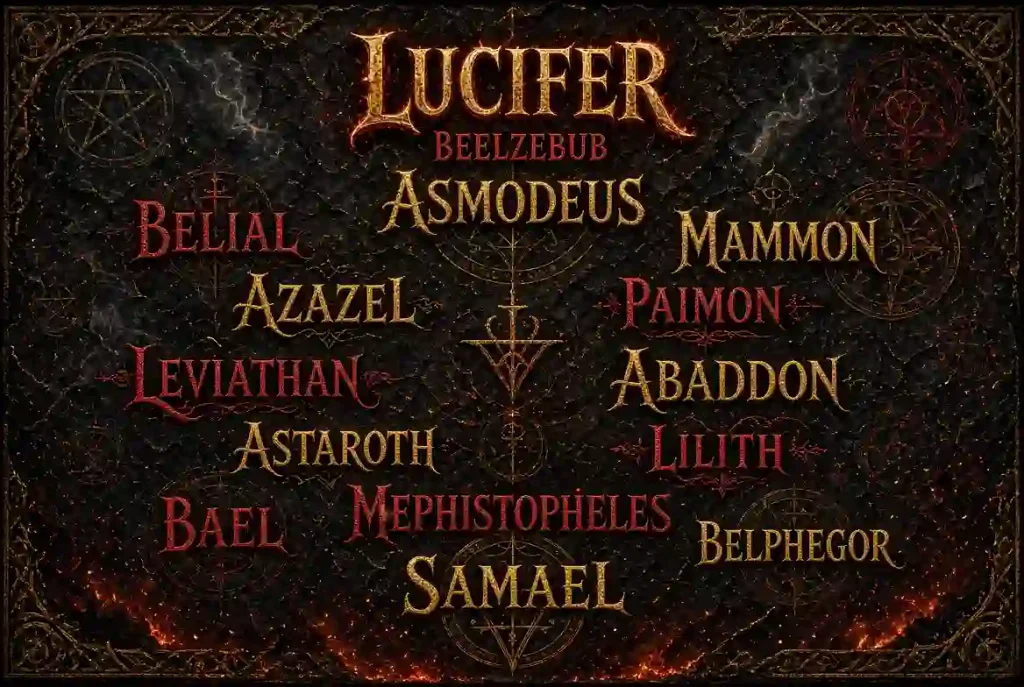
Demon names come from many different sources, including religious literature, ancient mythology, folklore, historical grimoires, and modern fantasy. Names such as Lucifer, Lilith, Asmodeus, and Abaddon have established literary or religious associations. Other names, such as Vexara and Malzorath, are creative inventions suited to fictional characters.
This guide brings together 100 demon-name ideas, with clear labels to distinguish documented supernatural figures from original fantasy suggestions. You will find names for powerful villains, mysterious spirits, female characters, male characters, horror stories, role-playing games, and fantasy worlds.
One important distinction: not every figure commonly called a demon began as one. Some names belong to gods, monsters, spirits, or adversarial figures whose roles changed across religious and cultural traditions. Where a name’s meaning is uncertain, it is better to say so than invent an explanation.
Famous Demon Names and Their Backgrounds
These names appear in religious literature, folklore, or historical demonological traditions. Their backgrounds and interpretations are not interchangeable.
| Name | Meaning or association | Background |
| 1. Abaddon | Destruction; associated with the realm of destruction | Hebrew Bible and Christian scripture |
| 2. Ahriman | Modern Persian form of Angra Mainyu | Zoroastrian tradition |
| 3. Angra Mainyu | Destructive or evil spirit | Zoroastrian tradition |
| 4. Asmodeus | Traditionally associated with a demon in the Book of Tobit | Jewish and Christian literature |
| 5. Azazel | Figure associated with the wilderness ritual in Leviticus; later interpretations vary | Biblical and later traditions |
| 6. Bael | Name recorded in European demonological literature | Ars Goetia |
| 7. Beelzebub | Traditionally rendered “lord of the flies” | Biblical literature and later demonology |
| 8. Belial | Associated with wickedness and later personified as a supernatural figure | Biblical and later traditions |
| 9. Belphegor | Name associated with a demon in later Christian tradition | European demonology |
| 10. Lilith | Derived from Akkadian lilitu, associated with the night | Ancient Near Eastern and Jewish traditions |
| 11. Lucifer | Latin for “light-bringer” | Latin literature and later Christian interpretation |
| 12. Mammon | Wealth or riches; later personified as greed | Biblical interpretation |
| 13. Samael | Complex figure in Jewish literature and later mystical traditions | Jewish tradition |
| 14. Satan | Adversary or accuser, depending on context | Biblical literature |
| 15. Astaroth | Name in later demonology, historically related to the name Astarte | Ancient Near Eastern religion and European demonology |
Important: These descriptions summarize associations, not universal definitions. For example, Lucifer’s Latin meaning is not “evil,” and Lilith’s history cannot be reduced to one story. The meanings and roles of these names should be checked against sources that distinguish etymology from later religious interpretation.
Male Demon Names
The following names are drawn from historical demonological catalogues and related literary traditions. Their inclusion does not establish the existence of supernatural beings.
| Name | Source or identification |
| 16. Aamon | Name in the Ars Goetia |
| 17. Agares | Name in the Ars Goetia |
| 18. Alloces | Name in the Ars Goetia |
| 19. Andras | Name in the Ars Goetia |
| 20. Andromalius | Name in the Ars Goetia |
| 21. Balam | Name in the Ars Goetia |
| 22. Barbatos | Name in the Ars Goetia |
| 23. Buer | Name in the Ars Goetia |
| 24. Caim | Name in the Ars Goetia |
| 25. Dantalion | Name in the Ars Goetia |
| 26. Forneus | Name in the Ars Goetia |
| 27. Furfur | Name in the Ars Goetia |
| 28. Gusion | Name in the Ars Goetia |
| 29. Malphas | Name in the Ars Goetia |
| 30. Marchosias | Name in the Ars Goetia |
| 31. Orobas | Name in the Ars Goetia |
| 32. Paimon | Name in the Ars Goetia |
| 33. Phenex | Name in the Ars Goetia |
| 34. Ronove | Name in the Ars Goetia |
| 35. Stolas | Name in the Ars Goetia |
The Ars Goetia is the first section of the Lesser Key of Solomon, an early modern grimoire that catalogues 72 spirits. Names and spellings may vary between editions.
These names work well for historical-fiction research, occult-inspired fantasy, and characters based on European demonological literature. If you want an accurate portrayal, consult a translation of the text rather than relying only on modern character descriptions.
Female Demon Names and Female Supernatural Figures
Some of these names belong to female figures described as demons in particular traditions. Others belong to monsters or supernatural beings that modern lists sometimes group under the same label.
| Name | Background |
| 36. Abyzou | Female demonic figure in Jewish and wider Mediterranean traditions |
| 37. Agrat bat Mahlat | Figure in Jewish demonological tradition |
| 38. Empusa | Supernatural female figure in Greek mythology |
| 39. Gello | Female spirit in Greek and later Byzantine folklore |
| 40. Lamia | Figure in Greek mythology, later associated with a monstrous female being |
| 41. Lamashtu | Mesopotamian female demon associated with dangers to mothers and infants |
| 42. Naamah | Figure appearing in Jewish literature and later traditions |
| 43. Eisheth Zenunim | Figure in later Jewish mystical and demonological literature |
| 44. Lilin | Term associated with Lilith and related spirits in some Jewish traditions |
| 45. Alecto | One of the Erinyes, or Furies, in Greek mythology |
These names have different histories. Lamashtu belongs to ancient Mesopotamian religion, while Empusa and Lamia are associated with Greek mythology. Alecto is one of the Furies, not simply a demon from a universal demonological system.
For fiction, these distinctions can help you create more thoughtful characters. A mythological monster, a spirit from religious literature, and a demon from a later European grimoire may have very different traditional roles.
Ancient Demon and Mythology Inspired Names
These names come from ancient religious and mythological settings. Their traditional identities should be preserved instead of automatically describing each figure as a demon.
| Name | Background and association |
| 46. Apep | Egyptian chaos serpent opposing the sun god Ra |
| 47. Pazuzu | Mesopotamian wind-associated supernatural figure, also connected with protective imagery |
| 48. Asag | Malevolent being in Sumerian literary tradition |
| 49. Aeshma | Figure associated with wrath in Zoroastrian tradition |
| 50. Nergal | Mesopotamian deity associated with war, plague, and the underworld |
| 51. Ereshkigal | Mesopotamian goddess of the underworld |
| 52. Tiamat | Primordial sea figure in the Babylonian creation epic |
| 53. Medusa | Gorgon from Greek mythology |
| 54. Scylla | Sea monster in Greek mythology |
| 55. Charybdis | Sea monster associated with a dangerous whirlpool in Greek mythology |
These figures offer different kinds of inspiration. Apep may suit a story about cosmic chaos, while Pazuzu can inspire a more complex supernatural character. Ereshkigal is a goddess, and Medusa is a Gorgon, so neither should automatically be described as a traditional demon.
A useful research rule is to identify the original source first, then explain how later writers or popular culture interpreted the figure.
Dark and Mysterious Fantasy Demon Names
The following names are original creative suggestions. They are not presented as ancient names, verified etymologies, or historical religious figures.
| Name | Suggested character role |
| 56. Varketh | Ancient demon ruler |
| 57. Malzorath | Powerful final antagonist |
| 58. Nethrul | Shadow creature |
| 59. Dreadvorn | Destroyer in a dark fantasy world |
| 60. Ashmourne | Cursed wanderer |
| 61. Voidrath | Cosmic horror character |
| 62. Kharzun | Guardian of forbidden ruins |
| 63. Vorzakar | Ruthless warlord |
| 64. Tharvex | Battlefield commander |
| 65. Drazhul | Brutal supernatural enemy |
| 66. Nethraz | Secretive assassin |
| 67. Morvath | Cursed knight |
| 68. Skathor | War demon |
| 69. Uldreth | Ancient guardian |
| 70. Zorvath | Powerful rival |
These suggestions gain their appeal from sound and style, not from historical meaning. For example, Varketh may suit an imposing ruler, while Nethrul may work for a creature that hides in darkness.
Treat the descriptions as creative guidance. They do not imply that the names have established linguistic meanings or traditional supernatural roles.
Unique Female Fantasy Demon Names
If you are writing about a female antagonist, a supernatural queen, or a mysterious sorceress, these invented names offer options without borrowing a documented figure’s identity.
| Name | Suggested character style |
| 71. Vexira | Clever and dangerous sorceress |
| 72. Morvena | Ancient shadow queen |
| 73. Drazira | Fearless warrior |
| 74. Nethira | Mysterious spirit |
| 75. Zorvella | Regal antagonist |
| 76. Ulzara | Powerful ruler |
| 77. Selvora | Enigmatic magical figure |
| 78. Nazrela | Secretive villain |
| 79. Vandira | Ambitious commander |
| 80. Malvera | Dark fantasy antagonist |
These are fictional naming ideas, not traditional female demon names. Their descriptions indicate possible character roles rather than meanings or personality traits established by their etymology.
To make a character feel original, give her a motive beyond simply being evil. She might guard a forgotten city, seek revenge for a betrayal, or protect a world that humans misunderstand. A distinctive motivation often makes a character more memorable than a frightening name alone.
Cute but Creepy Demon Names
Cute or playful names are useful for small fantasy creatures, game companions, cartoon villains, and mischievous imps.
| Name | Suggested use |
| 81. Impkin | Tiny mischievous creature |
| 82. Niblet | Small troublemaker |
| 83. Hexie | Playful magical character |
| 84. Grimsy | Cute creature with a gloomy side |
| 85. Duskle | Quiet shadow companion |
| 86. Emberbit | Small fire-themed creature |
| 87. Spooklet | Friendly spooky character |
| 88. Vexie | Clever little imp |
| 89. Cinderboo | Cute creature with a dark theme |
| 90. Gloomlet | Small creature from a shadowy world |
All ten are original suggestions. None should be assigned a traditional meaning or cultural origin without independent evidence.
A contrast between name and personality can also make a character fun. Cinderboo might look frightening but protect lost travelers, while Grimsby might be a cheerful creature living in an abandoned castle.
More Original Demon Names for Games and Stories
These final ten suggestions are suitable for role-playing games, fantasy novels, horror projects, and original worldbuilding.
| Name | Suggested role |
| 91. Orveth | Forgotten spirit |
| 92. Zorvath | Rival warlord |
| 93. Ravzun | Aggressive creature |
| 94. Vorleth | Quiet manipulator |
| 95. Ygrael | Supernatural judge |
| 96. Kazmoreth | Ancient ruler |
| 97. Vandreth | Wandering antagonist |
| 98. Belzor | Dark warrior |
| 99. Drazel | Rival fighter |
| 100. Khavra | Mysterious fantasy figure |
These names are invented. Their proposed roles are optional creative interpretations, not historical facts.
If you want a consistent naming system for your fictional world, establish a few rules. For example, rulers might have longer ceremonial names, while lesser creatures use short names. You could also give characters titles based on their actions, territories, or reputations.
15 Best Names for Demons
Here is a shortlist that combines documented traditional names with original suggestions. The labels explain why each might suit a particular purpose.
- Lucifer: A recognizable name with a complex history in Latin literature and Christian tradition.
- Lilith: A historically significant figure whose portrayal changes across traditions.
- Asmodeus: A well-known figure in Jewish and Christian literature.
- Abaddon: A strong choice for a character associated with destruction.
- Ahriman: Suitable for research or fiction inspired by Zoroastrian tradition.
- Pazuzu: An interesting choice for a character inspired by Mesopotamian religion.
- Lamashtu: A historically grounded female supernatural figure from Mesopotamia.
- Malphas: A name recorded in Ars Goetia.
- Paimon: Another recognizable name from Ars Goetia.
- Apep: A strong mythology-inspired option associated with chaos.
- Varketh: An original name for an imposing fictional ruler.
- Nethrul: An original name for a shadow creature.
- Vexira: An original suggestion for a female fantasy antagonist.
- Cinderboo: An original playful name for a small supernatural character.
- Malzorath: An original name for a major fantasy villain.
There is no objective ranking of the best demon names. The right choice depends on whether you value historical context, recognizable literary associations, ease of pronunciation, or creative freedom.
How to Choose a Demon Name
Before choosing a name, consider these five factors.
1. Decide whether you need a traditional or invented name. Historical names carry existing associations, while original names let you build your own mythology.
2. Research the source. If a name comes from a religious text, folklore, or ancient mythology, understand the context before using it.
3. Check the meaning carefully. Separate literal etymology from symbolic associations and later interpretations.
4. Match the name to the character. A short name may suit a mischievous imp, while a longer name may fit a fictional ruler. This is a creative preference, not a historical naming rule.
5. Keep your naming system consistent. Repeated sounds, naming conventions, and titles can help readers understand your fictional world.
Frequently Asked Questions
What are the most famous demon names?
Lucifer, Satan, Beelzebub, Asmodeus, Belial, Abaddon, Azazel, Lilith, and Mammon are among the best-known names associated with demonology and religious literature. Their meanings and roles differ across sources.
What are some female demon names?
Lilith, Abyzou, Lamashtu, Naamah, Empusa, Lamia, and Gello are associated with female supernatural figures in different traditions. Vexira, Morvena, and Nethira are invented alternatives for fictional characters.
What are some male demon names?
Aamon, Agares, Balam, Malphas, Orobas, Paimon, and Stolas appear in Ars Goetia. Lucifer, Asmodeus, and Abaddon are also recognizable names from religious or demonological literature, although they are not ordinary personal names in their original contexts.
What is a powerful name for a demon king?
Lucifer, Asmodeus, and Paimon have established literary or demonological associations that may suit a powerful fictional antagonist. Varketh and Malzorath are original alternatives if you want to create your own character.
Are all demon names from the Bible?
No. Names associated with demons and supernatural beings appear in biblical literature, Jewish and Christian traditions, ancient Mesopotamian texts, Zoroastrian literature, European grimoires, folklore, and modern fiction. These sources describe different kinds of beings.
Do demon names have real meanings?
Some names have documented linguistic meanings or etymologies. Others have uncertain origins, while many modern fantasy names are invented. A character’s symbolic role should not be confused with a word’s literal meaning.
Can I invent my own demon name?
Yes. For fiction, gaming, and worldbuilding, you can create a name based on your preferred sound, character role, and fictional culture. Label it as invented rather than claiming it comes from an ancient language.
Are demons and mythological monsters the same?
Not necessarily. The terms depend on the religious or cultural context. A figure described as a demon in one tradition may be understood as a god, spirit, monster, or adversarial figure in another. Researching the original source helps preserve these distinctions.
Final Thoughts
The best names for demons depend on the story you want to tell. Traditional names such as Lilith, Asmodeus, Abaddon, and Pazuzu offer connections to specific religious or mythological histories. Original suggestions such as Varketh, Vexira, and Malzorath provide more freedom for fantasy characters.
Before choosing a name, consider its source, meaning, and cultural associations. A historically grounded name can add depth to a character, while an invented name can help establish a unique fictional world. The strongest choice is one that fits your purpose and gives you a clear, honest foundation for the character you create.
Suggested Research References
- Behind the Name: https://www.behindthename.com/names/tag/demons
- Names.org, Demon Names: https://www.names.org/name-lists/demon-names/
- Fantasy Name Builder, Demon Names: https://www.fantasynamebuilder.com/demon-names/
- Facts.net, Female Demon Names: https://facts.net/female-demon-names/

PressoraMedia is a content platform dedicated to helping readers find the right words, names, meanings, and ideas for everyday use. Our content focuses on names, name meanings, naming inspiration, and useful language-related information in a simple and easy-to-understand format. At Pressora Media, we believe that choosing a name is more than simply finding a word. A name can carry meaning, personality, culture, and a special story. That is why we research names carefully and create helpful guides designed to make the naming process easier. Our authors and contributors focus on providing clear explanations, useful name suggestions, meanings, origins, pronunciations, and practical naming ideas. We aim to keep our content informative, reader-friendly, and genuinely useful. Whether you are searching for a meaningful name, exploring the origin of a name, looking for unique naming ideas, or simply curious about the meaning behind a word or name, Pressora Media is here to help.
Pressora Media Team
Helping you find the right name, meaning, and words.