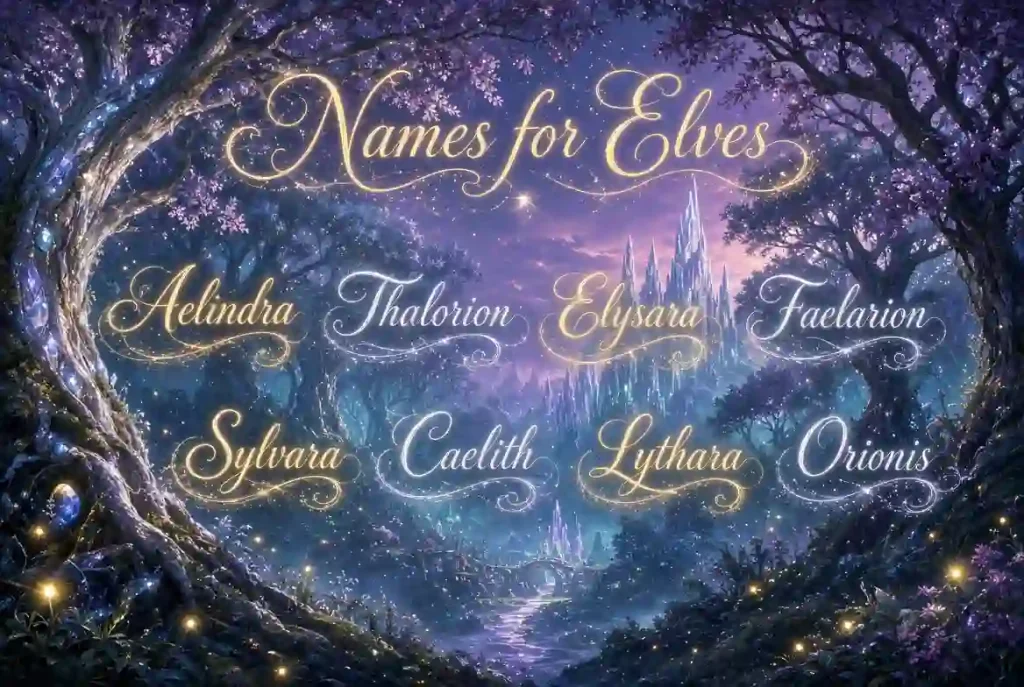
Names for elves can reflect ancient magic, woodland life, noble families, mysterious kingdoms, or a character’s role in a fantasy adventure. Whether you are naming a Dungeons & Dragons character, writing a fantasy novel, or creating a gaming avatar, the right name should fit your character and the world they inhabit.
Some elf names come from established fictional settings, including J.R.R. Tolkien’s Middle-earth and Dungeons & Dragons. Others are original creative suggestions made for fantasy storytelling. Understanding the difference matters because a documented name may have a known history or meaning, while a newly invented name may have neither.
This guide includes male and female elf names, short options, woodland names, dark elf suggestions, famous literary names, and fantasy family names. It also explains the difference between a name’s literal meaning and the qualities it suggests.
1. Male Elf Names
These male-associated names appear in the published Dungeons & Dragons elf naming list or Tolkien’s fictional world. Gender labels describe the relevant fictional convention rather than a universal rule.
- Adran: An established D&D adult elf name.
- Aelar: A D&D adult elf name suitable for a ranger or adventurer.
- Aramil: A published D&D name for a character in a fantasy campaign.
- Arannis: An established adult elf name in D&D.
- Aust: A short D&D adult elf name.
- Beiro: A published D&D elf name.
- Berrian: An established D&D adult elf name.
- Carric: A D&D name suitable for a player character.
- Enialis: A published D&D adult elf name.
- Erdan: An established D&D elf name.
- Erevan: A published adult elf name in D&D.
- Galinndan: A D&D elf name with a longer, distinctive sound.
- Hadarai: An established D&D adult elf name.
- Heian: A short D&D elf name.
- Himo: A compact option from the D&D list.
- Immeral: An established adult elf name in D&D.
- Ivellios: A longer D&D elf name for a fantasy character.
- Laucian: A published D&D name suited to a woodland character.
- Mindartis: An established D&D adult elf name.
- Paelias: A published adult elf name.
- Peren: A short D&D elf name.
- Quarion: An established D&D name with a flowing sound.
- Riardon: A published adult elf name.
- Rolen: A concise D&D elf name.
- Soveliss: An established D&D adult elf name.
- Thamior: A published D&D elf name.
- Theren: An established adult elf name.
- Varis: A short, memorable D&D elf name.
- Legolas: Tolkien’s Woodland Elf, whose name is associated with “Greenleaf.”
- Elrond: Tolkien’s Half-elven lord of Rivendell.
- Celeborn: Tolkien’s elven lord associated with Lothlórien.
- Glorfindel: A heroic elf in Tolkien’s legendarium.
The first 28 names come from the published D&D adult-name list. The final four are established Tolkien characters. The name meanings of the Tolkien examples should be checked individually rather than inferred from their sound. Legolas, for example, has a documented connection to “Greenleaf.” Source: D&D Basic Rules and Tolkien Gateway’s Legolas entry.
2. Female Elf Names
These names appear in the published D&D adult elf-name list or Tolkien’s legendarium. They can suit queens, scholars, healers, warriors, and other fantasy characters.
- Adrie: A published D&D adult elf name.
- Althaea: An established D&D elf name.
- Anastrianna: A longer name from the D&D list.
- Andraste: A published D&D adult elf name.
- Antinua: An established D&D name.
- Bethrynna: A longer D&D elf name.
- Birel: A short published D&D name.
- Caelynn: An established adult elf name in D&D.
- Drusilia: A published D&D elf name.
- Enna: A short option from the D&D list.
- Felosial: An established D&D adult elf name.
- Ielenia: A published D&D elf name.
- Jelenneth: An established D&D name.
- Keyleth: A D&D name also associated with a character from Critical Role.
- Leshanna: A published D&D adult elf name.
- Mialee: An established name from D&D.
- Naivara: A published adult elf name.
- Quelenna: An established D&D elf name.
- Sariel: A published D&D adult elf name.
- Shanairra: An established D&D name.
- Shava: A short name from the D&D list.
- Silaqui: A published adult elf name.
- Theirastra: An established D&D elf name.
- Vadania: A published adult elf name.
- Valanthe: An established D&D name.
- Xanaphia: A longer D&D elf name.
- Galadriel: Tolkien’s elven leader, whose name means “maiden crowned with a radiant garland.”
- Arwen: Tolkien’s Half-elven character, commonly translated as “noble maiden.”
- Lúthien: A legendary elven figure in Tolkien’s mythology.
- Tauriel: An elf character created for Peter Jackson’s Hobbit film adaptations, not a character in Tolkien’s original novel.
These are fictional-setting names, not a list of verified popular baby names. Galadriel’s documented meaning comes from Tolkien’s constructed language, Sindarin. Sources: D&D Basic Rules and Tolkien Gateway’s Galadriel entry.
3. Short Elf Names
Short names are useful for games, dialogue, character sheets, and stories with large casts. The examples below come from the D&D child-name list.
- Ara: Brief and simple.
- Bryn: Compact and memorable.
- Del: A one-syllable option.
- Eryn: A short D&D child name.
- Faen: A concise fantasy name.
- Innil: A distinctive short option.
- Lael: A compact name.
- Mella: A gentle-sounding choice.
- Naill: A short published name.
- Naeris: A slightly more elaborate option.
- Phann: A distinctive D&D child name.
- Rael: Brief and easy to remember.
- Rinn: A compact choice.
- Sai: A very short option.
- Sylli: A name from the D&D child-name list.
- Thia: A short published name.
- Vall: A concise option.
These are classified as child names in D&D. You can use them for characters of any age in your own setting, but that is a creative decision rather than proof that each is a universal unisex personal name.
4. Famous Elf Names From Tolkien’s World
Tolkien’s elves belong to a detailed fictional history with its own languages, peoples, and naming traditions. These established names are useful if you want your character to draw inspiration from Middle-earth.
- Galadriel: An elven leader associated with Lothlórien. Her name has a documented Sindarin meaning.
- Arwen: Elrond’s daughter, known as the Evenstar.
- Elrond: The lord of Rivendell and a Half-elven character.
- Legolas: A Woodland Elf and member of the Fellowship of the Ring.
- Celeborn: Galadriel’s husband and co-ruler of Lothlórien.
- Lúthien: A legendary elf whose story centers on Beren.
- Glorfindel: A heroic figure in Tolkien’s legendarium.
- Thranduil: The king of the Woodland Realm in The Hobbit.
- Fëanor: A Noldorin elf known for his extraordinary craftsmanship.
- Fingolfin: A prominent Noldorin leader in Tolkien’s mythology.
These are character names, not interchangeable examples of one generic elvish language. Tolkien developed languages such as Quenya and Sindarin over many years, and names need to be examined within their linguistic and historical context. See the Tolkien Estate’s introduction to Tolkien’s invented languages.
5. Woodland Elf Names
Woodland characters often have roles connected to forests, wildlife, tracking, and protection of their home. A name can support that theme without claiming a literal natural meaning.
Established fantasy names
- Legolas: A documented Tolkien name associated with “Greenleaf.”
- Laucian: An established D&D adult elf name.
- Soveliss: A published D&D elf name.
- Thamior: An established D&D name.
- Eryn: A D&D child name that can suit a young woodland character.
Original creative suggestions
- Mosswhisper: Suggests quiet movement through a mossy forest.
- Fernshade: Works for a hidden woodland ranger.
- Willowmere: A possible name for a forest village or elf.
- Oakenshade: Suits an ancient tree guardian.
- Briarwind: Suggests a swift forest scout.
- Dewfern: A gentle nature-inspired option.
- Thornvale: Could suit a secluded forest kingdom.
- Silverbough: A possible name for a tree-dwelling family.
- Leafwarden: A descriptive title or character name.
- Greenhollow: Works especially well as a settlement or family name.
The creative examples are English-language inventions. They do not have verified meanings in Sindarin, Quenya, or D&D’s fictional cultures.
6. Dark Elf Names
Dark elves vary between fictional worlds. Dungeons & Dragons uses the term drow for a particular kind of elf, but other fantasy settings have different histories and naming customs. A dark elf can be a healer, scholar, diplomat, ruler, or villain. The name does not have to determine the character’s morality.
Here are original creative suggestions for a mysterious or underground setting:
- Zareth: A possible name for a strategist.
- Veyra: A concise choice for a mage or scout.
- Nythra: Suits a secretive underground character.
- Draeven: A strong-sounding option for a warrior.
- Velthira: Could suit a noble or ruler.
- Morveth: Suggests a grim guardian.
- Zynara: A dramatic name for a magical character.
- Vaelith: Works for a quiet scout.
- Thessara: A possible name for a scholar or ruler.
- Nyxara: A night-inspired creative suggestion.
These names are not documented drow names or verified words in an established elvish language. Their descriptions convey an intended fictional mood, not literal meanings.
7. Elegant and Royal Elf Names
If your character belongs to a royal family or an ancient court, choose a name that fits the setting’s tone.
- Galadriel: A strong option for a powerful leader, supported by Tolkien’s established lore.
- Arwen: A familiar literary choice for a noble heroine.
- Elrond: A suitable inspiration for a wise ruler or mentor.
- Celeborn: Works for a character connected to an ancient elven court.
- Anastrianna: A published D&D adult elf name with a formal sound.
- Aramil: An established D&D name suitable for a court mage or noble.
- Caelynn: A published D&D name that can fit a royal character.
- Theren: A D&D name that can suit a ranger or noble adventurer.
For an original royal character, consider Silverthorn, Mooncrest, Starvale, or Evershade. These are invented English fantasy compounds, not traditional elvish names with established etymologies.
8. Elf Family Names and Their Meanings
Family names can give a character a stronger identity and help connect individual characters to a fictional family or clan. D&D’s published elf naming list provides examples with English translations.
| Family name | Published translation |
| Amakiir | Gemflower |
| Amastacia | Starflower |
| Galanodel | Moonwhisper |
| Holimion | Diamonddew |
| Ilphelkiir | Gemblossom |
| Liadon | Silverfrond |
| Meliamne | Oakenheel |
| Naïlo | Nightbreeze |
| Siannodel | Moonbrook |
| Xiloscient | Goldpetal |
These translations are presented in the D&D naming material. They should not automatically be treated as Tolkien Elvish or as real-world personal-name meanings. Source: D&D Basic Rules.
9. Unique Elf Names for Original Characters
If you want a name that does not immediately point to an existing character, an original creation may be the better choice. The following suggestions are invented for this guide.
- Aurelvyn: An elegant name for a scholar or royal adviser.
- Thornelith: A possible name for a forest guardian.
- Vaeloria: A formal-sounding option for a queen or mage.
- Duskryn: A short name for a night scout or exile.
- Elarith: A possible name for an adventurer.
- Sylvarin: A nature-inspired creative choice.
- Moonvale: Works for a settlement or family.
- Aethrien: A possible name for an ancient mage.
- Virelith: A distinctive option for a mysterious character.
- Nimoriel: A lyrical creative name.
- Lethwyn: A short fantasy suggestion.
- Starwhisper: A possible name for a seer or magical character.
- Silvermere: Suits a place, family, or noble character.
- Everwynn: An invented name with a gentle sound.
- Frostwillow: A nature-inspired option for a winter kingdom.
- Emberhollow: Could suit a volcanic settlement or family.
- Dawnspire: Works well as a city or tower name.
- Mistbloom: A possible name for a healer or forest dweller.
- Ravenmere: Suggests a mysterious location or family.
- Duskleaf: A possible woodland or night-themed name.
These are creative suggestions, not verified names from Tolkien, D&D, or a historical elvish language. No literal meanings are claimed.
10. How to Choose the Right Elf Name
Use these five steps to find a name that fits your character.
Choose the setting. If you are playing D&D, the published naming lists are a useful starting point. If your character belongs to Tolkien’s Middle-earth, check the relevant fictional language and lore.
Match the role. A ranger might suit a woodland-themed name. A ruler may need a more formal name, while a quick-moving game character may benefit from something short.
Check the meaning. Do not assume a name means “moon,” “star,” or “forest” just because it sounds magical. Use a documented translation when one exists.
Test pronunciation. Say the name aloud and check that you can use it comfortably in dialogue. Do not guess the pronunciation of an unfamiliar name if a reliable source is available.
Consider a family name. A personal name and family name can make a character feel connected to a larger world. If you invent a family-name system, keep it consistent within your own setting.
11. The 15 Best Names for Elves
These are editorial recommendations based on recognizability, usability, and the type of fantasy character they may suit.
| Name | Best use | Why choose it |
| Legolas | Woodland archer | Recognizable Tolkien character |
| Galadriel | Queen or leader | Established character with documented name meaning |
| Arwen | Noble heroine | Familiar Tolkien name |
| Elrond | Ruler or mentor | Strong connection to Rivendell |
| Lúthien | Legendary heroine | Important Tolkien mythological figure |
| Aelar | D&D adventurer | Published adult elf name |
| Sariel | D&D character | Published adult elf name |
| Eryn | Young elf | Short D&D child name |
| Theren | Ranger or traveler | Published adult elf name |
| Varis | Short character name | Easy to remember |
| Celeborn | Noble character | Established Tolkien figure |
| Glorfindel | Heroic character | Literary history and heroic associations |
| Briarwind | Original woodland character | Clear nature-inspired style |
| Vaeloria | Original royal character | Formal fantasy sound |
| Duskryn | Original dark-elf character | Short, mysterious style |
The final three are original suggestions. The others come from published D&D naming material or Tolkien’s fiction. This is a curated list, not a popularity ranking.
Frequently Asked Questions
What are good names for elves?
Legolas, Galadriel, Arwen, Elrond, Aelar, Sariel, and Theren are good starting points. Tolkien’s names suit readers who want a connection to Middle-earth, while D&D names work well for tabletop campaigns. If you want a name that feels more personal, consider an original suggestion such as Briarwind or Vaeloria, without assigning it an unsupported historical meaning.
What are the best female elf names?
Galadriel, Arwen, Lúthien, Adrie, Caelynn, Sariel, and Naivara offer several styles. The first three are connected to Tolkien’s fictional world, while the D&D names come from its published adult elf-name list. Their inclusion reflects fictional usage, not verified real-world baby-name popularity.
What are the best male elf names?
Legolas, Elrond, Celeborn, Glorfindel, Aelar, Aramil, Theren, and Varis are useful choices. The Tolkien names have established character associations, while the D&D examples listed adult elf names. Choose based on the character’s role and setting rather than assuming every name has a literal meaning.
Are elf names gender-neutral?
Some can be used creatively for characters of any gender. D&D lists Ara, Bryn, Eryn, Faen, Rael, Rinn, and Sai among its child names. That category does not establish universal real-world gender-neutral usage. If you are creating your own fantasy world, you can define your own gender conventions.
What are good dark elf names?
For original characters, Veyra, Nythra, Duskryn, Vaelith, and Morveth are possible choices. They are invented suggestions, not verified names from D&D’s drow lore or a constructed elvish language. If you want an established setting, consult that world’s published naming material.
Do elf names have meanings?
Some have documented meanings within fictional languages or naming systems. Legolas is associated with “Greenleaf” in Tolkien’s legendarium, while D&D lists translated family names such as Amakiir (“Gemflower”). Other names are character names or original inventions with no established etymology. Always distinguish a documented translation from an interpretation.
How can I create a unique elf name?
Start with the character’s setting, role, and preferred sound. Decide whether you want to follow an existing fictional naming system or invent one. Test spelling and pronunciation, and check whether the name already belongs to a well-known character. If you combine English words, label the result as an original fantasy name rather than authentic Sindarin or Quenya.
Conclusion
The best names for elves fit the character and the fictional world. Legolas, Galadriel, Arwen, and Elrond offer established Tolkien connections, while Aelar, Sariel, and Theren provide options from Dungeons & Dragons. Short choices such as Eryn and Faen work well when you want something memorable.
For original characters, names such as Briarwind, Vaeloria, and Duskryn offer creative freedom. Their value lies in the atmosphere they suggest, not in a historical meaning that has not been documented.
Before settling on a name, consider its pronunciation, source, and role in your story. If the character belongs to an established fictional setting, follow that setting’s naming conventions. If you are building your own world, create a consistent system and explain its meanings honestly. A name that fits your character will be more useful than one chosen only because it sounds magical.

PressoraMedia is a content platform dedicated to helping readers find the right words, names, meanings, and ideas for everyday use. Our content focuses on names, name meanings, naming inspiration, and useful language-related information in a simple and easy-to-understand format. At Pressora Media, we believe that choosing a name is more than simply finding a word. A name can carry meaning, personality, culture, and a special story. That is why we research names carefully and create helpful guides designed to make the naming process easier. Our authors and contributors focus on providing clear explanations, useful name suggestions, meanings, origins, pronunciations, and practical naming ideas. We aim to keep our content informative, reader-friendly, and genuinely useful. Whether you are searching for a meaningful name, exploring the origin of a name, looking for unique naming ideas, or simply curious about the meaning behind a word or name, Pressora Media is here to help.
Pressora Media Team
Helping you find the right name, meaning, and words.