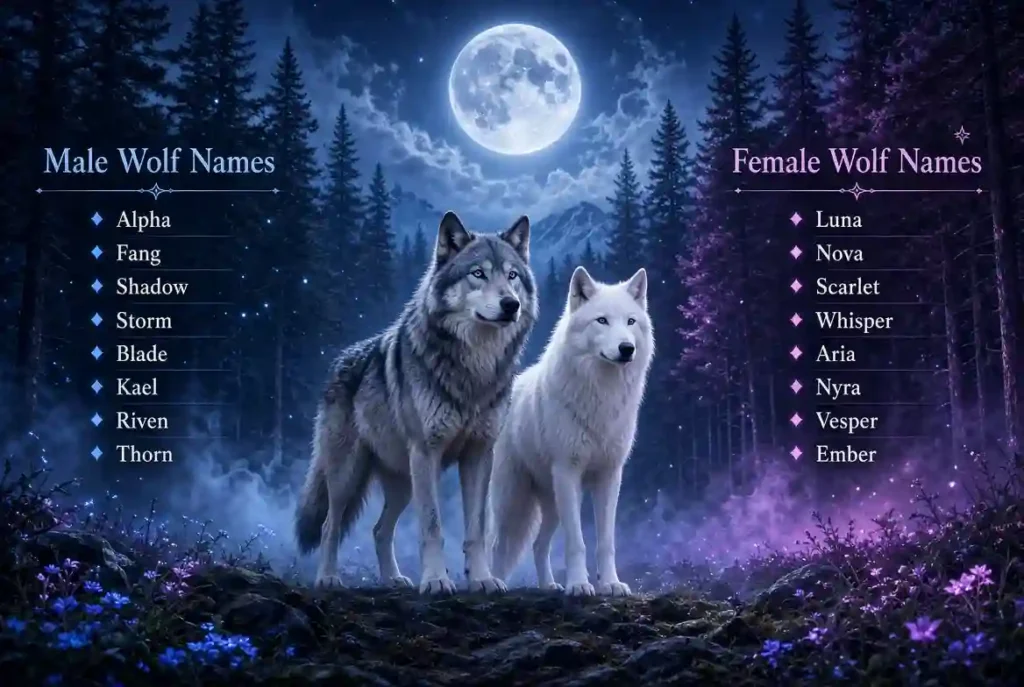

If you need names for male or female wolves, you have two good directions: choose a documented name that literally means wolf, or choose a name inspired by a wolf’s appearance, behavior, mythology, or wild setting.
The difference matters. Ulf really comes from an Old Norse word meaning “wolf,” while Fenrir is the name of a famous wolf in Norse mythology. Shadow and Storm, on the other hand, are descriptive names that simply suit a wolf’s image. They are all useful choices, but they are not the same kind of name.
This guide separates those categories so you can choose with confidence. You will find documented male and female names connected directly to wolves, historical Germanic names containing the wolf element, mythological wolf names, nature-inspired choices, and practical names for a real wolf, wolf-like dog, fictional character, or gaming character. Where a name’s connection is indirect, that is clearly stated rather than presented as a literal meaning.
Names That Literally Mean “Wolf”
If your main goal is a name whose documented meaning is actually wolf, start with this group. Specialist name references identify several established names with this meaning, including Amaruq, Ulf, Varg, Vuk, Valko, Wolf, Zeev and others.
Ulf
Meaning: “Wolf”
Origin: Old Norse
Usage: Swedish, Norwegian, Danish, German
Gender: Masculine
Pronunciation: OOLF
Ulf comes from the Old Norse byname Úlfr, meaning “wolf.” It is one of the simplest genuine wolf names because the connection is direct rather than symbolic.
Amaruq
Meaning: “Wolf”
Origin: Inuktitut
Gender: Masculine
Amaruq is a documented Inuktitut name meaning wolf. It is a strong choice if you specifically want a culturally rooted name rather than an English word.
Zeev
Meaning: “Wolf”
Origin: Hebrew
Gender: Masculine
Pronunciation: ZEV or zeh-EHV
Zeev is the English transliteration of the Hebrew name זְאֵב. The spelling Zev is also used. Both forms connect directly to the Hebrew word for wolf.
Zev
Meaning: “Wolf”
Origin: Hebrew
Gender: Masculine
Pronunciation: ZEV
Zev is a shorter English-friendly spelling of Zeev. It is particularly useful if you want a wolf name that is easy to say and spell.
Varg
Meaning: “Wolf”
Origin: Old Norse
Usage: Norwegian, Swedish
Gender: Masculine
Pronunciation: VARG
Varg has a strong Scandinavian sound and a direct wolf meaning. Behind the Name lists it as a rare Norwegian and Swedish name derived from Old Norse.
Vuk
Meaning: “Wolf”
Origin: Serbian
Gender: Masculine
Pronunciation: VOOK
Vuk is a Serbian masculine name whose meaning is directly “wolf.” It is one of the clearest Slavic choices for this theme.
Valko
Meaning: “Wolf”
Origin: Bulgarian
Gender: Masculine
Pronunciation: VAL-koh
Valko comes from Bulgarian вълк, meaning “wolf.” It gives you a less familiar European alternative to Ulf or Wolf.
Wolf
Meaning: “Wolf”
Origin: Germanic; also used as a German, Yiddish and rare English name
Gender: Masculine
Wolf can be an independent word-based name, and it also functions as a short form of longer Germanic names containing the wolf element.
Loup
Meaning: “Wolf”
Origin: French, from Latin lupus
Gender: Masculine
Pronunciation: LOO
Loup is a documented French form connected to the Latin wolf name Lupus.
Lupus
Meaning: “Wolf”
Origin: Latin
Gender: Masculine
Pronunciation: LOO-pus
Lupus was an Ancient Roman personal name derived from the Latin word for wolf. It is a particularly good choice for a historical or Roman-themed character.
Lycus
Meaning: “Wolf”
Origin: Ancient Greek
Gender: Masculine
Pronunciation: LIE-kus
Lycus is the Latinized form of Ancient Greek Lykos, meaning “wolf.” It was also borne by several figures in Greek mythology.
Lykos
Meaning: “Wolf”
Origin: Ancient Greek
Gender: Masculine
Pronunciation: LEE-kos
Lykos is the original Greek form behind Lycus. It works especially well for a Greek mythology-inspired character.
Velvel
Meaning: “Little wolf”
Origin: Yiddish
Gender: Masculine
Velvel is a Yiddish name connected with volf, “wolf.” It is a diminutive rather than simply another translation of the word.
Farkas
Meaning: “Wolf”
Origin: Hungarian
Gender: Masculine
Pronunciation: FAR-kash
Farkas is a Hungarian personal name derived from the Hungarian word for wolf. It is an excellent option for a character with a Hungarian setting.
Female Wolf Names With a Genuine Wolf Connection
There are fewer well-documented feminine personal names that literally mean “wolf.” That is an important point often lost in giant online lists.
Ylva
Meaning: “She-wolf”
Origin: Old Norse
Usage: Swedish, Norwegian
Gender: Feminine
Pronunciation: IL-vah
Ylva is one of the strongest choices for a female wolf because its documented meaning is specifically “she-wolf.” It is derived from Old Norse úlfr, “wolf.”
Ylfa
Meaning: Feminine form related to Ylva
Origin: Icelandic
Gender: Feminine
Pronunciation: IL-vah
Ylfa is the Icelandic form of Ylva.
Wulfrun
Meaning: “Wolf” + “secret lore/rune”
Origin: Old English
Gender: Feminine
Pronunciation: WOOLF-roon
Wulfrun is a genuine historical Anglo-Saxon name. It was borne by a 10th-century English noblewoman associated with the foundation of Wolverhampton.
Wulfgifu
Meaning: “Wolf” + “gift”
Origin: Old English
Gender: Feminine
Wulfgifu is an authentic Anglo-Saxon compound containing the Old English element wulf, “wolf,” and giefu, “gift.”
Wulfþryð
Meaning: “Wolf” + “strength”
Origin: Old English
Gender: Feminine
Wulfþryð is a historical feminine name. Its second element means “strength,” giving the complete name a particularly powerful feel. It was borne by a ninth-century queen of Wessex.
Wulfthryth
Meaning: Variant of Wulfþryð
Origin: Old English
Gender: Feminine
Wulfthryth is a later form of Wulfþryð rather than a completely separate name.
Wulfwynn
Meaning: “Wolf” + “joy”
Origin: Old English
Gender: Feminine
Wulfwynn combines wulf, “wolf,” with wynn, “joy.” It is a genuine historical name and gives a softer alternative to harsher wolf names.
Wulfflæd
Meaning: “Wolf” + a second element possibly meaning “beauty”
Origin: Old English
Gender: Feminine
The second element has been interpreted cautiously, so this name should not be advertised as having a completely certain “wolf beauty” meaning. Its wolf element itself is clear.
Historical Male Names Containing the Wolf Element
Germanic and Old English naming traditions created many compounds with wolf/wulf. These are especially useful if you want a historical name rather than simply the word “Wolf.”
Wulfric
Meaning: “Wolf” + “ruler”
Origin: Old English
Gender: Masculine
Pronunciation: WOOLF-rik
Wulfric is one of the strongest historical choices because its two elements give it a clear wolf-and-rulership connection.
Wulfstan
Meaning: “Wolf” + “stone”
Origin: Old English
Gender: Masculine
Wulfstan has an unmistakably Anglo-Saxon feel. It is a documented historical name, not a modern wolf-name invention.
Wulfsige
Meaning: “Wolf” + “victory”
Origin: Old English
Gender: Masculine
Wulfsige combines the wolf element with sige, “victory.”
Wolfgang
Meaning: Wolf + a second element associated with a path or journey
Origin: Germanic
Gender: Masculine
Pronunciation: WULF-gahng
Wolfgang is a genuine Germanic personal name. It should not be described simply as “son of the wolf,” a claim that appears frequently in generic wolf-name articles.
Wolfram
Meaning: “Wolf” + “raven”
Origin: Germanic
Gender: Masculine
Pronunciation: WOLF-rahm
Wolfram combines two animal elements, wolf and raven, making it especially attractive for a dark or wilderness-themed character.
Wolfhard
Meaning: “Wolf” + an element associated with firmness or bravery
Origin: Germanic
Gender: Masculine
Wolfhard is another genuine Germanic compound containing the wolf element.
Arnulf
Meaning: “Eagle” + “wolf”
Origin: Germanic
Gender: Masculine
Arnulf combines two powerful animal images. The name was historically borne by saints and rulers.
Rudolf
Meaning: “Fame” + “wolf”
Origin: Germanic
Gender: Masculine
Rudolf developed from a Germanic compound containing the wolf element. It is a better choice for historical depth than using an invented “wolf meaning.”
Randolph
Meaning: Germanic wolf compound traditionally associated with a shield + wolf
Origin: Germanic/English
Gender: Masculine
Randolph is a later form within a Germanic family of names containing the wolf element.
Ráðúlfr
Meaning: Counsel + wolf
Origin: Old Norse
Gender: Masculine
This is an Old Norse historical form that belongs to the same broad wolf-name family as later Ralph-type names.
Mythological Wolf Names
Mythological names should be kept separate from names that literally mean “wolf.” Their value comes from the story attached to the name.
Fenrir
Connection: Famous wolf in Norse mythology
Gender: Mythological male figure
Pronunciation: FEN-rir
Fenrir is probably the most recognizable mythological wolf name. He is a monstrous wolf in Norse mythology and is particularly suitable for fantasy characters, games and stories.
Hati
Meaning: “Hater” or “despiser”
Connection: Norse mythological wolf
Gender: Traditionally male in the myth
Hati is not a word meaning wolf. In Norse mythology, Hati is the wolf who pursues the moon. The distinction is important because the name’s own meaning and its character’s identity are two different things.
Skoll
Connection: Norse mythology
Gender: Mythological male wolf
Skoll is traditionally the wolf associated with pursuing the sun. It makes a strong companion name to Haiti.
Lycus
Lycus deserves a second mention here because it is both a genuine personal name meaning “wolf” and a name borne by figures in Greek mythology. That gives it a rare combination of linguistic and mythological relevance.
Vidar
Connection: Norse mythology and Fenrir
Gender: Masculine
Pronunciation: VEE-dar
Vidar is not a wolf name in the literal sense. In Norse mythology, he is the son of Odin and is destined to kill Fenrir during Ragnarök. This makes Vidar a wolf-associated name, not a name meaning wolf.
Roman Wolf, Associated Names
Romulus
Connection: Roman legend
Gender: Masculine
Pronunciation: ROM-yoo-lus
Romulus is the legendary founder of Rome and twin brother of Remus. Roman legend says the twins were raised by a she-wolf. The name itself is associated with Rome rather than literally meaning wolf.
Remus
Connection: Roman legend
Gender: Masculine
Pronunciation: REE-mus
Remus is the twin brother of Romulus. His own name has an uncertain etymology, so it should not be presented as meaning “wolf.” His wolf connection comes from the Roman foundation legend.
Important correction: I would not use Accalia as a “Latin name meaning she-wolf.” That claim is not sufficiently reliable. The term is connected with Acca Larentia and the Roman festival called Accalia, and the “she-wolf” explanation is much less secure than popular baby-name sites suggest.
Short Wolf Names
If you need a name that is easy to call, remember, or use as a character name, these are strong options.
- Ulf — literal wolf meaning
- Zev — Hebrew, “wolf”
- Vuk — Serbian, “wolf”
- Varg — Old Norse, “wolf”
- Wolf — direct word name
- Loup — French, “wolf”
- Ash — nature-inspired
- Storm — weather-inspired
- Snow — winter-inspired
- Raven — bird-inspired
- Fang — descriptive/fictional
- Skoll — mythological
- Hati — mythological
- Ylva — “she-wolf”
For everyday use, Ulf, Zev, Vuk, Ash, Storm and Ylva are among the easiest.
Strong Names for Male Wolves
If the goal is a bold, commanding sound rather than a literal wolf meaning, consider:
- Wulfric
- Wulfstan
- Wulfsige
- Fenrir
- Varg
- Ulf
- Wolf
- Zev
- Vuk
- Arnulf
- Rudolf
- Wolfram
- Wolfhard
- Thor
- Odin
- Ragnar
- Gunnar
- Atlas
- Titan
- Storm
- Flint
- Thunder
- Shadow
- Ranger
- North
The first group has genuine historical or linguistic wolf connections. The second group is more about sound and imagery.
Female Names for Wolves
For a female wolf, these are especially strong:
- Ylva
- Ylfa
- Wulfrun
- Wulfgifu
- Wulfwynn
- Wulfþryð
- Wulfthryth
- Wulfflæd
- Luna
- Aurora
- Willow
- Raven
- Winter
- Snow
- Storm
- Ember
- Nova
- Shadow
- Skye
- Sage
- Frost
- Dawn
- Moon
- Mist
- Star
Ylva is the clearest choice if you specifically want a documented female name meaning “she-wolf.” The rest should generally be understood as nature, appearance, sound, or thematic choices rather than literal wolf meanings.
Unisex Wolf Names
For a wolf where you do not want the name tied to sex, try:
- Shadow
- Storm
- Snow
- Winter
- River
- Ash
- Raven
- Echo
- Frost
- Moon
- Sky
- North
- Flint
- Ember
- Onyx
- Silver
- Smoke
- Spirit
- Scout
- Aspen
- Cedar
- Sage
- Star
- Midnight
- Blizzard
These are mostly word, nature, color, or atmosphere names. Their appeal comes from the image they create, not from a claim that they mean “wolf.”
Names for a Black Wolf
For a black wolf or dark-coated wolf, descriptive names work particularly well:
- Shadow
- Onyx
- Raven
- Midnight
- Smoke
- Cinder
- Obsidian
- Dusk
- Night
- Storm
- Coal
- Sable
- Eclipse
- Ash
- Phantom
Best overall: Shadow
Best elegant choice: Onyx
Best fantasy choice: Fenrir
Best short choice: Ash
Names for a White or Arctic Wolf
For a white wolf, try:
- Snow
- Frost
- Ice
- Winter
- Glacier
- Blizzard
- Ivory
- Aurora
- Tundra
- Polar
- Moon
- Cloud
- Alpine
- Star
- Silver
These are visual or environmental associations. They do not literally mean “white wolf.”
Names for a Gray Wolf
Gray wolves can inspire names based on stone, weather, smoke and silver:
- Flint
- Slate
- Silver
- Steel
- Smoke
- Ash
- Storm
- Mist
- Shadow
- Stone
- Granite
- Cloud
- Rain
- River
- Frost
- Winter
- Onyx
- Raven
- North
- Tundra
Flint is especially good if you want a short, rugged name. Slate and Stone have a quieter feel.
Cute Wolf Pup Names
A young wolf does not need a fierce name. Short and playful choices can work better:
- Cub
- Ash
- Snow
- Luna
- Ylva
- Zev
- Echo
- Willow
- Ember
- Nova
- Moon
- Star
- Sky
- Mist
- Frost
- River
- Scout
- Sage
- Cloud
- Teddy
If you want the name itself to carry wolf meaning, Ylva, Ulf and Zev are better choices than simply choosing a cute word.
Names for a Fantasy Wolf Character
Fantasy gives you more freedom, but established mythology can add depth.
Ancient and Mythic
- Fenrir
- Hati
- Skoll
- Lycus
- Lykos
- Wulfric
- Wulfstan
- Wulfsige
- Wolfram
- Arnulf
Dark Fantasy
- Shadow
- Onyx
- Dusk
- Raven
- Night
- Storm
- Cinder
- Frost
- Phantom
- Eclipse
Noble Fantasy
- Wulfric
- Wolfhard
- Wolfgang
- Vidar
- Odin
- Ragnar
- Atlas
- North
- Sterling
- Silver
One useful rule for fantasy writing is to decide whether you want the name to tell the reader something about the wolf or simply create a mood. Fenrir tells the reader there is a mythological connection. Shadow creates an atmosphere but does not provide an etymological story.
25 More Wolf Name Ideas
If you want a broader creative pool, these names can work well for wolves without being presented as literal wolf meanings:
- Blaze
- Boulder
- Canyon
- Cedar
- Cloud
- Copper
- Dawn
- Echo
- Ember
- Everest
- Flint
- Forest
- Glacier
- Hunter
- Indigo
- Jasper
- Kodiak
- Maple
- Mist
- Orion
- Phoenix
- Rain
- Ridge
- River
- Thunder
These are creative or descriptive wolf names, not additional names that literally mean wolf.
How to Choose Between Male and Female Wolf Names
You do not have to make a wolf’s name strongly masculine or feminine unless that matters to you.
If you want a male name with a literal wolf meaning, choose Ulf, Zev, Vuk, Varg, Wolf, Amaruq or Farkas.
If you want a female name with a direct wolf connection, Ylva is the clearest option. Wulfrun, Wulfgifu and Wulfwynn provide historical alternatives.
If you want a mythological name, choose Fenrir, Hati or Skoll.
If you want a simple everyday name, Shadow, Storm, Ash, Snow, River or Raven are easier.
If cultural accuracy is your priority, keep the original language attached to the name. A Serbian name meaning wolf should not be relabeled as Scandinavian simply because it sounds similar to another wolf name.
15 Best Names for Male or Female Wolves
Here is the final shortlist based on the strength of the wolf connection, usability, historical interest, and distinctiveness.
- Ylva — Best female name; literally “she-wolf.”
- Ulf — Best short male name; directly means “wolf.”
- Zev — Best short Hebrew wolf name.
- Vuk — Best Serbian wolf name.
- Varg — Best Old Norse wolf name.
- Amaruq — Best documented Inuktitut choice.
- Wulfric — Best historical “wolf ruler” name.
- Fenrir — Best mythological wolf name.
- Lycus — Best Greek wolf name.
- Wulfwynn — Best unusual historical female name.
- Wulfrun — Best Anglo-Saxon female choice.
- Wolfram — Best sophisticated Germanic choice.
- Loup — Best French wolf name.
- Farkas — Best Hungarian wolf name.
- Shadow — Best simple descriptive wolf name.
Quick Comparison: Which Wolf Name Should You Choose?
| If you want… | Best choice |
| A literal wolf meaning | Ulf |
| A female “she-wolf” name | Ylva |
| A short name | Zev |
| A Serbian wolf name | Vuk |
| A Scandinavian wolf name | Varg |
| An Inuktitut wolf name | Amaruq |
| A historical name | Wulfric |
| A Greek wolf name | Lycus |
| A mythological wolf | Fenrir |
| A female historical name | Wulfrun |
| A dark wolf | Shadow |
| A white wolf | Snow |
| A gray wolf | Flint |
| A fantasy wolf | Fenrir |
| A simple everyday name | Ash |
Frequently Asked Questions
Question: What are the best names for male or female wolves?
Answer: For documented wolf meanings, strong choices include Ulf, Zev, Vuk, Varg, Amaruq, Wolf, Farkas and Ylva. For mythology, Fenrir, Hati and Skoll stand out. For descriptive names, Shadow, Storm, Snow, Ash and Raven are simple and memorable.
Question: What female name means “she-wolf”?
Answer: Ylva is one of the clearest documented feminine names meaning “she-wolf.” It is used in Swedish and Norwegian and derives from Old Norse úlfr, “wolf.” Ylfa is the Icelandic form.
Question: What male name literally means wolf?
Answer: Several documented male names mean “wolf,” including Ulf, Varg, Vuk, Valko, Wolf, Zeev, Amaruq and Lykos/Lycus. They come from different languages, so each should be treated as its own cultural and linguistic name rather than as interchangeable translations.
Question: Is Fenrir a name that means wolf?
Answer: No. Fenrir is better described as the name of a famous wolf in Norse mythology. It is strongly associated with wolves, but its mythological identity should not be confused with a dictionary meaning of “wolf.”
Question: Is Hati a wolf name?
Answer: Hati is a mythological wolf in Norse tradition. The name itself is associated with the meaning “hater” or “despiser,” while the wolf connection comes from the mythological character who pursues the moon.
Question: What is the best unique female wolf name?
Answer: Ylva is probably the strongest choice if you want something unusual with a genuine meaning. Wulfrun and Wulfwynn are better choices if you want a historical Anglo-Saxon feel. For a creative name, Shadow, Raven and Winter are easier to use.
Question: Are Shadow and Storm real wolf names?
Answer: They are good wolf-name choices, but they are not personal names that literally mean wolf. They are English words used creatively because their meanings and sounds fit a wolf’s image. Keeping this distinction clear avoids misleading etymology.
Question: Should I use a wolf name for a real wolf or a wolf-like dog?
Answer: Both can work. For a real animal or wolf-like dog, short names such as Ulf, Zev, Ash, Storm and Ylva are easy to say. For a fictional or gaming character, longer historical or mythological names such as Wulfric, Wolfram and Fenrir can give the character more identity.
Why This List Is Different From Typical Wolf-Name Lists
Many large wolf-name articles focus on quantity. Some offer 300, 500 or even more names, but place human names, fictional characters, ordinary English words, geographic names and translated vocabulary together without explaining their relationship to wolves.
That approach is useful for brainstorming, but it creates a factual problem when the heading says “names that mean wolf.”
A better system is to separate the choices into four levels:
1. Literal wolf meaning
Examples: Ulf, Vuk, Varg, Zev and Ylva.
2. Wolf element in the etymology
Examples: Wulfric, Wulfstan, Wulfsige and Wulfgifu.
3. Mythological or historical wolf connection
Examples: Fenrir, Hati, Skoll and the Romulus/Remus tradition.
4. Creative wolf suitability
Examples: Shadow, Storm, Snow, Ash and Raven.
This classification gives readers more information without pretending that every attractive wolf-related word is a traditional personal name.
Final Takeaway
The best names for male or female wolves depend on what kind of connection you want. For a name that genuinely means wolf, start with Ulf, Vuk, Varg, Zev, Wolf, Amaruq, Farkas or Lykos. For a female name with a direct wolf meaning, Ylva is the standout choice. If you want history, Wulfric, Wulfstan, Wulfrun and Wulfwynn offer much deeper roots. For mythology, Fenrir, Hati and Skoll are obvious choices.
If the goal is simply a memorable name for a wolf, you have more freedom. Shadow, Storm, Snow, Ash, Raven, Winter and Flint all work well without needing a forced etymology. The most important thing is to know what you are choosing. A name can literally mean wolf, contain a wolf element, belong to a mythological wolf, or simply sound right for one. Keeping those categories separate makes the list more accurate and makes your final choice much easier.

PressoraMedia is a content platform dedicated to helping readers find the right words, names, meanings, and ideas for everyday use. Our content focuses on names, name meanings, naming inspiration, and useful language-related information in a simple and easy-to-understand format. At Pressora Media, we believe that choosing a name is more than simply finding a word. A name can carry meaning, personality, culture, and a special story. That is why we research names carefully and create helpful guides designed to make the naming process easier. Our authors and contributors focus on providing clear explanations, useful name suggestions, meanings, origins, pronunciations, and practical naming ideas. We aim to keep our content informative, reader-friendly, and genuinely useful. Whether you are searching for a meaningful name, exploring the origin of a name, looking for unique naming ideas, or simply curious about the meaning behind a word or name, Pressora Media is here to help.
Pressora Media Team
Helping you find the right name, meaning, and words.