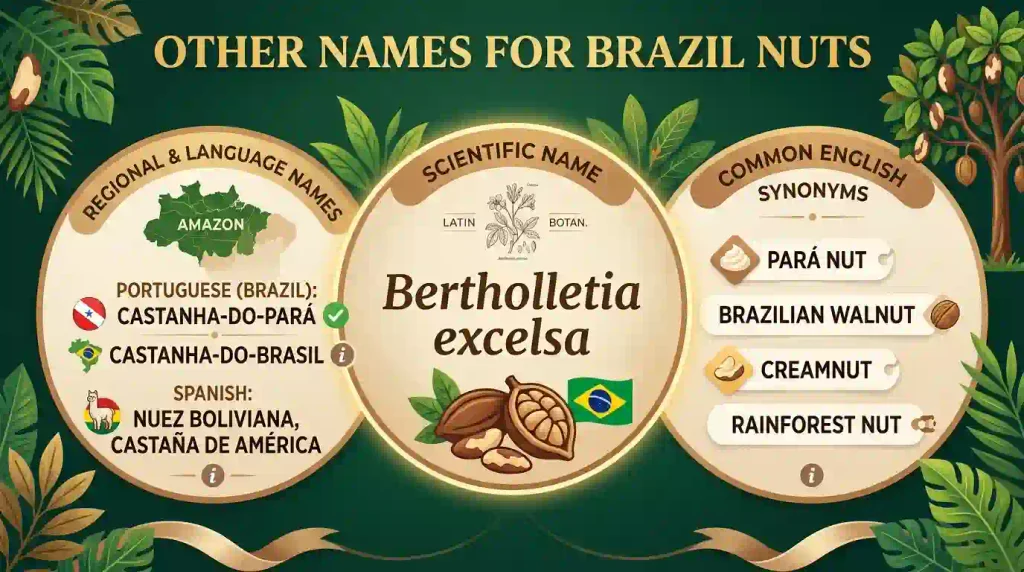
If you are looking for other names for Brazil nuts, the most established alternatives include Pará nut, cream nut, castanha-do-Pará, castanha-do-Brasil, castanha-da-Amazônia, nuez del Brasil, castaña del Brasil, noix du Brésil, and Paranuss. The scientific name of the species is Bertholletia excelsa.
Brazil nuts have many names because the tree grows naturally across the Amazon region of South America, including Brazil, Bolivia, Peru, Colombia, Venezuela, and neighboring areas. Different languages and local communities developed their own names for the tree and its seeds.
However, not every name is a perfect synonym. Some terms specifically describe the nut, some describe the tree, some are geographic names, and others are regional or historical forms. This guide separates those categories so you can tell which names are genuinely documented.
What Is Another Name for Brazil Nuts?
The clearest established English alternative is Pará nut.
Other documented names include:
- Pará nut
- Cream nut
- Butter nut
- Brazilnut
- Brazil-nut
- Castanha-do-Pará
- Castanha-do-Brasil
- Castanha-da-Amazônia
- Castanheira
- Nuez del Brasil
- Castaña del Brasil
- Nuez de Pará
- Castaña de Pará
- Noix du Brésil
- Noix du Pará
- Noyer du Brésil
- Paranuss
- Paranöt
- Noce del Brasile
- Amazon nut
- Amazonian nut
- Tapa
- Almendra del Beni
- Castaña
- several Indigenous and regional names
These terms are not all equally common in modern English. Some are regional names, while others belong to Portuguese, Spanish, French, German, Italian, Swedish, or Indigenous languages.
1. Pará Nut
Language: English
Type: Established common name
Refers to: Nut/seed
Connection: Geographic
Pronunciation: puh-RAH nut
Pará nut is the strongest alternative English name for Brazil nut.
The name comes from Pará, a state in northern Brazil that has a long association with Brazil-nut harvesting and trade. FAO lists “Para nut” as an English alternative, while the Royal Horticultural Society and other botanical sources also recognize it.
This is a genuine common name, not a creative nickname.
2. Cream Nut
Language: English
Type: Traditional common name
Refers to: Nut/seed
Pronunciation: KREEM nut
Cream nut is another documented English name for Brazil nut.
Thermo Fisher Scientific lists Cream nut alongside Brazil nut and Para-nut, while FAO also records the term.
It is less familiar to many modern English speakers than “Brazil nut,” but it has a real history in English plant and food terminology.
3. Butter Nut
Language: English
Type: Historical/common name
Refers to: Nut/seed
Pronunciation: BUHT-er nut
Butter nut appears in older botanical and agricultural sources as another name for Bertholletia excelsa. FAO lists it among the English names of the species.
It should not be confused with the butternut tree, which is a different species, Juglans cinerea.
For modern writing, “Brazil nut” or “Pará nut” is clearer.
Portuguese Names for Brazil Nuts
Portuguese names are especially important because Bertholletia excelsa is native to the Amazon and Brazil has historically been a major center of Brazil-nut harvesting and trade.
4. Castanha-do-Pará
Language: Brazilian Portuguese
Type: Regional common name
Literal sense: “Pará chestnut”
Refers to: Nut/seed
Pronunciation: kas-TAHN-yah doo pah-RAH
Castanha-do-Pará is one of the best-known Brazilian names for Brazil nuts.
The word castanha is commonly translated as “chestnut,” while do Pará means “of Pará.” The name therefore identifies the product geographically.
Embrapa and Brazilian technical literature document castanha-do-Pará as a common name for Bertholletia excelsa.
5. Castanha-do-Brasil
Language: Brazilian Portuguese
Type: Common name
Literal sense: “Brazil chestnut”
Refers to: Nut/seed
Pronunciation: kas-TAHN-yah doo brah-ZEEL
Castanha-do-Brasil is another well-established Brazilian name.
Embrapa uses the name in technical material about the species, and academic literature also records it alongside castanha-do-Pará and castanha-da-Amazônia.
The difference between this name and castanha-do-Pará is primarily geographic naming. One emphasizes Brazil, while the other emphasizes Pará.
6. Castanha-da-Amazônia
Language: Portuguese
Type: Regional/geographic common name
Literal sense: “Amazon chestnut”
Refers to: Nut/seed
Pronunciation: kas-TAHN-yah dah ah-mah-ZOH-nyah
Castanha-da-Amazônia highlights the wider Amazonian identity of the species.
This name is particularly interesting because Brazil nuts are not limited to Brazil. The species occurs naturally across several Amazonian countries.
Academic and Brazilian sources document this name as an alternative to castanha-do-Pará and castanha-do-Brasil.
7. Castanheira
Language: Portuguese
Type: Tree name
Refers to: The Brazil nut tree
Castanheira is important because it shows why common-name lists need context.
It generally refers to the tree, not simply the edible seed. Brazilian technical literature lists castanheira among common names for Bertholletia excelsa.
So it is better to translate it as a tree-related name rather than simply putting “castanheira = Brazil nut” in a synonym list.
Spanish Names for Brazil Nuts
8. Nuez del Brasil
Language: Spanish
Type: Common name
Literal sense: “Nut of Brazil”
Refers to: Nut/seed
Pronunciation: NWEHS del brah-SEEL
Nuez del Brasil is a straightforward Spanish name for Brazil nut.
The New York Botanical Garden’s botanical database records Nunez del Brasil among Spanish common names for Bertholletia excelsa.
9. Castaña del Brasil
Language: Spanish
Type: Common name
Literal sense: “Brazil chestnut”
Refers to: Nut/seed
Castaña del Brasil is another documented Spanish form.
It is recorded in botanical common-name databases and technical literature.
The use of castaña does not mean Brazil nuts are botanically the same as true chestnuts. It is simply part of the common naming tradition.
10. Nuez de Pará
Language: Spanish
Type: Regional common name
Literal sense: “Nut of Pará”
Refers to: Nut/seed
Nuez de Pará connects the nut with the Brazilian state of Pará.
FAO and botanical references document Spanish Pará-based names among the common names of Bertholletia excelsa.
11. Castaña de Pará
Language: Spanish
Type: Regional common name
Refers to: Nut/seed
Castaña de Pará follows the same geographic naming pattern às Pará nut and castanha-do-Pará.
The form appears in botanical and multilingual plant-name records.
12. Castaño de Pará
Language: Spanish
Type: Tree name
Refers to: Brazil nut tree
This name should be separated from castaña de Pará.
The ending -o indicates a tree-related form in Spanish usage, and botanical references record castaño de Pará among names for Bertholletia excelsa.
This is a good example of why translations should not be treated as interchangeable.
French Names
13. Noix du Brésil
Language: French
Type: Common name
Literal sense: “Nut of Brazil”
Refers to: Nut/seed
Pronunciation: NWAH du breh-ZEEL
Noix du Brésil is the standard French form.
FAO and botanical sources document the name for Bertholletia excelsa.
14. Noix du Pará
Language: French
Type: Geographic/common name
Literal sense: “Nut of Pará”
Refers to: Nut/seed
Noix du Pará is a documented French alternative.
Historical and multilingual botanical sources record both Noix du Pará and Noix du Brésil.
15. Noyer du Brésil
Language: French
Type: Tree name
Refers to: Brazil nut tree
This term belongs in a separate tree-name category.
It is documented in multilingual botanical resources, but it should not simply be translated as another name for the edible nut.
German, Italian, and Swedish Names
16. Paranuss
Language: German
Type: Common name
Refers to: Nut
Pronunciation: pah-rah-NOOS
Paranuss is a German name for Brazil nut.
The University of Melbourne’s multilingual plant-name database lists Paranußbaum for the tree, while broader botanical sources record related German forms.
17. Paranöt
Language: Swedish
Type: Common name
Refers to: Nut
Paranöt is a Swedish name documented in multilingual plant-name records.
It follows the same Pará-based naming pattern found in several European languages.
18. Noce del Brasile
Language: Italian
Type: Common name
Literal sense: “Nut of Brazil”
Refers to: Nut
Noce del Brasile is a documented Italian name for Brazil nut. FAO and multilingual botanical sources record the Italian form.
Amazon Nut and Amazonian Nut
19. Amazon Nut
Language: English
Type: Regional/common name
Connection: Geographic
Amazon nut is a documented alternative name, especially in academic and Amazon-focused literature.
A 2019 study on Bertholletia excelsa explains that the researchers used Amazon-nut rather than Brazil-nut because the species is native to multiple Amazonian countries.
That makes “Amazon nut” particularly useful when the discussion is about the entire Amazon basin rather than Brazil alone.
However, it should not be presented as though it has completely replaced “Brazil nut” in ordinary English.
20. Amazonian Nut
Language: English
Type: Regional descriptive name
Amazonian nuts also appear in specialist literature. A review of non-timber forest products lists Brazil nut, Pará nut, Amazonian nut, and castaña among common names.
It is best understood as a geographic common name rather than a separate species.
Regional South American Names
21. Castaña
Language: Spanish
Type: Regional common name
Usage: Particularly documented in Peru
The simple word castaña can refer to Brazil nuts in regional South American contexts.
The New York Botanical Garden records castaña as a Spanish common name for Bertholletia excelsa.
It should not be treated as a universal Spanish synonym because “castaña” can refer to other chestnut-related foods in Spanish.
22. Tapa
Language: Regional Spanish
Usage: Bolivia
Type: Local common name
Tapa is documented as a Bolivian common name for Bertholletia excelsa.
This is a good example of a name that belongs in a regional category rather than in a list of everyday English synonyms.
23. Almendra del Beni
Language: Spanish
Usage: Bolivia
Type: Regional common name
Connection: Geographic
Almendra del Beni means roughly “almond of Beni.”
The name refers to the nut in connection with Beni, a department of Bolivia. Brazilian technical literature records it among regional names.
The word almendra does not mean that the seed is botanically an almond. It is part of the regional common-name tradition.
Indigenous and Local Names
Botanical databases document additional local names such as touka, iuvia, jibia, ingie noto, kokeleko, para noot, totoka, tetoka, toeka, and related forms.
These names deserve careful treatment.
They should not automatically be translated into English or assigned invented meanings. A local name may belong to a particular Indigenous language, community, or geographic area, and its exact etymology may require specialist linguistic evidence.
For an English-language names article, listing the documented form and its location is more trustworthy than inventing a literal translation.
The Scientific Name of Brazil Nut
Bertholletia excelsa
Scientific name: Bertholletia excelsa Bonpl.
Family: Lecythidaceae
Type: Botanical species name
The accepted botanical name is Bertholletia excelsa. The species belongs to the family Lecythidaceae and is native to tropical South America. Kew and the New York Botanical Garden recognize Bertholletia excelsa as the accepted name.
The species was formally published by Aimé Bonpland in 1807.
A useful distinction is that Bertholletia excelsa is the scientific name of the species, not simply another everyday English name for the nut.
The edible product is the seed found inside the large fruit of the tree.
Why Does Brazil Nut Have So Many Names?
The naming history mainly reflects geography, language, and local usage.
Brazil-based names
Brazil nut, castanha-do-Brasil, nuez del Brasil, and noix du Brésil identify the product through Brazil.
Pará-based names
Pará nut, castanha-do-Pará, nuez de Pará, and noix du Pará connect the product with Pará.
Amazon-based names
Amazon nut, Amazonian nut, and castanha-da-Amazônia emphasize the wider Amazon region.
Descriptive English names
Cream nut and butter nut represent older English common-name traditions.
Local names
Names such as tapa, iuvia, jibia, and touka show that the species has been known under different local naming systems across Amazonian communities.
This is why a good alternative-name article should not simply put every term into one undifferentiated list.
Brazil Nut vs Pará Nut
Brazil nut and Pará nut refer to the same species and edible product in established English usage.
The difference is mainly in the geographic emphasis.
- Brazil nut: emphasizes Brazil.
- Pará nut: emphasizes Pará.
- Amazon nut: emphasizes the wider Amazon region.
FAO, Thermo Fisher, and botanical resources all document Pará nut as an alternative name.
Brazil Nut vs Amazon Nut
These terms can refer to the same species, but the wording has a different geographic emphasis.
Brazil nut is the familiar general English name.
Amazon nut is useful when discussing the species across the Amazon basin, which extends beyond Brazil. Academic researchers have explicitly chosen “Amazon nut” for this broader geographic reason.
So it is better to call Amazon nut a documented regional/common alternative, rather than claim that it is the official replacement for Brazil nut.
Are Brazil Nuts Actually Nuts?
In everyday food language, yes, they are called nuts.
Botanically, however, the edible Brazil nut is a seed contained within the large fruit of Bertholletia excelsa. The tree produces a large woody fruit containing multiple seeds.
This distinction explains why scientific descriptions may use “seed” while grocery stores and consumers use “nut.”
Both terms can therefore appear in reliable sources, but they are being used in different contexts.
Which Alternative Name Should You Use?
The best term depends on the context.
For everyday English:
Use Brazil nuts.
For an established English alternative:
Use Pará nuts.
For historical English terminology:
Use cream nut or butter nut, with appropriate context.
For Brazilian Portuguese:
Use castanha-do-Pará por castanha-do-Brasil, depending on the intended regional terminology.
For Spanish:
Use nuez del Brasil or a documented regional form such as castaña del Brasil.
For French:
Une noix du Brésil.
For scientific writing:
Use Bertholletia excelsa.
This approach avoids treating a regional word as though it were the universal English name.
Quick List of Verified Other Names for Brazil Nuts
Here is a concise reference list based on botanical, agricultural, and multilingual sources:
- Pará nut
- Cream nut
- Butter nut
- Brazilnut
- Brazil-nut
- Castanha-do-Pará
- Castanha-do-Brasil
- Castanha-da-Amazônia
- Castanheira
- Nuez del Brasil
- Castaña del Brasil
- Nuez de Pará
- Castaña de Pará
- Castaño de Pará
- Noix du Brésil
- Noix du Pará
- Noyer du Brésil
- Paranuss
- Paranöt
- Noce del Brasile
- Amazon nut
- Amazonian nut
- Castaña
- Tapa
- Almendra del Beni
- Touka
- Iuvia
- Jibia
- Ingie noto
- Kokeleko
- Para noot
- Totoka
- Tetoka
- Toeka
Not all 34 have the same status. The first group contains established English and major international names, while several later terms are regional or local names. Botanical sources confirm that Bertholletia excelsa has a much larger multilingual common-name record than the handful of terms usually repeated by general food websites.
Names That Should Not Be Presented as Standard Synonyms
A strong article should also explain what not to do.
“Bertholletia nut”
The scientific name is Bertholletia excelsa. That does not automatically make “Bertholletia nut” a standard English common name.
“Queen Nut”
This is not sufficiently established in the authoritative botanical sources reviewed for this article. It is better excluded.
“Cream Beech”
The term and its explanation are unreliable as a standard alternative. Bertholletia excelsa belongs to Lecythidaceae, not the beech family Fagaceae.
Creative names
Terms such as “Brazil Bombs,” “South American Macadamias,” or other invented marketing expressions are not documented synonyms. They should never be presented as established names.
This distinction is especially important for a search query containing “other names.” Readers generally want names that people actually use, not creative replacements.
A Note About Offensive Historical Names
Some historical English sources contain an offensive racial slur among the former common names of Brazil nuts. FAO’s older database and other historical references preserve such terminology as part of the historical record.
It does not need to be repeated here as a usable synonym.
There is an important editorial difference between documenting historical nomenclature and recommending language for modern readers. A current names reference should prioritize respectful, useful, and well-established terminology.
15 Best Other Names for Brazil Nuts
If you need the most useful alternatives rather than the longest possible list, these are the strongest documented choices:
- Pará nut – Best established English alternative.
- Cream nut – Traditional English common name.
- Butter nut – Historical English common name.
- Castanha-do-Pará – Importante Brazilian Portuguese name.
- Castanha-do-Brasil – Brazil-focused Portuguese name.
- Castanha-da-Amazônia – Broader Amazonian Portuguese name.
- Nuez del Brasil – Clear Spanish equivalent.
- Castaña del Brasil – Documented Spanish alternative.
- Nuez de Pará – Spanish geographic form.
- Castaña de Pará – Another Pará-based Spanish form.
- Noix du Brésil – Standard French name.
- Noix du Pará – French Pará-based name.
- Paranuss – German name.
- Noce del Brasile – Italian name.
- Amazon nut – Useful broader geographic term.
The choice depends on whether you need an English synonym, a regional name, a translated name, or a scientific reference.
Frequently Asked Questions
Question: What is another name for Brazil nuts?
Answer: The clearest established English alternative is Pará nut. Other documented names include cream nut, butter nut, Amazon nut, castanha-do-Pará, castanha-do-Brasil, nuez del Brasil, noix du Brésil, and Paranuss. The scientific species name is Bertholletia excelsa.
Question: Are Pará nuts the same as Brazil nuts?
Answer: Yes. Pará nut is an established English common name for the same species, Bertholletia excelsa. The term emphasizes the connection with Pará in Brazil rather than using the broader country name.
Question: What is Brazil nut called in Portuguese?
Answer: Important Portuguese names include castanha-do-Pará, castanha-do-Brasil, and castanha-da-Amazônia. Castanheira is also documented, but it can refer to the tree rather than specifically to the edible seed.
Question: What is Brazil nut called in Spanish?
Answer: Documented Spanish forms include nuez del Brasil, castaña del Brasil, nuez de Pará, castaña de Pará, and castaña in some regional contexts. Exact usage varies by country.
Question: What is the scientific name for Brazil nuts?
Answer: The accepted scientific name is Bertholletia excelsa Bonpl. It belongs to the Lecythidaceae family and is native to tropical South America.
Question: Is Amazon nut another name for Brazil nut?
Answer: Amazon nut is a documented common name for Bertholletia excelsa. It emphasizes the species’ Amazonian distribution. Some researchers prefer the term because the species occurs across several Amazonian countries, not only Brazil.
Question: Is cream nut another name for Brazil nut?
Answer: Yes. Cream nut is a documented English common name for Bertholletia excelsa. It is less familiar today than Brazil nut, but specialist and agricultural sources record it.
Question: Does castanha mean Brazil nut?
Answer: It can in regional contexts, but the word should not be treated as a universal synonym. More specific documented forms include castanha-do-Pará and castanha-do-Brasil. Regional Spanish also uses castaña for Brazil nuts in some areas.
Related Name Topics
For a names and language website, this article can naturally connect to:
- Names of nuts and seeds
- Names of Amazonian plants
- Portuguese plant names
- Spanish plant names
- Common names vs scientific names
- Amazon rainforest vocabulary
- Names of tropical plants
- Botanical names and their meanings
- Regional food names
- Names of Brazilian plants
These are stronger internal-link opportunities than unrelated baby-name categories.
Conclusion
The phrase “other names for Brazil nuts” sounds simple, but the naming history is much richer than a basic synonym list suggests. The most useful English alternative is Pará nut, while cream nut and butter nut are documented older English names. In Brazil, castanha-do-Pará, castanha-do-Brasil, and castanha-da-Amazônia are important Portuguese forms. Spanish, French, German, Italian, and regional Amazonian languages have their own documented names as well.
The scientific identity is Bertholletia excelsa. That name should be kept separate from ordinary common names. The same rule applies to tree names such as castanheira and regional terms such as tapa. For a simple English answer, use Brazil nut or Pará nut. For regional writing, use the documented local name that fits the language and location.

PressoraMedia is a content platform dedicated to helping readers find the right words, names, meanings, and ideas for everyday use. Our content focuses on names, name meanings, naming inspiration, and useful language-related information in a simple and easy-to-understand format. At Pressora Media, we believe that choosing a name is more than simply finding a word. A name can carry meaning, personality, culture, and a special story. That is why we research names carefully and create helpful guides designed to make the naming process easier. Our authors and contributors focus on providing clear explanations, useful name suggestions, meanings, origins, pronunciations, and practical naming ideas. We aim to keep our content informative, reader-friendly, and genuinely useful. Whether you are searching for a meaningful name, exploring the origin of a name, looking for unique naming ideas, or simply curious about the meaning behind a word or name, Pressora Media is here to help.
Pressora Media Team
Helping you find the right name, meaning, and words.