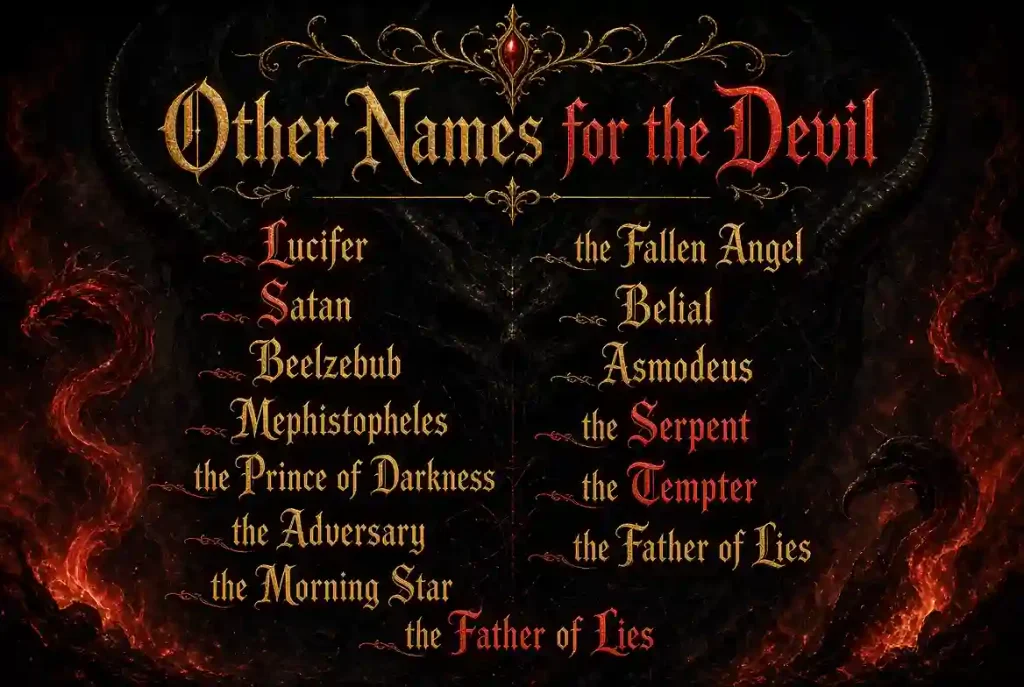

Other names for the Devil include Satan, Lucifer, Beelzebub, the Adversary, the Tempter, and the Prince of Darkness. However, these terms do not all have the same origin or religious meaning. Some are biblical names, some are descriptive titles, and others come from folklore, literature, or separate religious traditions.
This guide explains more than 50 names and related terms, including their meanings, pronunciations, historical backgrounds, and connections to the Devil. It also distinguishes Satan from figures such as Iblis, Mephistopheles, Azazel, and the Antichrist, whose identities and roles depend on their source traditions.
What Are the Most Common Other Names for the Devil?
The most recognizable names include Satan, Lucifer, Beelzebub, Beelzebul, and Old Nick. Common titles include the Adversary, the Tempter, the Deceiver, the Evil One, and the Prince of Darkness. The first group contains names or traditional nicknames, while the second mainly describes roles or characteristics.
For religious research, Satan, the Devil, and Lucifer need particular care because their histories and meanings differ. Lucifer originally comes from Latin, while Satan derives from a Hebrew word associated with opposition or accusation. Their close association in later Christian tradition does not make their original linguistic meanings identical.
1. Biblical Names and Titles for the Devil
The following terms appear in biblical passages or are closely connected with biblical descriptions of Satan. Their exact relationship to the Devil depends on the passage and its interpretation.
| Name or title | Meaning or association | Biblical reference |
| Satan (SAY-tuhn) | Adversary or opponent | Job 1:6–12; Revelation 12:9 |
| The Devil (DEE-vuhl) | From Greek diabolos, meaning slanderer or accuser | Matthew 4:1 |
| The Adversary | An opponent or accuser | 1 Peter 5:8 |
| The Tempter | One who tempts people | Matthew 4:3 |
| The Accuser | One who brings accusations | Revelation 12:10 |
| The Deceiver | One who misleads others | Revelation 12:9 |
| The Evil One | A figure associated with evil | Matthew 13:19; 1 John 5:19 |
| The Father of Lies | A title emphasizing deception | John 8:44 |
| The Ancient Serpent | Serpent imagery linked with Satan | Revelation 12:9 |
| The Great Dragon | A symbolic image of Satan | Revelation 12:9 |
| The Enemy | An opponent of God’s purposes | Matthew 13:39 |
| The Destroyer | A title associated with destruction | Compare Revelation 9:11 |
| The Ruler of This World | A title for a spiritual power opposing God | John 12:31 |
| The God of This Age | A title used in a discussion of spiritual blindness | 2 Corinthians 4:4 |
| The Prince of the Power of the Air | A title associated with spiritual evil | Ephesians 2:2 |
| Beelzebul (bee-EL-zuh-buhl) | A title associated with the ruler of demons | Matthew 12:24 |
| Beelzebub (bee-EL-zuh-bub) | A related name traditionally rendered “Lord of the Flies” | Matthew 12:24 |
| Belial (BEE-lee-uhl) | Associated with wickedness or worthlessness | 2 Corinthians 6:15 |
| Lucifer (LOO-sih-fer) | Latin for “light-bearer” or “morning star” | Isaiah 14:12 in the Latin tradition |
| The Serpent | A serpent associated with temptation in later Christian interpretation | Genesis 3; Revelation 12:9 |
Important: Not every title in the table is a separate personal name. Some are descriptions, and some passages have different interpretations among religious traditions. Genesis 3 describes a serpent tempting Eve; Revelation 12:9 explicitly identifies the ancient serpent with the Devil and Satan. That later identification is important when explaining the connection between the two passages.
Lucifer: Is It Really Another Name for Satan?
Lucifer is one of the most widely recognized names associated with the Devil. Its Latin meaning is “light-bearer” or “morning star.” In Isaiah 14:12, the Latin Bible uses lucifer in a passage addressing the fallen morning star.
The passage’s immediate context is a taunt against the king of Babylon. Many Christians later interpreted the imagery as referring to Satan’s fall, helping establish Lucifer as a name for the Devil in Christian tradition.
For accuracy, distinguish the word’s original meaning from its later religious association. Lucifer is not simply a Latin word that literally means “Satan.”
Beelzebub and Beelzebul
Beelzebub and Beelzebul are closely related forms used in discussions of demonic power. The New Testament connects Beelzebul with the ruler of demons. Beelzebub is traditionally rendered “Lord of the Flies,” and the name has a more complex history involving an earlier Philistine deity.
Although later literature frequently treats Beelzebub as a name for Satan, writers should explain the relevant passage rather than assume every historical use referred to the same figure.
Abaddon and Apollyon
Abaddon and Apollyon are particularly important examples of names that need context. Revelation 9:11 describes the angel of the abyss and gives the name Abaddon in Hebrew and Apollyon in Greek. Both are associated with destruction.
Apollyon is often translated or explained as “Destroyer.” Some interpretations identify this figure with Satan, while others understand the passage differently. The text itself does not require every reader to treat Apollyon as another personal name for Satan.
2. Traditional Nicknames and Literary Titles
These expressions appear in folklore, English usage, religious writing, or literature. Some are traditional nicknames; others are descriptive titles rather than historically established personal names.
| Name or title | Meaning or usage | Classification |
| Old Nick | Traditional nickname for the Devil | Folklore |
| Old Scratch | Traditional nickname for the Devil | Folklore |
| Old Harry | Informal nickname for the Devil | British English |
| The Deuce | Euphemistic reference to the Devil | Informal English |
| The Archfiend | The chief or supreme fiend | Literary title |
| The Foul Fiend | A dark, old-fashioned expression | Literary title |
| The Prince of Darkness | A title associated with darkness and evil | Religious and literary usage |
| The Dark One | A broad name for a dark or evil figure | Modern descriptive title |
| The Lord of Darkness | A dramatic title for a villainous figure | Literary usage |
| The Wicked One | A title emphasizing wickedness | Religious usage |
| The Evil Spirit | A general description, not a unique personal name | Religious vocabulary |
| The Fiend | An evil or cruel being | English vocabulary |
| The Horned One | A title used for different horned supernatural figures | Context-dependent |
| The Fallen Angel | A description used in later traditions about Satan | Theological description |
| The Enemy of Good | A general descriptive phrase | Creative usage |
These terms are useful for different purposes. Old Nick and Old Scratch work well in discussions of folklore, while the Prince of Darkness is more recognizable in religious and literary contexts. The Dark One and Lord of Darkness are broad titles that can also describe fictional villains who have no connection to biblical Satan.
The distinction matters because a descriptive title is not necessarily an ancient name. Writers should not assign a precise historical origin to a phrase unless a reliable source supports that claim.
3. Names from Islamic Tradition
Islamic tradition has its own vocabulary for Iblis, Satan, and rebellious or evil beings. These terms should be explained in their Islamic context rather than treated as exact translations of Christian demonological names.
| Term | Pronunciation | Meaning and context |
| Iblis | ib-LEES | The being who refuses God’s command concerning Adam in the Qur’anic account |
| Shaytan | shay-TAAN | An Arabic term for Satan or a devil |
| Al-Shaytan | ash-shay-TAAN | “The Satan” or “the Devil,” depending on context and pronunciation |
| Ash-Shayatin | ash-sha-yaa-TEEN | A plural form referring to devils or satans |
| Al-Waswas | al-was-WAAS | Related to whispering or insidious suggestion; not a universal proper name for Iblis |
Iblis and Shaytan: What Is the Difference?
Iblis is a specific figure in the Qur’anic account of the refusal to bow before Adam. Shaytan is a broader term used for Satan or a devil. Depending on the passage, it may refer to Iblis or to other rebellious beings.
The plural shayatin refers to devils or satans, not to several alternative personal names for Iblis. Similarly, waswas relates to whispering or insinuation, so it is more accurate to describe it as a concept associated with temptation than as a universally recognized personal name.
These distinctions help readers compare religious terminology without erasing differences between traditions.
4. Other Supernatural Figures Often Confused with the Devil
The following figures are associated with demons, evil, temptation, death, or supernatural power in different traditions. They are relevant to the wider topic, but they should not all be counted as direct names for Satan.
| Figure | Tradition or background | Why it is different |
| Mephistopheles | Faust legends and European literature | A literary demon who may serve the Devil or function as the Devil in particular versions |
| Antichrist | Christian scripture and later theology | A figure or concept opposing Christ, not a universal synonym for Satan |
| Azazel | Biblical and later Jewish traditions | An ambiguous figure or term whose interpretation varies |
| Samael | Jewish religious and mystical literature | A figure with differing roles across sources |
| Asmodeus | Jewish and Christian demonological traditions | A distinct demonic figure |
| Mammon | Biblical and later Christian usage | Originally associated with wealth; later personified as a demonic figure |
| Leviathan | Biblical imagery and later tradition | A sea creature or chaos figure, not universally identified as Satan |
| Lilith | Jewish folklore and later literature | A distinct figure with a changing history across traditions |
| Moloch | Ancient religious and biblical context | A separate figure whose precise historical interpretation is debated |
| Astaroth | Later demonological literature | A named demon in later traditions |
| Belphegor | Later demonological literature | A distinct demonic figure |
| Pazuzu | Ancient Mesopotamian religion | A supernatural figure associated with harmful winds |
| Baphomet | Medieval accusations and later esoteric traditions | Not a straightforward biblical name for the Devil |
| Hades | Greek mythology | Ruler of the Greek underworld, not the Christian Devil |
| Ahriman | Zoroastrian religious tradition | A major destructive or evil spirit in a different theological framework |
| Angra Mainyu | Zoroastrian tradition | An Avestan designation associated with destructive spirit |
| Legion | New Testament narrative | The name given by a group of demons in a possession account, not a name for Satan |
| Asura | South Asian religious traditions | A broad category of beings whose roles differ across traditions |
Why Mephistopheles Is Not Always the Devil
Mephistopheles is best known from the Faust legend. In Christopher Marlowe’s Doctor Faustus and Johann Wolfgang von Goethe’s Faust, the figure plays a role in a story about knowledge, temptation, and a pact with supernatural powers.
Depending on the version, Mephistopheles is a demon who serves the Devil or a figure closely identified with the Devil. It is therefore more accurate to classify it as a literary or legendary figure than as a direct biblical name for Satan.
Why the Antichrist Is Different
The Antichrist is associated with opposition to Christ in the New Testament and with later Christian interpretations of end-times events. Some popular stories connect the Antichrist closely with Satan, but the terms do not have identical meanings in every Christian tradition.
This is an important distinction for readers searching for religious names rather than fictional villain names.
5. Choosing the Right Name for Your Purpose
The most suitable name depends on the kind of research or writing you are doing.
- For biblical research: Start with Satan, the Devil, the Adversary, the Tempter, Beelzebul, and the Ancient Serpent. Check the relevant passage before treating a title as a proper name.
- For folklore: Old Nick and Old Scratch are useful traditional English nicknames.
- For fiction: Mephistopheles, the Archfiend, and the Dark One can create a dramatic tone, but they carry different historical or literary associations.
- For Islamic research: Use Iblis and shaytan-related terminology within its Qur’anic and theological context.
- For comparative religion: Study figures such as Ahriman, Samael, and Azazel through sources from their respective traditions.
- For academic writing: Distinguish direct textual evidence from later interpretation, legend, and modern popular culture.
A name can sound dark or supernatural without being an established historical name for the Devil. If factual accuracy matters, explain whether the term is a personal name, title, nickname, disputed identification, or separate figure.
Frequently Asked Questions
What is the most common other name for the Devil?
Satan is one of the most widely recognized alternative names for the Devil in English-language religious discussion. Lucifer and Beelzebub are also familiar, although their origins and relationships to Satan differ.
What does Satan mean?
Satan comes from a Hebrew word associated with an adversary or opponent. In some biblical contexts, it also carries the sense of an accuser. The word’s role develops across biblical texts and later religious interpretation.
Does Lucifer literally mean the Devil?
No. Lucifer is Latin for “light-bearer” and is associated with the morning star. Its use as a name for Satan developed through Christian interpretation of biblical imagery, particularly Isaiah 14:12.
Are Beelzebub and Beelzebul the same?
They are closely related forms used in biblical and later religious contexts. Their spellings and historical backgrounds should not be assumed to be completely identical in every source.
Is Abaddon another name for Satan?
Not definitively. Revelation 9:11 connects Abaddon with the angel of the abyss and gives Apollyon as the Greek name. Some interpretations connect this figure with Satan, but the identification is not universally accepted.
What is the Islamic name for the Devil?
Iblis is the specific figure who refuses God’s command concerning Adam in the Qur’anic account. Shaytan is a broader Arabic term for Satan or a devil.
Is the Antichrist the same as Satan?
Not necessarily. The Antichrist is associated with opposition to Christ. Some traditions connect the figure with Satan, but the terms are not interchangeable in every interpretation.
Are all demons names for the Devil?
No. Many religious traditions distinguish a chief adversary from other demons or evil spirits. Asmodeus, Mephistopheles, and Legion, for example, have their own roles in their respective sources.
What are some old fashioned names for the Devil?
Old Nick, Old Scratch, and Old Harry are familiar examples of traditional English nicknames. Their use varies by period and region.
Conclusion
Other names for the Devil include Satan, Lucifer, Beelzebub, the Adversary, the Tempter, and the Prince of Darkness. However, the meanings and origins of these terms differ. Some are biblical names, others are descriptive titles or folklore nicknames, and still others belong to separate religious and literary traditions.
The best way to understand them is to check the source, distinguish original meaning from later association, and avoid treating every supernatural figure as another name for Satan. This approach gives readers a more reliable guide to the Devil’s names and the traditions behind them.
References
- Bible Gateway, Encyclopedia of the Bible: Satan: https://www.biblegateway.com/resources/encyclopedia-of-the-bible/Satan
- Bible Gateway, A Field Guide to Biblically Accurate Demons: https://www.biblegateway.com/learn/topics-themes/explainers/biblically-accurate-demons/
- HISTORY, The Devil: Definition, Origin & Names for Satan: https://www.history.com/articles/history-of-the-devil
- Dictionary.com, Speak of the Devil! 15 Infernal Names for The Evil One: https://www.dictionary.com/articles/speak-of-the-devil
- Learn Religions, Other Names for the Devil and His Demons: https://www.learnreligions.com/other-names-for-the-devil-2158925
- NET Bible, Satan: https://classic.net.bible.org/dictionary.php?word=SATAN

PressoraMedia is a content platform dedicated to helping readers find the right words, names, meanings, and ideas for everyday use. Our content focuses on names, name meanings, naming inspiration, and useful language-related information in a simple and easy-to-understand format. At Pressora Media, we believe that choosing a name is more than simply finding a word. A name can carry meaning, personality, culture, and a special story. That is why we research names carefully and create helpful guides designed to make the naming process easier. Our authors and contributors focus on providing clear explanations, useful name suggestions, meanings, origins, pronunciations, and practical naming ideas. We aim to keep our content informative, reader-friendly, and genuinely useful. Whether you are searching for a meaningful name, exploring the origin of a name, looking for unique naming ideas, or simply curious about the meaning behind a word or name, Pressora Media is here to help.
Pressora Media Team
Helping you find the right name, meaning, and words.