Yin and yang have several established forms and closely related terms, but they are not all exact synonyms. The most direct alternatives are yinyang, yin-yang, and yin and yang. Liangyi (兩儀), usually translated as Two Modes or Two Forms, is a closely related classical term. If you mean the famous black-and-white diagram, taijitu (太極圖) is the more precise name.
This distinction is important because terms such as Taiji, Great Ultimate, Supreme Ultimate, polarity, and complementary opposites are often listed online as synonyms even though they describe related ideas rather than being direct replacements for yin-yang.
Here is the accurate breakdown.
1. Yinyang
Chinese: 陰陽 / 阴阳
Pinyin: yīnyáng
Pronunciation: yin-YAHNG
Type: Established Chinese compound
Relationship: Direct
Yinyang is the most straightforward alternative spelling of yin and yang.
The two characters are:
- 陰 / 阴 (yīn) = yin
- 陽 / 阳 (yáng) = yang
The compound yinyang treats the two as one conceptual pair. English-language academic writing sometimes uses this closed form when discussing the concept as a unified system.
The historical roots of the individual terms are connected with contrasting sides of natural features, especially the shaded and sunlit sides of a mountain or river landscape. An early Western Zhou bronze inscription already uses the compound in a geographical context.
Best choice: When you want the shortest formal name for the concept.
2. Yin-Yang
Chinese: 陰陽 / 阴阳
Pinyin: yīnyáng
Pronunciation: yin-YAHNG
Type: English rendering
Relationship: Direct
Yin-yang is probably the most familiar English form.
It can refer to the philosophical concept or, in everyday usage, to the associated black-and-white symbol.
For a general audience, this is usually the safest alternative because readers already recognize it.
Best choice: General articles, everyday English, design and popular culture.
3. Yin and Yang
Chinese: 陰陽 / 阴阳
Pronunciation: yin and YAHNG
Type: English expression
Relationship: Direct
Yin and yang is the full English expression.
Unlike many terms in this article, it is not a translation that changes the underlying concept. It simply spells out the two components individually.
This is often the clearest wording when explaining how yin and yang relate to one another.
4. Liangyi
Chinese: 兩儀 / 两仪
Pinyin: liǎngyí
Pronunciation: lyahng-EE
Common translation: Two Modes / Two Forms
Type: Classical Chinese philosophical term
Relationship: Closely related, not a perfect synonym
Liangyi is one of the most important terms associated with the question.
In the Yijing tradition, the famous sequence says that the Great Ultimate generates the Two Modes; the Two Modes generate the Four Images; the Four Images generate the Eight Trigrams. Traditional interpretations connect the Two Modes with yin and yang.
But there is an important editorial distinction.
Liangyi is not simply another everyday Chinese word for yin-yang.
It is a technical term within a larger cosmological and divinatory framework.
Best choice: Classical Chinese philosophy and Yijing discussions.
5. Two Modes
Chinese: 兩儀 / 两仪
Pinyin: liǎngyí
Type: English translation
Relationship: Classical related term
Two Modes is one of the most common translations of liangyi.
It is particularly useful when discussing the development of yin and yang within the Yijing system.
Some sources translate liangyi differently, including Two Forms, Two Instruments, and other variations. That variation is one reason it is better to preserve the Chinese term when precision matters.
6. Two Forms
Chinese: 兩儀 / 两仪
Pinyin: liǎngyí
Type: Translation
Relationship: Classical related term
Two Forms is another established translation of liangyi.
The word form can help modern readers understand that the term belongs to a system of symbolic differentiation.
It should not, however, be presented as though ancient Chinese texts routinely used the English phrase “Two Forms.” It is an English translation of the Chinese term.
7. Two Instruments
Chinese: 兩儀 / 两仪
Pinyin: liǎngyí
Type: Historical translation
Relationship: Classical related term
Two Instruments is another translation found in English translations of the Yijing tradition.
This term can be confusing to modern readers because instrument does not mean a physical tool here. It reflects an older translation choice for yi.
For an accessible modern article, Two Modes is generally easier to understand, while liangyi provides the safest way to preserve the original terminology.
Names Connected With the Yin-Yang Symbol
The next terms are especially useful if your search for “other names for yin and yang” actually means “What is the yin-yang symbol called?”
8. Taijitu
Chinese: 太極圖 / 太极图
Pinyin: tàijítú
Pronunciation: tie-JEE-too
Literal structure: taiji + tu (“diagram”)
Type: Diagram name
Relationship: Symbolic, not a synonym for yin-yang
Taijitu is the most important term to know if you mean the diagram.
The character 圖 / 图 (tú) means a diagram or chart. Thus, taijitu is fundamentally a diagram associated with taiji.
The familiar black-and-white swirling design is commonly called a taijitu in modern Chinese and English reference works. But the history of taijitu diagrams is more complicated than the common claim that one ancient symbol has existed unchanged for thousands of years.
Best choice: When referring specifically to the visual symbol.
9. Yin-Yang Symbol
Type: Modern English name
Relationship: Direct to the symbol
Yin-yang symbol is the most familiar English name for the black-and-white design.
It is easy to understand, but it is less technically precise than taijitu because “yin-yang” describes the philosophical pair, while taijitu identifies the diagram.
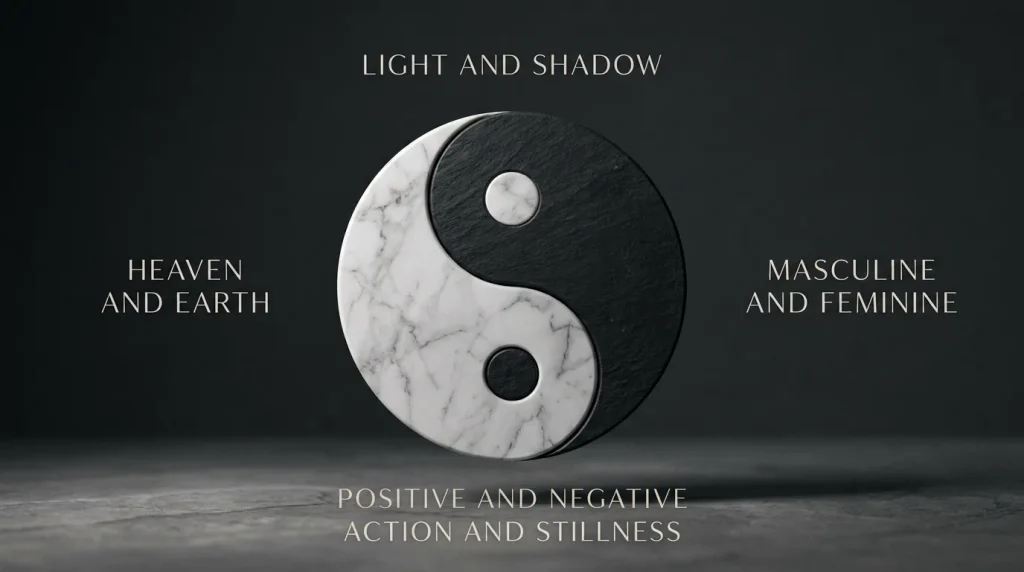
The Academy of Contemporary China and World Studies explains the symbol as a circular design divided into two interlocking parts, with each side containing a dot of the opposite color.
10. Taiji Diagram
Chinese: 太極圖 / 太极图
Pinyin: tàijítú
Type: English descriptive name
Relationship: Symbolic
Taiji diagram is a straightforward English rendering of taijitu.
It is useful when writing for readers who may understand the “yin-yang symbol” but have never encountered the Chinese term.
This is also a safer term than claiming that every historical taijitu had exactly the same black-and-white appearance as the modern symbol.
11. Two-Part Taiji Diagram
Chinese: 太極兩儀圖 / 太极两仪图
Type: More specific descriptive term
Relationship: Symbolic
The two-part Taiji diagram is particularly useful for distinguishing the familiar divided circular form from other diagrams associated with taiji.
This distinction is rarely explained on basic SEO pages, but it matters historically because taijitu can refer to more than one diagrammatic tradition.
12. Great Monad
Type: Historical English label
Relationship: Historical name for the symbol
Great Monad is an interesting historical term that deserves mention, but it should not be presented as the traditional Chinese name.
The phrase appeared in older Western discussions of Chinese cosmological imagery. Historical sources connect the label with late-19th- and early-20th-century Western interpretations of the symbol.
Therefore:
Great Monad = historical English label
not:
Great Monad = original Chinese name for yin and yang
That distinction is important.
What About Taiji, Great Ultimate and Supreme Ultimate?
These terms belong in the article, but not in the direct synonym list.
Taiji
Chinese: 太極 / 太极
Pinyin: tàijí
Pronunciation: tie-JEE
Taiji is usually translated as Great Ultimate, Supreme Ultimate, or, in some scholarly translations, Supreme Polarity.
It is closely connected with yin and yang, but it is not simply another word for the pair.
The Yijing tradition gives the well-known sequence in which taiji generates the Two Modes.
So the correct relationship is:
Taiji → Liangyi → Yin and Yang
with the exact interpretation depending on the philosophical tradition and translation.
Great Ultimate
Chinese: 太極 / 太极
Relationship: Translation of taiji
Great Ultimate is an established English translation of taiji.
It is therefore a legitimate term to include in an explanation of yin-yang philosophy, but not as a strict synonym for yin and yang.
Supreme Ultimate
Chinese: 太極 / 太极
Relationship: Translation of taiji
Supreme Ultimate is another established translation.
Different scholars prefer different English renderings because translating classical Chinese philosophical terminology is not always a simple word-for-word exercise.
That is why an accurate article should retain taiji alongside the English translation.
What Terms Should NOT Be Called Synonyms?
This is where many competing articles lose accuracy.
Dao / Tao
Dao means “Way” and is a major concept in Chinese philosophy. It is not another name for yin and yang.
Qi / Chi
Qi is a major concept in Chinese thought and can be discussed in relation to yin and yang. But qi is not a synonym for yin-yang.
Bagua
Bagua, or the Eight Trigrams, belongs to the same larger Yijing system but is not another name for yin and yang.
Wuxing
Wuxing, commonly translated as the Five Phases, is another related part of Chinese correlative thought. It is not a synonym for yin and yang.
Wuji
Wuji is another important philosophical term associated with discussions of taiji. It should not casually be substituted for yin and yang.
This separation is important because these concepts form relationships within larger philosophical systems rather than functioning as interchangeable vocabulary.
The Etymology of Yin and Yang
The strongest answer to “what do yin and yang mean?” begins with geography.
The individual terms have early associations with shaded and sunlit sides of natural features. One etymological source records an early Western Zhou use of the compound in connection with the shaded and sunny sides of the Luo River.
A useful simplified explanation is:
Yin: associated with shade, shadow and the less-sunny side.
Yang: associated with sunlight and the sunny side.
Over time, these physical distinctions became much broader conceptual categories.
Researchers have traced how the meanings expanded through metaphor and philosophical development, rather than assuming that every later yin-yang association was part of the original literal meaning.
That is why it is inaccurate to say that yin literally means “female energy” or that yang literally means “male energy.” Those are later conceptual associations within particular systems, not the basic lexical origin of the characters.
Yin Does Not Simply Mean “Bad” and Yang Does Not Simply Mean “Good”
This is another major misconception.
Yin and yang are often described through paired contrasts such as:
- shade and sunlight
- cool and warm
- inward and outward
- stillness and activity
- yielding and assertive tendencies
But the relationship is not simply:
bad vs. good
The philosophical model emphasizes interaction, complementarity and transformation. Zhou Dunyi’s Taijitu shuo, for example, describes activity and stillness as alternating and yin and yang as being established through their differentiation.
So “good and evil” should not be listed as another name for yin and yang.
Why the Two Dots Matter
The dots inside the familiar symbol are often explained as showing that each side contains an aspect or “seed” of the other.
The Academy of Contemporary China and World Studies explains the white dot within the dark section and the black dot within the light section as representing yin within yang and yang within yin.
This is one reason the symbol communicates more than simple opposition.
The two sides are shown as connected and capable of transformation, rather than as two isolated enemies.
Is the Yin-Yang Symbol Ancient?
The idea of yin and yang is ancient, but the familiar black-and-white swirling symbol should not simply be described as an unchanged symbol from ancient China.
This is one of the biggest historical gaps in simplified articles.
Zhou Dunyi, an 11th-century Song-dynasty thinker, is associated with the Taijitu shuo, but the diagram associated with his work is not identical to the simple modern black-and-white icon. Later diagram traditions developed additional forms, including the familiar swirling design.
Some research places important developments of the familiar swirling form in the Ming period, including work associated with Zhao Huiqian and later developments involving dots.
So the safest wording is:
The yin-yang concept is ancient; the familiar taijitu design has a later and more complicated history.
Yin and Yang in Chinese Writing
The Traditional Chinese form is:
陰陽
The Simplified Chinese form is:
阴阳
In Mandarin:
yīnyáng
The characters also occur in other East Asian languages, although pronunciation and usage differ.
For example, the same Chinese characters are used in Japanese contexts with readings such as inyō and onmyō, while Korean uses eumyang. The important point is that the written characters do not guarantee identical pronunciation across languages.
The Most Accurate Alternatives at a Glance
| Term | What it refers to | Exact synonym? |
| Yinyang | Yin and yang as a compound | Yes |
| Yin-yang | English form of yinyang | Yes |
| Yin and yang | Full English expression | Yes |
| Liangyi | Classical Two Modes | Closely related |
| Two Modes | Translation of liangyi | Closely related |
| Two Forms | Translation of liangyi | Closely related |
| Two Instruments | Historical translation of liangyi | Closely related |
| Taijitu | Diagram associated with taiji | No, symbol |
| Yin-yang symbol | Common English name for diagram | Symbol name |
| Taiji diagram | English rendering of taijitu | Symbol name |
| Two-part Taiji diagram | More specific diagram description | Symbol name |
| Great Monad | Historical Western label | Historical symbol label |
| Taiji | Great/Supreme Ultimate | No |
| Great Ultimate | Translation of taiji | No |
| Supreme Ultimate | Translation of taiji | No |
Which Name Should You Use?
If you are writing about the philosophical concept, use:
Yin and yang or yinyang
If you want a classical technical term, use:
liangyi (Two Modes)
If you mean the black-and-white symbol, use:
taijitu
If you want the term most readers immediately recognize:
yin-yang symbol
If you are discussing the broader philosophical framework:
taiji
If you are writing academically, retain the Chinese characters and pinyin because English translations of classical terminology can vary.
15 Best Terms Related to “Other Names for Yin and Yang”
Rather than pretending that all 15 are exact synonyms, here is the more useful classification:
- Yinyang – direct alternative
- Yin-yang – direct English form
- Yin and yang – full English expression
- Liangyi – classical related term
- Two Modes – translation of liangyi
- Two Forms – translation of liangyi
- Two Instruments – historical translation of liangyi
- Taijitu – name of the diagram
- Yin-yang symbol – common name for the diagram
- Taiji diagram – English diagram term
- Two-part Taiji diagram – more specific diagram description
- Great Monad – historical Western label
- Taiji – related philosophical concept
- Great Ultimate – translation of taiji
- Supreme Ultimate – translation of taiji
Important: Only the first three should normally be treated as straightforward synonyms for yin and yang. The rest belong to different levels of terminology.
Frequently Asked Questions
What is another name for yin and yang?
The closest alternatives are yinyang, yin-yang, and yin and yang. In classical Chinese philosophy, liangyi, usually translated as Two Modes or Two Forms, is closely associated with yin and yang. If you mean the visual symbol rather than the concept, taijitu is the more precise term.
What is the Chinese name for yin and yang?
The Chinese term is 陰陽 in Traditional Chinese and 阴阳 in Simplified Chinese. In Mandarin pinyin it is yīnyáng. The individual characters have early associations with shaded and sunny sides of geographical features before their meanings expanded into broader philosophical categories.
What is the yin-yang symbol called?
The diagram is commonly called a taijitu (太極圖 / 太极图). The term refers to a diagram associated with taiji, while “yin-yang symbol” is the familiar English expression. The history of the diagram is more complicated than simply saying that the modern symbol existed unchanged in ancient China.
Is Taiji another name for yin and yang?
Not exactly. Taiji (太極) is a related philosophical concept commonly translated as Great Ultimate or Supreme Ultimate. In the classical Yijing sequence, taiji is associated with generating the Two Modes, which are traditionally connected with yin and yang.
What does Liangyi mean?
Liangyi (兩儀 / 两仪) is commonly translated as Two Modes, Two Forms, or, in older translations, Two Instruments. It is a technical term in the Yijing tradition and is closely associated with the differentiation of yin and yang. It is better described as a classical related term than as a universal synonym.
Does yin mean female and yang mean male?
Female and male are among the traditional associations that became attached to yin and yang in Chinese correlative thought, but they are not the literal dictionary meanings of the two words. Their early lexical associations are more closely connected with shade/sunlight and geographical position.
Is yin and yang the same as good and evil?
No. Yin and yang are not a simple good-versus-evil pair. They describe contrasting aspects that can interact, complement one another and transform. Reducing yin to evil and yang to good gives a misleading picture of the philosophical concept.
Final Takeaway
If someone searches for other names for yin and yang, the answer depends on whether they want another name for the concept, a classical Chinese term, or a name for the symbol. The cleanest answer is: Yinyang, yin-yang, and yin and yang are the direct alternative forms. Liangyi, Two Modes, and Two Forms are closely related classical terminology. Taijitu and yin-yang symbols refer to the visual representation.
Taiji, Great Ultimate, and Supreme Ultimate belong to the broader philosophical framework and should not be treated as exact synonyms. That distinction is the key improvement over most generic lists. It gives readers not just more terms, but the right term for the right context. The history also becomes clearer: the yin-yang idea is ancient, while the familiar swirling taijitu has a later and more complex development.

PressoraMedia is a content platform dedicated to helping readers find the right words, names, meanings, and ideas for everyday use. Our content focuses on names, name meanings, naming inspiration, and useful language-related information in a simple and easy-to-understand format. At Pressora Media, we believe that choosing a name is more than simply finding a word. A name can carry meaning, personality, culture, and a special story. That is why we research names carefully and create helpful guides designed to make the naming process easier. Our authors and contributors focus on providing clear explanations, useful name suggestions, meanings, origins, pronunciations, and practical naming ideas. We aim to keep our content informative, reader-friendly, and genuinely useful. Whether you are searching for a meaningful name, exploring the origin of a name, looking for unique naming ideas, or simply curious about the meaning behind a word or name, Pressora Media is here to help.
Pressora Media Team
Helping you find the right name, meaning, and words.