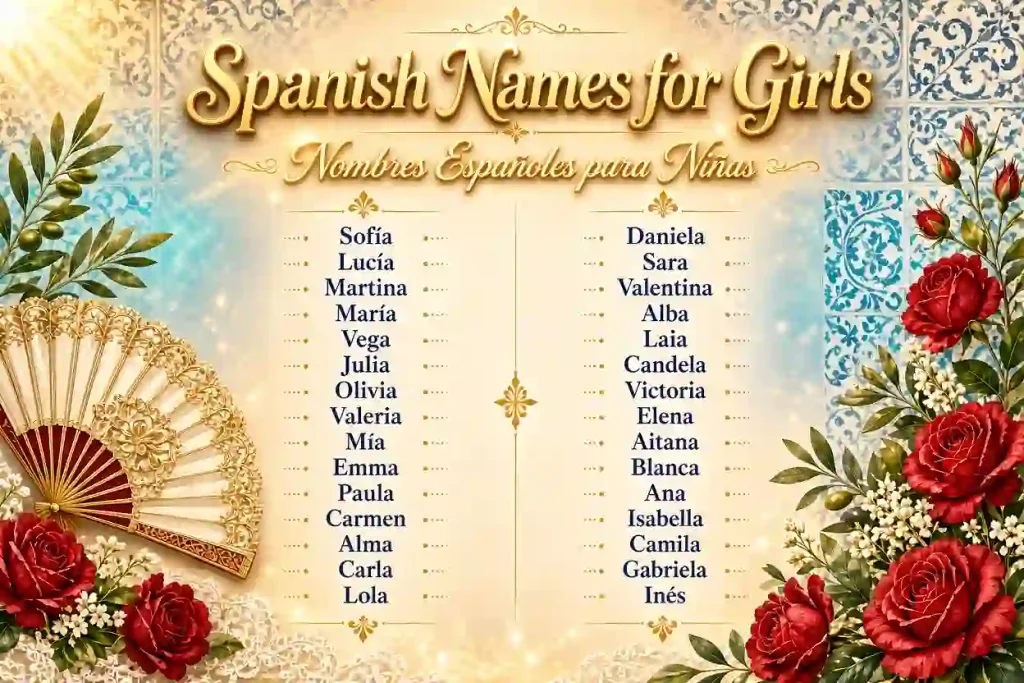
Looking for Spanish names for girls? This guide brings together 100+ established names used in Spain and Spanish-speaking communities, with their documented meanings, linguistic origins, pronunciation help, and cultural context.
One important distinction comes first: Spanish use does not always mean Spanish origin. Sofía comes from Greek, Lucía from Latin, and Gabriela from Hebrew. Other names belong specifically to regional languages of Spain, such as Catalan or Basque. Understanding that difference makes it much easier to choose a name for its real history rather than a made-up meaning.
For parents choosing a baby name, the best options depend on what you value. You might want a traditional Spanish name such as María or Carmen, a short choice such as Alba or Luz, a modern favorite such as Vega, or a regional name such as Laia or Ainara.
Below, the names are grouped by style and cultural connection so you can compare them more easily.
Popular Spanish Girl Names in Spain
Spain’s latest official newborn-name data gives us a useful starting point. In 2024, Sofía was the most frequently registered girl name in Spain, with 3,325 registrations. Lucía followed with 2,830, and Martina with 2,364. These figures refer specifically to births registered in Spain in 2024, not to the entire Spanish-speaking world.
1. Sofía
Meaning: Wisdom
Origin: Greek
Spanish form: Sofía
Pronunciation: so-FEE-ah
Vibe: Classic and elegant
Sofía is currently the strongest data-backed choice for a newborn girl in Spain. It was the country’s top girl name in 2024.
2. Lucía
Meaning: Related to Latin lux, “light”
Origin: Latin
Pronunciation: loo-SEE-ah
Vibe: Bright and timeless
3. Martina
Meaning: Feminine form of Martinus, associated with Mars
Origin: Latin
Pronunciation: mar-TEE-nah
Vibe: Strong and modern
4. María
Meaning: Etymology uncertain and debated
Origin: Hebrew, through Greek and Latin forms
Pronunciation: mah-REE-ah
Vibe: Traditional and enduring
María is one of the most culturally important names in Spanish-speaking Christian traditions.
5. Vega
Meaning: A fertile plain or meadow
Origin: Spanish
Pronunciation: BAY-gah
Name type: Spanish word/place-associated name
Vibe: Modern and distinctive
6. Julia
Meaning: Feminine form of Julius; the deeper Roman family-name etymology is uncertain
Origin: Latin/Roman
Pronunciation: HOO-lyah
Vibe: Classic
7. Olivia
Meaning: Traditionally associated with the olive tree
Origin: Latin/European
Pronunciation: oh-LEE-byah
Vibe: International and polished
8. Valeria
Meaning: Strong, healthy
Origin: Latin
Pronunciation: bah-LEH-ryah
Vibe: Confident
9. Emma
Meaning: Associated with a Germanic element meaning “whole” or “universal”
Origin: Germanic
Pronunciation: EH-mah
Vibe: Short and international
10. Paula
Meaning: Small or humble
Origin: Latin
Pronunciation: POW-lah
Vibe: Familiar and classic
Classic Spanish Girl Names
These names have long-standing use in Spanish naming traditions.
11. Ana
Meaning: Grace or favor
Origin: Hebrew
Pronunciation: AH-nah
12. Isabel
Meaning: Traditionally interpreted as “God is my oath”
Origin: Hebrew, through European forms
Pronunciation: ee-sah-BEL
13. Beatriz
Meaning: Traditionally associated with happiness or blessedness
Origin: Latin
Pronunciation: beh-ah-TREES
14. Teresa
Meaning: Uncertain
Origin: Uncertain/disputed; long-established in Spanish usage
Pronunciation: teh-REH-sah
Teresa is a good example of why a names article should not force a neat meaning onto an uncertain etymology.
15. Antonia
Meaning: Feminine form of Antonius; original Roman family-name meaning is uncertain
Origin: Latin
Pronunciation: an-TOH-nyah
16. Francisca
Meaning: Feminine form of Francisco, ultimately connected with Franciscus
Origin: Latin
Pronunciation: fran-THEES-kah
17. Dolores
Meaning: Sorrows
Origin: Spanish religious tradition
Pronunciation: doh-LOH-res
Dolores comes from the devotional expression María de los Dolores, referring to Mary’s sorrows.
18. Mercedes
Meaning: Mercies
Origin: Latin through Spanish religious usage
Pronunciation: mer-THEH-des
19. Pilar
Meaning: Pillar
Origin: Spanish religious tradition
Pronunciation: pee-LAR
Pilar developed from the Marian title Nuestra Señora del Pilar.
20. Rosario
Meaning: Rosary
Origin: Spanish religious tradition
Pronunciation: roh-SAH-ryoh
21. Consuelo
Meaning: Consolation
Origin: Spanish
Pronunciation: kon-SWEH-loh
22. Amparo
Meaning: Protection, shelter, refuge
Origin: Spanish
Pronunciation: am-PAH-roh
23. Concepción
Meaning: Conception
Origin: Latin/Spanish religious tradition
Pronunciation: kon-sep-see-ON
24. Asunción
Meaning: Assumption
Origin: Latin/Spanish religious tradition
Pronunciation: ah-soon-see-ON
25. Encarnación
Meaning: Incarnation
Origin: Latin/Spanish religious tradition
Pronunciation: en-kar-na-see-ON
Elegant Spanish Girl Names
If you want something polished but still familiar, these are strong candidates.
26. Alejandra
Meaning: Defender of people/mankind
Origin: Greek
Spanish form: Alexandra
Pronunciation: ah-leh-KHAN-drah
27. Gabriela
Meaning: “God is my strength”
Origin: Hebrew
Pronunciation: gah-bree-EH-lah
28. Catalina
Meaning: Traditionally associated with “pure,” although the deeper etymology is debated
Origin: Greek/European name tradition
Pronunciation: kah-tah-LEE-nah
29. Elena
Meaning: Traditionally associated with brightness or shining; deeper etymology is debated
Origin: Greek
Pronunciation: eh-LEH-nah
30. Victoria
Meaning: Victory
Origin: Latin
Pronunciation: beek-TOH-ryah
31. Valentina
Meaning: Strong, healthy
Origin: Latin
Pronunciation: bah-len-TEE-nah
32. Adriana
Meaning: From Hadria
Origin: Latin
Pronunciation: ah-ree-AH-nah
33. Natalia
Meaning: Related to birth; later strongly associated with Christmas/Nativity
Origin: Latin
Pronunciation: nah-tah-LEE-ah
34. Claudia
Meaning: Feminine form of Claudius; original Roman family-name meaning is uncertain
Origin: Latin
Pronunciation: KLOW-dyah
35. Carolina
Meaning: Feminine form of Carolus/Charles
Origin: Germanic through Latin forms
Pronunciation: kah-roh-LEE-nah
36. Alicia
Meaning: Noble
Origin: Germanic, through the European Alice forms
Pronunciation: ah-LEE-thyah in Spain
37. Carlota
Meaning: Feminine form related to Charles/Carl
Origin: Germanic through Romance forms
Pronunciation: kar-LOH-tah
38. Emilia
Meaning: Feminine form of Aemilius; original Roman family-name meaning is uncertain
Origin: Latin
Pronunciation: eh-MEE-lyah
39. Patricia
Meaning: Noblewoman, patrician
Origin: Latin
Pronunciation: pah-TREE-thyah
40. Laura
Meaning: Laurel
Origin: Latin
Pronunciation: LOW-rah
Short Spanish Names for Girls
Short names are easy to say, easy to remember, and can work especially well with longer surnames.
41. Alba
Meaning: Dawn; also connected with Latin albus, “white”
Origin: Latin/Spanish
Pronunciation: AHL-bah
42. Luz
Meaning: Light
Origin: Spanish word name/religious tradition
Pronunciation: LOOS
43. Paz
Meaning: Peace
Origin: Spanish word name/religious tradition
Pronunciation: PATH in much of Spain; PAS in many Latin American varieties
44. Sol
Meaning: Sun
Origin: Spanish word name
Pronunciation: SOL
45. Mar
Meaning: Sea
Origin: Spanish/Catalan word name
Pronunciation: MAR
46. Eva
Meaning: Traditionally “living” or “life”
Origin: Hebrew
Pronunciation: EH-bah
47. Sara
Meaning: Princess
Origin: Hebrew
Pronunciation: SAH-rah
48. Inés
Meaning: Traditionally “pure”
Origin: Greek, through Latin
Pronunciation: ee-NES
49. Lola
Meaning: Traditional short form of Dolores
Origin: Spanish
Pronunciation: LOH-lah
Lola is an especially useful example of a traditional diminutive that is now widely used as a given name in its own right.
50. Noa
Meaning: Biblical feminine name; etymology associated with Hebrew
Origin: Hebrew
Pronunciation: NO-ah
Spanish Girl Names Inspired by Nature
Some Spanish names are directly connected with natural objects, while others are established given names whose meanings come from older languages.
51. Estrella
Meaning: Star
Origin: Spanish word name
Pronunciation: es-TREH-yah
52. Luna
Meaning: Moon
Origin: Latin/Spanish word name
Pronunciation: LOO-nah
53. Aurora
Meaning: Dawn
Origin: Latin
Pronunciation: ow-ROH-rah
54. Abril
Meaning: April
Origin: Latin month name through Spanish
Pronunciation: ah-BREEL
55. Violeta
Meaning: Violet, the flower
Origin: Latin/European botanical tradition
Pronunciation: bee-oh-LEH-tah
56. Margarita
Meaning: Pearl; in Spanish, also the common word for daisy
Origin: Greek for “pearl”
Pronunciation: mar-gah-REE-tah
57. Paloma
Meaning: Dove
Origin: Spanish
Pronunciation: pah-LOH-mah
58. Flor
Meaning: Flower
Origin: Spanish/Latin vocabulary
Pronunciation: FLOR
59. Marina
Meaning: Of the sea
Origin: Latin
Pronunciation: mah-REE-nah
60. Coral
Meaning: Coral
Origin: Spanish word name
Pronunciation: koh-RAL
61. Rosa
Meaning: Rose
Origin: Latin/European floral name tradition
Pronunciation: ROH-sah
62. Cielo
Meaning: Sky or heaven
Origin: Spanish word name
Pronunciation: THYEH-loh in much of Spain; SYEH-loh in much of Latin America
Cielo is an established Spanish given name, but it should be described as a word name rather than assigned an invented ancient etymology. Specialist name references document its Spanish usage.
Spanish Girl Names With Meaningful Associations
These names are useful when meaning is more important than having a strictly Spanish linguistic origin.
63. Esperanza
Meaning: Hope
Origin: Spanish
Pronunciation: es-peh-RAN-thah in Spain; es-peh-RAN-sah in much of Latin America
64. Gloria
Meaning: Glory
Origin: Latin
Pronunciation: GLOH-ryah
65. Clara
Meaning: Clear, bright
Origin: Latin
Pronunciation: KLAH-rah
66. Blanca
Meaning: White, bright
Origin: Germanic through Romance forms
Pronunciation: BLAN-kah
67. Irene
Meaning: Peace
Origin: Greek
Pronunciation: ee-REH-neh
68. Amada
Meaning: Beloved
Origin: Latin/Spanish
Pronunciation: ah-MAH-dah
69. Felicia
Meaning: Fortunate, happy
Origin: Latin
Pronunciation: feh-LEE-thyah in Spain
70. Leticia
Meaning: Joy, gladness
Origin: Latin
Pronunciation: leh-TEE-thyah in Spain
71. Victoria
Meaning: Victory
Origin: Latin
Pronunciation: beek-TOH-ryah
72. Serena
Meaning: Serene, calm
Origin: Latin
Pronunciation: seh-REH-nah
Spanish Biblical and Christian Girl Names
Many names used in Spanish Christian traditions originated in Hebrew or Greek rather than Spanish. Their Spanish identity comes from their established Spanish forms and cultural use.
73. Magdalena
Meaning: From Magdala
Origin: Hebrew/Aramaic through Greek
Pronunciation: mag-dah-LEH-nah
74. Raquel
Meaning: Traditionally associated with “ewe”
Origin: Hebrew
Pronunciation: rah-KEL
75. Noemí
Meaning: Pleasantness
Origin: Hebrew
Pronunciation: noh-eh-MEE
76. Miriam
Meaning: Uncertain and debated
Origin: Hebrew
Pronunciation: MEE-ryam
77. Esther
Meaning: Etymology uncertain; various explanations exist
Origin: Hebrew/Persian-associated tradition
Pronunciation: es-TER
78. Rebeca
Meaning: Etymology uncertain
Origin: Hebrew
Pronunciation: reh-BEH-kah
79. Judit
Meaning: Jewish woman/woman of Judea
Origin: Hebrew
Pronunciation: hoo-DEET
80. Belén
Meaning: Bethlehem
Origin: Biblical place name through Spanish religious usage
Pronunciation: beh-LEN
81. Guadalupe
Meaning: Place-name origin; deeper etymology is uncertain
Origin: Spanish place/religious tradition
Pronunciation: gwah-dah-LOO-peh
82. Trinidad
Meaning: Trinity
Origin: Spanish religious tradition
Pronunciation: tree-nee-DAD
Regional Names From Spain
Spain is not linguistically uniform. Basque, Catalan, Galician and other regional traditions contribute names that should not simply be relabeled as generic “Spanish.”
83. Laia
Meaning: Catalan form of Eulalia
Origin: Catalan
Pronunciation: LAH-yah
Laia has particularly strong regional relevance. It was the leading girl name in Catalonia in the INE’s 2024 regional results.
84. Núria
Meaning: Place-name associated with Núria in Catalonia
Origin: Catalan
Pronunciation: NOO-ryah
85. Ainara
Meaning: Swallow, the bird
Origin: Basque
Pronunciation: eye-NAH-rah
86. Ainhoa
Meaning: Place-name associated with Ainhoa in the Basque Country
Origin: Basque
Pronunciation: eye-NO-ah
87. Amaia
Meaning: Traditionally interpreted in Basque as “end,” though the etymology is not completely straightforward
Origin: Basque
Pronunciation: ah-MY-ah
88. Maialen
Meaning: Basque form related to Magdalene
Origin: Basque
Pronunciation: my-ah-LEN
89. Nerea
Meaning: Used in Basque; relationship to Nereus is discussed in name scholarship
Origin: Basque/Greek-associated tradition
Pronunciation: neh-REH-ah
90. Begoña
Meaning: Place-name associated with Begoña
Origin: Basque
Pronunciation: beh-GOH-nyah
91. Montserrat
Meaning: Jagged or serrated mountain
Origin: Catalan
Pronunciation: mon-seh-RAT
92. Aroa
Meaning: Etymology uncertain
Origin: Basque usage
Pronunciation: ah-ROH-ah
For regional names, it is better to preserve the regional identity than to force them into a generic Spanish category.
Distinctive Spanish Girl Names
These are established names that may feel less conventional to English-speaking readers.
93. Araceli
Meaning: From the Latin expression ara caeli, traditionally interpreted as “altar of heaven”
Origin: Latin/Spanish religious tradition
Pronunciation: ah-rah-THEH-lee in Spain
94. Almudena
Meaning: Place-name/religious name associated with Madrid’s patron saint
Origin: Spanish/Madrid tradition
Pronunciation: al-moo-DEH-nah
95. Rocío
Meaning: Dew
Origin: Spanish
Pronunciation: roh-SEE-oh
96. Soledad
Meaning: Solitude
Origin: Spanish religious tradition
Pronunciation: soh-leh-DAD
97. Marisol
Meaning: Traditionally connected with María de la Soledad; also heard as María + Sol
Origin: Spanish compound/blended usage
Pronunciation: mah-ree-SOL
98. Maribel
Meaning: Established blended form, commonly associated with María and Isabel
Origin: Spanish usage
Pronunciation: mah-ree-BEL
99. Carmela
Meaning: Related to Carmel
Origin: Hebrew through Spanish/European religious tradition
Pronunciation: kar-MEH-lah
100. Casilda
Meaning: Uncertain
Origin: Uncertain; sometimes proposed as Arabic or Visigothic
Pronunciation: kah-SEEL-dah
Casilda is a good example of a name where uncertainty should remain visible. Specialist name references do not treat one proposed etymology as proven.
101. Cinta
Meaning: Ribbon
Origin: Spanish/Catalan religious usage
Pronunciation: SEEN-tah in Spain
Cinta comes from the devotional title La Virgen de la Cinta and is documented as a Spanish and Catalan feminine name.
102. Charo
Meaning: Diminutive of Rosario
Origin: Spanish
Pronunciation: CHAR-oh
103. Chelo
Meaning: Diminutive of Consuelo
Origin: Spanish
Pronunciation: CHEH-loh
104. Concha
Meaning: Shell
Origin: Spanish diminutive/name form associated with Concepción
Pronunciation: KON-cha
105. Carmenza
Meaning: Elaborated form of Carmen
Origin: Spanish Latin American usage
Pronunciation: kar-MEN-thah in many Latin American varieties
Spanish Girl Names That Work Well Internationally
If the child may grow up using both Spanish and English, pronunciation and spelling can become practical considerations. No name is universally effortless, but these tend to have recognizable forms in several languages.
106. Clara
Short, familiar and easy to recognize in both Spanish and English.
107. Elena
A long-established international form with Spanish usage.
108. Julia
Classic, compact and familiar across many European languages.
109. Gabriela
Clearly recognizable in Spanish and English-speaking environments.
110. Victoria
A traditional name with an established form in both languages.
111. Valeria
Retains a distinctly Spanish pronunciation while remaining familiar internationally.
112. Marina
Easy to recognize and connected with the sea through its Latin origin.
113. Natalia
Traditional, international and strongly established in Spanish.
114. Camila
Spanish and Portuguese form of Camilla, ultimately from a Roman name.
115. Diana
International name with long-standing Spanish use.
What About Double Spanish Girl Names?
A major cultural feature missing from many simple “100 Spanish names” lists is the tradition of compound or double given names.
Examples include:
- María José
- Ana Sofía
- María Carmen
- María Isabel
- María del Carmen
- María de los Ángeles
- María de la Luz
- María del Mar
- María de Jesús
- María de la Cruz
These are not simply a first name plus a middle name in every cultural context. Some combinations function as a unified given-name tradition.
Specialist Spanish-name references document compound forms such as María de Jesús, María de la Cruz, María de la Luz, María de las Mercedes, María del Carmen, María del Mar and María de los Ángeles.
If honoring a family tradition is important, a compound name can therefore offer more cultural depth than simply choosing a name because it “sounds Spanish.”
15 Best Spanish Names for Girls
Here are my strongest choices from the article, selected for different reasons rather than claiming that one name is universally best.
- Sofía — Best overall modern classic and Spain’s #1 girl name for 2024 births.
- Lucía — Best classic name with a clear “light” connection.
- María — Best for deep Spanish Christian tradition.
- Carmen — Best for strong Spanish cultural identity.
- Vega — Best modern Spanish nature/place name.
- Alba — Best short name with a dawn connection.
- Luz — Best simple name meaning “light.”
- Paz — Best short name meaning “peace.”
- Valentina — Best strong and elegant choice.
- Clara — Best internationally familiar classic.
- Rocío — Best poetic Spanish name.
- Laia — Best Catalan regional choice.
- Ainara — Best Basque nature name.
- Paloma — Best animal-inspired choice.
- Esperanza — Best name meaning “hope.”
How to Choose a Spanish Girl Name
Choose Sofía or Lucía if you want a familiar, current choice in Spain.
Choose Carmen or María if traditional Spanish cultural history matters most.
Choose Vega, Alba or Rocío if you prefer names connected with nature or poetic imagery.
Choose Laia, Núria, Ainara or Ainhoa if you specifically want a regional Spanish name. Just remember that these belong to Catalan or Basque traditions rather than being generic Spanish-language names.
Choose Luz, Paz or Sol if you want a short word name.
Choose Clara, Julia, Elena or Victoria if international usability is important.
Most importantly, check the name in its original linguistic and cultural context. A name that looks Spanish on a baby-name website may actually be Greek, Hebrew, Latin, Basque, Catalan or another origin.
Frequently Asked Questions
Question: What are the most popular Spanish girl names?
Answer: According to Spain’s official 2024 birth statistics, the top three girl names were Sofía (3,325), Lucía (2,830), and Martina (2,364). These figures describe babies registered in Spain in 2024 and should not be interpreted as worldwide popularity statistics.
Question: What is the prettiest Spanish girl name?
Answer: There is no objective “prettiest” name. Sofía, Lucía, Carmen, Alba, Vega, Valentina and Rocío are strong choices for different styles. Sofía and Lucía feel classic, Vega feels modern, Carmen has deep cultural history, and Alba has a short, nature-related quality.
Question: What Spanish girl names mean light?
Answer: Lucía has a documented connection with Latin lux, “light,” while Luz is the Spanish word for “light” and is also used as a given name. Clara has a related sense of brightness or clarity through its Latin origin.
Question: What are some rare Spanish girl names?
Answer: “Rare” should be used carefully because reliable rarity data depends on country and year. Instead of labeling names such as Casilda, Cinta or Carmenza universally rare, it is safer to call them less familiar or distinctive in many English-speaking naming contexts.
Question: Are Spanish girl names originally from Spain?
Answer: Not necessarily. Spanish naming includes names inherited from Greek, Hebrew, Latin, Germanic and other languages. Sofía is Greek in origin, Lucía is Latin, and Gabriela is Hebrew in origin. Their Spanish identity comes from their established Spanish forms and usage.
Question: Are Basque names Spanish names?
Answer: Basque names can certainly be names used in Spain, but Basque is a separate language with its own naming tradition. Ainara, Ainhoa and Amaia should therefore be described as Basque names used in Spain rather than simply claiming that they originated in Spanish.
Question: What are good short Spanish names for girls?
Answer: Alba, Luz, Paz, Sol, Mar, Eva, Sara, Inés, Lola and Noa are useful choices. Some are traditional names, while others are Spanish word names or names inherited from another language. Checking the individual origin gives a more accurate picture.
Question: Are María José and María del Carmen Spanish names?
Answer: Yes. Compound names are an important part of Spanish naming traditions. Forms such as María José, María del Carmen, María de la Luz and María de los Ángeles are documented Spanish given-name forms and can carry religious or family significance.
Conclusion
The best Spanish names for girls are not limited to one style. You can choose a current favorite such as Sofía or Lucía, a deeply traditional name such as María or Carmen, a short word name such as Luz or Paz, or a regional choice such as Laia or Ainara. The most important improvement when researching these names is to look beyond a simple meaning list. A name’s origin, Spanish form, regional language, pronunciation, religious history and current usage can all tell you something different.
Spain’s official statistics also show that naming trends change over time. Sofía leads current newborn naming, while regional favorites such as Laia and María show how different naming traditions coexist within Spain. Take your time, say your favorite names aloud with the surname, and check their original history. A name does not need to be unusual to be special. It needs to be meaningful, appropriate for your family, and accurately understood.

PressoraMedia is a content platform dedicated to helping readers find the right words, names, meanings, and ideas for everyday use. Our content focuses on names, name meanings, naming inspiration, and useful language-related information in a simple and easy-to-understand format. At Pressora Media, we believe that choosing a name is more than simply finding a word. A name can carry meaning, personality, culture, and a special story. That is why we research names carefully and create helpful guides designed to make the naming process easier. Our authors and contributors focus on providing clear explanations, useful name suggestions, meanings, origins, pronunciations, and practical naming ideas. We aim to keep our content informative, reader-friendly, and genuinely useful. Whether you are searching for a meaningful name, exploring the origin of a name, looking for unique naming ideas, or simply curious about the meaning behind a word or name, Pressora Media is here to help.
Pressora Media Team
Helping you find the right name, meaning, and words.