
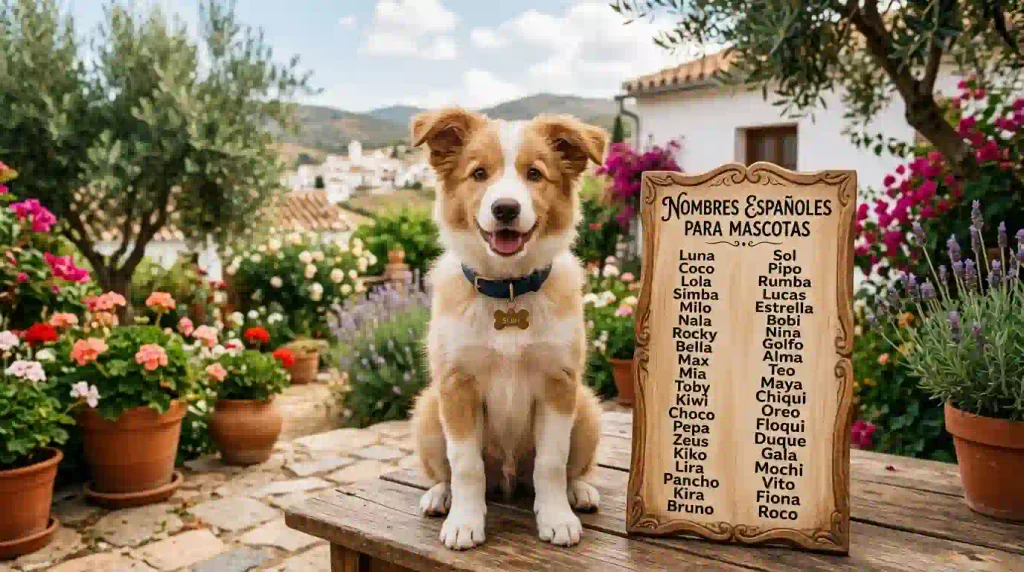
Looking for Spanish names for pets? You can choose an established Spanish personal names such as Lola, Paco, Alma, Diego, Lucía, Mateo, Carmen, or Pablo, or use a Spanish word such as Sol, Cielo, Luz, Luna, Canela, or Chispa as a creative pet name.
The difference matters. A Spanish personal name has a naming history, while a Spanish word may simply be a word that works nicely as a pet name. This guide keeps those two groups separate so you can choose with confidence.
You will find Spanish names for dogs, cats, puppies, kittens, rabbits, birds, and other pets. There are also short names, cute names, nature-inspired words, food-inspired ideas, Spanish nicknames, and names with documented meanings.
If you want cultural accuracy, the most important rule is simple: Spanish usage does not always mean Spanish origin. A name can be commonly used in Spanish while its deeper roots come from Latin, Hebrew, Greek, Germanic, or another language.
Spanish Names for Pets: Real Names vs. Spanish Words
Before choosing a name, decide which type you want.
Established Spanish name:
A personal name used in Spanish-speaking naming traditions. Examples include Lola, Diego, Carmen, Mateo, Lucía, and Paco.
Spanish diminutive or nickname:
An established short or affectionate form of another name. Examples include Paco from Francisco, Pepe from José, and Lupe from Guadalupe.
Spanish word name:
An ordinary Spanish word that works creatively as a pet name. Examples include Sol (“sun”), Cielo (“sky/heaven”), Luz (“light”), and Fuego (“fire”).
That distinction is one of the biggest things missing from many Spanish pet-name lists. Large competitor lists often combine all three types into one list.
1. Best Established Spanish Names for Pets
These are genuine personal names used in Spanish rather than simply English translations of Spanish vocabulary.
Lola
Origin: Spanish usage
Name type: Diminutive
Related name: Dolores
Pronunciation: LOH-lah
Vibe: Playful and friendly
Lola is a Spanish diminutive of Dolores. It is therefore more accurate to explain its naming history than to give it a made-up literal meaning.
Paco
Origin: Spanish
Name type: Diminutive
Related name: Francisco
Pronunciation: PAH-koh
Vibe: Friendly and lively
Paco is an established Spanish diminutive of Francisco.
Alma
Meaning: Soul
Usage: Spanish and other languages
Pronunciation: AHL-mah
Type: Established given name and Spanish vocabulary word
Alma is particularly interesting because it can function both as a personal name and as an ordinary Spanish word meaning “soul.”
Diego
Usage: Established Spanish masculine given name
Pronunciation: dee-EH-goh
Vibe: Classic and energetic
Diego is a long-established Spanish given name. Its deeper etymology is complex, so it is better not to force one simplistic literal meaning onto it.
Carmen
Usage: Established Spanish given name
Pronunciation: KAR-men
Vibe: Traditional and recognizable
Carmen has a particularly strong history in Spanish naming and religious culture. It is a human name rather than simply a Spanish vocabulary word.
Lucía
Meaning connection: Light
Origin: Latin, through the name Lucia
Pronunciation: loo-SEE-ah
Type: Established Spanish given name
Lucía is associated etymologically with Latin lux, “light.” It should therefore be described as a Spanish-used name with Latin roots rather than as a name that originated from modern Spanish vocabulary.
Mateo
Origin: Hebrew through Greek and Latin traditions
Spanish usage: Established
Pronunciation: mah-TEH-oh
Traditional meaning: “Gift of God”
Mateo is an especially useful example of the difference between origin and usage. It is a Spanish form of Matthew, but its deeper history is not originally Spanish.
Pablo
Origin: Latin, through Paul
Spanish usage: Established
Pronunciation: PAH-bloh
Vibe: Familiar and traditional
Rafael
Meaning: “God has healed”
Origin: Hebrew, through the biblical name Raphael
Spanish usage: Established
Pronunciation: rah-fah-EL
Isabel
Origin: Spanish form of Elizabeth
Pronunciation: ee-sah-BEL
Vibe: Elegant and traditional
2. Spanish Female Names for Pets
If you want your female dog, cat, rabbit, or bird to have a genuine Spanish personal name, these are strong options.
Sofía
Meaning: Wisdom
Origin: Greek
Spanish usage: Established
Pronunciation: soh-FEE-ah
Sofía is not merely a Spanish word. It is a well-established personal name. Spain’s National Statistics Institute recorded 3,325 newborn girls named Sofía in 2024, making it the most frequent girl name in that year’s Spanish birth statistics. This is human naming data, not pet-name popularity.
Valentina
Origin: Latin
Meaning: Connected with strength, health and the Latin valens
Pronunciation: vah-lehn-TEE-nah
Elena
Origin: Spanish form related to Helen
Pronunciation: eh-LEH-nah
Isabel
Origin: Spanish form of Elizabeth
Pronunciation: ee-sah-BEL
Gabriela
Origin: Feminine form of Gabriel
Pronunciation: gah-bree-EH-lah
Teresa
Usage: Established Spanish given name
Pronunciation: teh-REH-sah
Inés
Origin: Spanish form of Agnes
Pronunciation: ee-NES
Rosa
Meaning: Rose
Type: Established given name and Spanish vocabulary word
Pronunciation: ROH-sah
Catalina
Usage: Established Spanish form related to Katherine
Pronunciation: kah-tah-LEE-nah
Ximena
Usage: Established Spanish feminine given name
Pronunciation: hee-MEH-nah in common Spanish pronunciation
Ximena has an uncertain deeper etymology, so it is better to avoid confidently assigning a single ancient meaning without qualification.
3. Spanish Male Names for Pets
For a male dog, cat, rabbit, bird, or other companion, established Spanish masculine names can give you a more traditional feel.
Mateo
Gift of God; Spanish form of Matthew.
Diego
Established Spanish masculine name with a complex historical etymology.
Pablo
Spanish form of Paul.
Miguel
Spanish form of Michael.
Pronunciation: mee-GEL
Javier
Established Spanish masculine name.
Pronunciation: hah-VYEHR
Fernando
Spanish form of Ferdinand.
Pronunciation: fehr-NAHN-doh
Francisco
Spanish form of Francis.
Pronunciation: frahn-SEES-koh
Vicente
Spanish form of Vincent.
Pronunciation: vee-SEN-teh
Sebastián
Spanish form of Sebastian.
Pronunciation: seh-bahs-tee-AN
Carlos
Spanish form of Charles.
Pronunciation: KAR-lohs
4. Short Spanish Pet Names
Short names are practical because you may say them dozens of times each day. Here are some especially easy options.
| Name | Meaning / connection | Type |
| Sol | Sun | Spanish word |
| Luz | Light | Word + given name |
| Paz | Peace | Spanish word + given name |
| Mar | Sea | Spanish word + given name |
| Lola | Diminutive of Dolores | Established name |
| Paco | Diminutive of Francisco | Established nickname |
| Pepe | Diminutive of José | Established nickname |
| Lupe | Short form of Guadalupe | Established short form |
| Rosa | Rose | Word + given name |
| Alma | Soul | Word + given name |
Behind the Name specifically identifies Paco as a Spanish diminutive of Francisco, Pepe as a Spanish diminutive of José, and Lupe as a Spanish short form of Guadalupe.
5. Cute Spanish Word Names for Pets
These are Spanish words used creatively as pet names, not all traditional personal names.
Cielo
Meaning: Sky; heaven
Pronunciation: SYEH-loh
Best for: A gentle, affectionate pet
Sol
Meaning: Sun
Pronunciation: SOHL
Best for: A bright or cheerful pet
Luz
Meaning: Light
Pronunciation: LOOS
Best for: A light-colored or beloved pet
Dulce
Meaning: Sweet
Pronunciation: DOOL-seh
Best for: A calm or affectionate pet
Amor
Meaning: Love
Pronunciation: ah-MOR
Best for: A deeply loved companion
Paz
Meaning: Peace
Pronunciation: PAHS
Best for: A calm pet
Flor
Meaning: Flower
Pronunciation: FLOHR
Best for: A delicate-looking pet
Estrella
Meaning: Star
Pronunciation: eh-STREH-yah
Best for: A pet that stands out
Brisa
Meaning: Breeze
Pronunciation: BREE-sah
Best for: A gentle, energetic pet
Alegría
Meaning: Joy
Pronunciation: ah-leh-GREE-ah
Best for: A cheerful pet
6. Spanish Nature Names for Pets
Nature gives you some of the most natural Spanish word-name choices.
Luna
Meaning: Moon
Pronunciation: LOO-nah
Type: Spanish word and established given name
Nube
Meaning: Cloud
Pronunciation: NOO-beh
Type: Spanish word name
Nieve
Meaning: Snow
Pronunciation: NYEH-beh
Type: Spanish word name
Río
Meaning: River
Pronunciation: REE-oh
Type: Spanish word name and established given name in broader usage
Mar
Meaning: Sea
Pronunciation: MAR
Type: Word name and established personal name
Estrella
Meaning: Star
Pronunciation: eh-STREH-yah
Sol
Meaning: Sun
Pronunciation: SOHL
Brisa
Meaning: Breeze
Pronunciation: BREE-sah
Flor
Meaning: Flower
Pronunciation: FLOHR
Sombra
Meaning: Shadow
Pronunciation: SOHM-brah
This category is intentionally separate from traditional names. Calling Sombra a Spanish word name is more accurate than pretending it is a conventional Spanish personal name.
7. Spanish Animal Inspired Pet Names
If your pet has a bold or funny personality, Spanish animal words can make memorable names.
Lobo
Meaning: Wolf
Pronunciation: LOH-boh
Zorro
Meaning: Fox
Pronunciation: SOH-rroh in many Latin American varieties
Oso
Meaning: Bear
Pronunciation: OH-soh
Toro
Meaning: Bull
Pronunciation: TOH-rroh
Tigre
Meaning: Tiger
Pronunciation: TEE-greh
Paloma
Meaning: Dove/pigeon
Pronunciation: pah-LOH-mah
Type: Both vocabulary word and established given name
Mariposa
Meaning: Butterfly
Pronunciation: mah-ree-POH-sah
Loba
Meaning: Female wolf
Pronunciation: LOH-bah
Osa
Meaning: Female bear
Pronunciation: OH-sah
Gatito
Meaning: Little cat/kitten
Pronunciation: gah-TEE-toh
Type: Diminutive vocabulary word, not a traditional personal name
8. Spanish Food Names for Pets
Food-inspired names are playful, but they should not automatically be classified as traditional Spanish names.
Canela
Meaning: Cinnamon
Pronunciation: kah-NEH-lah
Churro
Meaning: Churro
Pronunciation: CHOO-rroh
Queso
Meaning: Cheese
Pronunciation: KEH-soh
Miel
Meaning: Honey
Pronunciation: MYEL
Caramelo
Meaning: Caramel/candy
Pronunciation: kah-rah-MEH-loh
Oliva
Meaning: Olive
Pronunciation: oh-LEE-bah
Note: Oliva also exists as a personal name, so context matters.
Nacho
Name connection: Spanish diminutive of Ignacio
Pronunciation: NAH-choh
Nacho is particularly interesting because it works as both a familiar Spanish nickname and a food-related pet name. Behind the Name identifies Nacho as a diminutive used with Ignacio.
9. Spanish Nicknames and Diminutives for Pets
Diminutives are especially useful when you want your pet to have a name with an authentic Spanish naming connection.
Paco
Diminutive of Francisco.
Pancho
Spanish diminutive of Francisco.
Paquito
Diminutive of Francisco.
Pepe
Spanish diminutive of José.
Pepito
Spanish diminutive related to José.
Rafa
Spanish short form of Rafael.
Lupe
Short form of Guadalupe.
Lupita
Diminutive of Guadalupe.
Lola
Spanish diminutive of Dolores.
Quique
Spanish diminutive of Enrique.
These names give you something many generic pet-name lists miss: a direct connection to real Spanish naming practice.
10. Unique Spanish Inspired Pet Names
For something more distinctive, Spanish vocabulary offers plenty of creative possibilities.
- Chispa — spark
- Fuego — fire
- Trueno — thunder
- Rayo — lightning/ray
- Sombra — shadow
- Tormenta — storm
- Suerte — luck
- Valiente — brave
- Rey — king
- Reina — queen
- Jefe — boss/chief
- Bravo — brave/bold
- Dorado — golden
- Perla — pearl
- Milagro — miracle
These should be understood as Spanish word-name choices unless the word is also independently documented as a personal name.
Rey
Meaning: King
Type: Spanish word; also used as a personal name/short form in Spanish contexts.
Reina
Meaning: Queen
Type: Spanish vocabulary word; also used as a given name in some contexts.
Chispa
Meaning: Spark
Type: Spanish vocabulary word used creatively as a pet name.
Fuego
Meaning: Fire
Type: Spanish vocabulary word.
Suerte
Meaning: Luck
Type: Spanish vocabulary word.
Spanish Pet Names by Personality
Instead of choosing a name only because its translation looks attractive, you can match the name to a visible trait.
For a playful pet:
Lola, Chispa, Paco, Nacho, Churro
For a calm pet:
Paz, Alma, Cielo, Luz, Brisa
For a bold pet:
Lobo, Toro, Fuego, Rey, Jefe
For a gentle pet:
Dulce, Miel, Flor, Luna, Cielo
For an energetic pet:
Rayo, Chispa, Trueno, Fuego, Brisa
For a dark-colored pet:
Sombra, Noche, Lobo
For a white-colored pet:
Nieve, Perla, Luna
These are editorial matches, not claims that a name determines an animal’s personality.
15 Best Spanish Names for Pets
Here is a balanced shortlist based on different naming needs.
- Lola — Best established playful name; it has a genuine Spanish diminutive history.
- Paco — Best male nickname; an established diminutive of Francisco.
- Alma — Best meaningful short name; “soul.”
- Luna — Best natural name; “moon.”
- Sol — Best one-syllable word name; “sun.”
- Luz — Best light-related name; “light.”
- Cielo — Best affectionate word name; “sky/heaven.”
- Chispa — Best energetic word name; “spark.”
- Canela — Best food-inspired name; “cinnamon.”
- Lobo — Best animal-inspired name; “wolf.”
- Nacho — Best food/name crossover because it is also a Spanish diminutive of Ignacio.
- Rosa — Best flower-related established name.
- Paz — Best peaceful name; “peace.”
- Reina — Best regal word name; “queen.”
- Diego — Best classic male given name.
How to Choose the Right Spanish Pet Name
Think about three things before making the final choice.
First, decide what kind of Spanish name you want.
If you want a real Spanish personal name, choose Lola, Paco, Diego, Carmen, Lucía, Mateo, or Pablo. If you want a Spanish word, consider Sol, Luz, Cielo, Fuego, or Chispa.
Second, say it out loud.
A beautiful name is not useful if you dislike saying it. Try calling the name naturally several times.
Third, consider cultural context.
Spanish is spoken across many countries and communities. A name associated with Spain may not have the same history or everyday usage throughout Latin America. Avoid treating “Spanish” and “Hispanic” as interchangeable labels.
Spanish Names for Dogs vs. Cats
Some names work especially naturally depending on the type of pet.
Spanish Dog Names
For dogs, consider:
Paco, Diego, Lobo, Chispa, Fuego, Rey, Toro, Nacho, Sol, and Jefe.
Short names and clear sounds are especially practical when calling a dog outdoors.
Spanish Cat Names
For cats, consider:
Luna, Lola, Alma, Luz, Cielo, Sombra, Nube, Rosa, Miel, & Canela.
Soft-sounding names can be appealing, but the most important factor is still whether you enjoy using the name every day.
Spanish Names for Small Pets
For rabbits, guinea pigs, hamsters, and similar pets:
Miel, Nube, Sol, Luz, Coco, Chispa, Canela, Alma, Paz, y Lola.
Spanish Names for Birds
For birds:
Cielo, Estrella, Brisa, Sol, Paloma, Flor, Luna, y Rayo.
What Makes a Spanish Pet Name Authentic?
“Authentic” does not mean that every pet name must be a traditional human name.
There are three perfectly reasonable approaches:
1. Traditional Spanish name:
Lola, Diego, Carmen, Mateo, Lucía.
2. Spanish nickname:
Paco, Pepe, Pancho, Lupe, Rafa.
3. Spanish word used creatively:
Sol, Cielo, Fuego, Chispa, Canela.
The mistake is not using a Spanish word as a pet name. The mistake is calling every Spanish word a traditional Spanish personal name.
That distinction makes your choice more informed and respectful.
Frequently Asked Questions
Question: What are the best Spanish names for pets?
Good choices include Lola, Paco, Alma, Luna, Sol, Luz, Cielo, Chispa, Canela, Lobo, Diego, and Nacho. The best option depends on whether you want an established Spanish personal name, a nickname, or a Spanish vocabulary word.
Question: What is a cute Spanish name for a dog?
Paco, Lola, Chispa, Nacho, Canela, Lobo, Sol, and Cielo are good choices. Paco and Lola have established Spanish naming histories, while Chispa, Canela, and Cielo are Spanish words that work creatively as pet names.
Question: What is a cute Spanish name for a cat?
Luna, Lola, Alma, Luz, Cielo, Nube, Miel, Rosa, and Sombra are good options. Luna and Alma are particularly interesting because they can function as both Spanish vocabulary words and established personal names.
Question: What Spanish pet name means love?
Amor directly means “love” in Spanish. It is best classified as a Spanish vocabulary word used as a pet name rather than automatically calling it a traditional Spanish personal name.
Question: What Spanish pet name means light?
Luz directly means “light” in Spanish. Lucía is an established Spanish given name whose etymological history is connected with Latin lux, also meaning “light.”
Question: Is Paco really a Spanish name?
Yes. Paco is an established Spanish diminutive of Francisco. It is therefore more than a randomly selected Spanish word.
Question: Is Lola a Spanish name?
Yes. Lola is an established Spanish diminutive of Dolores. It is also used internationally today.
Question: Are Spanish pet names only for Spanish breeds?
No. You can give a Spanish name to any dog, cat, bird, rabbit, or other pet. The name can reflect your language interests, cultural connection, personal taste, or simply the sound you like.
Related Name Ideas
If you want more pet-name inspiration, these topics naturally connect with Spanish names for pets:
- Spanish dog names
- Spanish cat names
- Mexican dog names
- Cute dog names
- Cute cat names
- Unique pet names
- Dog names with meanings
- Cat names with meanings
- Nature names for pets
- Food names for pets
- Short pet names
- International pet names
- Male dog names
- Female dog names
Conclusion
Choosing among Spanish names for pets becomes much easier when you first decide what kind of name you want. Lola, Paco, Diego, Carmen, Lucía, Mateo, and Alma are established names with Spanish usage or naming history. Paco, Pepe, Lupe, and Pancho give you authentic Spanish diminutive options, while Sol, Luz, Cielo, Chispa, Canela, and Fuego offer creative Spanish word names.
The biggest lesson is not to judge a name only by its translation. Check whether it is a personal name, nickname, vocabulary word, or another type of name. That small distinction helps you avoid inaccurate meanings and gives your pet a name with a clearer linguistic connection. Whether you choose a traditional name like Diego, a sweet name like Dulce, or a lively word like Chispa, pick something that feels natural when you say it every day. Your pet will soon make the name their own.

PressoraMedia is a content platform dedicated to helping readers find the right words, names, meanings, and ideas for everyday use. Our content focuses on names, name meanings, naming inspiration, and useful language-related information in a simple and easy-to-understand format. At Pressora Media, we believe that choosing a name is more than simply finding a word. A name can carry meaning, personality, culture, and a special story. That is why we research names carefully and create helpful guides designed to make the naming process easier. Our authors and contributors focus on providing clear explanations, useful name suggestions, meanings, origins, pronunciations, and practical naming ideas. We aim to keep our content informative, reader-friendly, and genuinely useful. Whether you are searching for a meaningful name, exploring the origin of a name, looking for unique naming ideas, or simply curious about the meaning behind a word or name, Pressora Media is here to help.
Pressora Media Team
Helping you find the right name, meaning, and words.