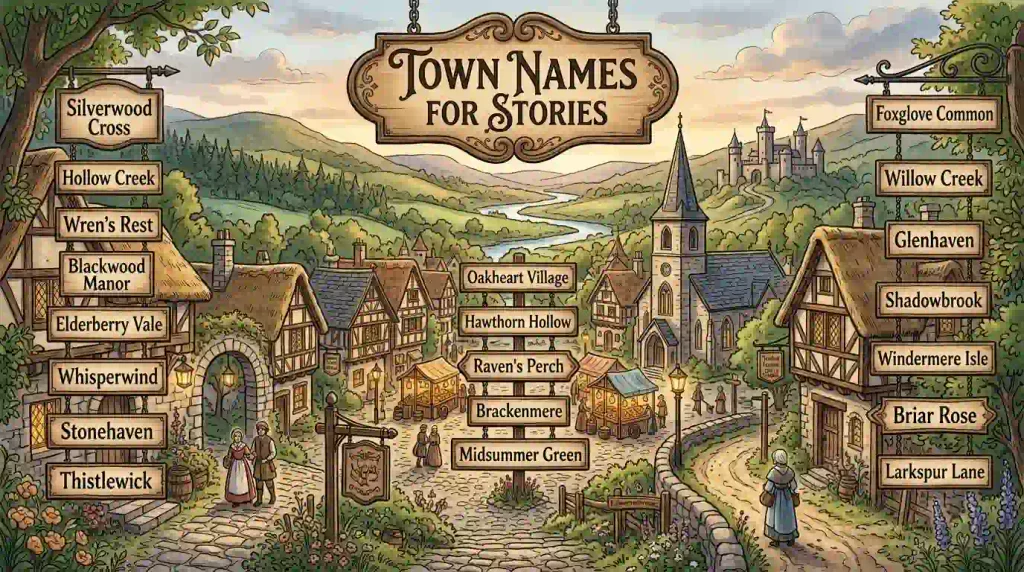

Looking for town names for stories? A good fictional town name should do more than sound nice. It should fit the setting, match the story’s genre, and give readers a small clue about the place they are entering.
Below are 120 town name ideas for stories, organized by the kind of fictional setting they can support. You’ll find names for cozy towns, mysteries, fantasy worlds, coastal communities, mountain settlements, historical fiction, contemporary stories, and darker plots.
One important distinction comes first: the names below are creative fiction suggestions, not claims that these are historically documented place names. Some may resemble or coincide with real places because fiction often uses familiar geographic words such as ford, brook, ridge, and vale. Before using a name commercially, check whether it already belongs to a real place, company, fictional work, or trademark.
The most convincing fictional towns usually have a reason for existing. They may have grown around a river crossing, mine, harbor, railway, farm region, factory, forest, military road, or market. That connection between name, geography, history, and story is what makes a fictional setting feel lived-in.
How to Choose a Town Name for a Story
Start with four questions:
- Where is the town?
- Why was it founded?
- What is its atmosphere?
- What role does it play in the story?
For example, a coastal fishing town should probably not sound like an isolated mountain settlement unless there is a reason for the contrast.
Reedsy’s current town-name guidance similarly recommends considering genre, atmosphere, historical era, cultural or geographic inspiration, industry, population, and surrounding locations when creating a fictional town.
Real place names can also provide useful inspiration. Settlement names often preserve clues about landscape, people, settlement types, and older languages. That does not mean a writer should randomly attach historical suffixes to invented words and call the result authentic. The linguistic background needs to fit the setting.
Cozy Town Names for Stories
These names suit romance, family fiction, cozy mysteries, children’s stories, and gentle contemporary fiction.
1. Willowmere
Story impression: A quiet town beside a lake or wetland.
Works for: Romance, cozy mystery, family fiction.
2. Honeybrook
Story impression: A warm rural community with farms and gardens.
Works for: Romance and small-town fiction.
3. Brambleton
Story impression: An older countryside settlement surrounded by hedges and woodland.
Works for: Cozy mystery and children’s fiction.
4. Fernwick
Story impression: A green, established settlement near woodland.
Works for: Cozy fantasy or rural fiction.
5. Maplehollow
Story impression: A wooded community tucked into a low valley.
Works for: Family stories and romance.
6. Clovermere
Story impression: Open meadows surrounding a small body of water.
Works for: Gentle contemporary fiction.
7. Honeyvale
Story impression: A sunny farming community in a sheltered valley.
Works for: Romance and children’s fiction.
8. Applebrook
Story impression: A rural town near orchards and a stream.
Works for: Family and seasonal stories.
9. Bellmeadow
Story impression: A quiet agricultural town with an old community center or church bell.
Works for: Historical or cozy fiction.
10. Larkfield
Story impression: Open countryside with farms and grassland.
Works for: Contemporary small-town stories.
11. Willowbank
Story impression: A settlement following the bank of a river.
Works for: Romance and literary fiction.
12. Meadowwick
Story impression: A small established community surrounded by meadowland.
Works for: Cozy fantasy and children’s fiction.
Contemporary Small Town Names
These names are intentionally less fantastical. They can work when you want readers to believe the town could exist in a present-day novel.
13. Cedar Grove
A straightforward suburban or semi-rural community.
14. Northfield
A practical name for a town surrounded by farmland.
15. Brookdale
A familiar-sounding community near a stream or valley.
16. Clearbrook
A modern rural town connected to a local waterway.
17. Pinecrest
A community on elevated land near pine woodland.
18. Riverbend
A town built beside a bend in a river.
19. Oakridge
A settlement near an oak-covered ridge.
20. Lakewood
A town surrounded by woodland and a lake.
21. Fairmont
A developed town on elevated ground.
22. Westbrook
A settlement named in relation to a western stream or neighboring town.
23. Greenridge
A modern community near green hills or farmland.
24. Silverbrook
A contemporary town whose local creek has a distinctive appearance or nickname.
Important: These are creative suggestions, not evidence that the names are unused in the real world. Simple names have a particularly high chance of overlapping with existing places.
Mystery Town Names
For mysteries, the name does not have to announce that something terrible happened there. A slightly ordinary name can actually make the mystery more effective.
25. Blackmere
A quiet settlement beside dark-looking water.
26. Mistvale
A valley where fog is common.
27. Raven Hollow
A secluded settlement surrounded by wooded hills.
28. Greyfen
A wetland community with a muted, isolated atmosphere.
29. Hollowmere
A remote town near a lake or lowland basin.
30. Thornbridge
A settlement built around an old bridge and difficult terrain.
31. Crowfield
An agricultural community with a darker literary tone.
32. Duskford
A river crossing with an old, atmospheric feel.
33. Ash Hollow
A secluded settlement surrounded by ash trees or the remains of an older landscape.
34. Wrenmoor
A moorland town with a quiet, windswept setting.
35. Coldmere
A lakeside town with a remote northern atmosphere.
36. Fox Hollow
A woodland settlement that can support either a cozy or darker interpretation.
Dark and Gothic Town Names
These work for horror, gothic fiction, supernatural stories, and psychological mysteries.
37. Shadowmere
A secluded settlement beside a dark lake.
38. Nightfall
A dramatic name for a town with a troubled history.
39. Hollowshade
A forest settlement where the landscape feels enclosed.
40. Ashenvale
A valley associated in the story with fire, ruins, or old industry.
41. Crowhaven
A remote community with a gothic atmosphere.
42. Duskhaven
A harbor or settlement associated with evening darkness.
43. Thornvale
A difficult valley surrounded by dense vegetation.
44. Grim Hollow
A deliberately ominous fictional settlement.
45. Blackthorn
A darker rural setting with a strong plant-based image.
46. Sablemoor
A moorland settlement with a somber fictional tone.
47. Darkwater
A community beside deep or unusually dark water.
48. Ravenmere
A lakeside town with a supernatural atmosphere.
These names use atmospheric associations, not historical etymologies. For fiction, that distinction matters.
Fantasy Town Names
Fantasy names can be more imaginative, but they still benefit from internal consistency.
49. Moonvale
A valley settlement associated with moonlight.
50. Starhaven
A refuge beneath a prominent night sky.
51. Dawnspire
A town centered around a tall tower or mountain spire.
52. Frosthaven
A settlement in a cold region that serves as a refuge for travelers.
53. Stormreach
A remote settlement at the edge of storm-prone territory.
54. Silverfen
A wetland settlement with a magical appearance.
55. Emberfall
A town connected with fire, volcanic terrain, or an old catastrophe.
56. Ironwood
A forest settlement with a strong industrial or military character.
57. Cloudrest
A high settlement near mountains or cliffs.
58. Thornwatch
A fortified settlement protecting a dangerous frontier.
59. Sunmere
A bright lakeside settlement.
60. Evermist
A mysterious settlement surrounded by persistent fictional mist.
FantasyNameGenerators uses a similar broad principle by combining word elements to create fantasy settlements, while noting that its outputs are intentionally varied rather than guaranteed to fit every story.
The difference in this article is that each name is connected to a possible place function, rather than being presented as a random result.
Coastal Town Names
A coastal town becomes more believable when its name reflects what actually matters locally: a harbor, tide, cliffs, fishing, shipping, salt marshes, or the sea.
61. Tidehaven
A sheltered coastal settlement.
62. Saltwick
A fictional old-style coastal community associated with salt production or marshland.
63. Windport
A harbor exposed to strong sea winds.
64. Cliffhaven
A settlement beneath high coastal cliffs.
65. Seabrook
A town where a freshwater stream reaches the sea.
66. Gullhaven
A harbor community with a strong maritime atmosphere.
67. Driftmere
A coastal or tidal settlement beside shallow water.
68. Coral Reach
A warm-water coastal setting.
69. Stormbay
A bay known in the story for rough weather.
70. Harbourmere
A fictional coastal name combining harbor imagery with water.
71. Bluecove
A smaller coastal community around a sheltered cove.
72. Saltmarket
A trading settlement whose history centers on salt and maritime commerce.
Mountain Town Names
These names work best when the fictional settlement sits in a highland region.
73. Stonecrest
A settlement near a rocky ridge.
74. Pinewatch
A mountain town surrounded by pine forest.
75. Northpass
A settlement beside an important mountain route.
76. Frostpeak
A cold community near a snowy mountain.
77. Ironridge
A rugged settlement associated with mining or mountain industry.
78. Highstone
A town built on elevated rocky ground.
79. Silverridge
A mountain community with a mineral or winter atmosphere.
80. Wolfpine
A forested highland settlement.
81. Redcliff
A town beside distinctive red-colored cliffs.
82. Granite Vale
A settlement between large rocky slopes.
83. Eagle Pass
A mountain crossing that could serve travelers or traders.
84. Summit Hollow
A secluded settlement hidden among high slopes.
Historical and Old World Style Town Names
If your story takes place in the past, do not simply add -shire, -bury, or -ton to random words. First decide what language and naming tradition your fictional region uses.
For an English-inspired setting, the following names can provide a starting point:
85. Bellford
A settlement centered around a river crossing.
86. Westmere
A western settlement near a lake or marsh.
87. Kingsfield
A community associated in the fictional history with a royal estate.
88. Millford
A settlement near a mill and river crossing.
89. Oldhaven
An established coastal settlement with a long history.
90. Eastwick
A fictional settlement name with an old-fashioned sound.
91. Highstead
A settlement imagined on elevated ground.
92. Redmere
A town beside a body of water with a distinctive local color.
93. Stonebury
A fictional old settlement associated with stone construction.
94. Westford
A settlement positioned around a western river crossing.
95. Millstone
A community whose early economy centered on milling.
96. Crownfield
A fictional settlement connected with a royal estate or administrative district.
These should be treated as fictional naming constructions, not historical English etymologies. Real historical place-name elements have specific linguistic histories, and their meanings vary by language, period, and region.
Funny and Quirky Town Names
Comedy gives you more freedom. A deliberately unusual name can become part of the story itself.
97. Pickleford
A ridiculous but memorable small town.
98. Wobbleton
A town suited to comic fiction.
99. Noodlebrook
A playful settlement beside an imaginary stream.
100. Puddlewick
A humorous village name.
101. Bumbleton
A cheerful, slightly absurd town.
102. Muffin Hill
A deliberately whimsical community.
103. Doodleby
A short comic place name.
104. Waffletown
A deliberately exaggerated setting for satire.
105. Giggleford
A children’s-fiction or comedy setting.
106. Buttonvale
A playful valley settlement.
107. Tumblewick
A chaotic little town with comic potential.
108. Snugglebrook
A deliberately cute fictional community.
Unique Town Names With a Strong Story Hook
These names are especially useful when the town itself is important to the plot.
109. Lanternmere
A town where lanterns could have historical importance, perhaps because of fog, mining, or a harbor.
110. Bellshadow
A settlement dominated by an old bell tower or a mysterious local tradition.
111. Copperhollow
A former mining settlement in a narrow valley.
112. Marrowfield
A darker rural setting suitable for mystery or horror.
113. Glassmere
A town beside unusually clear water, or a place historically associated with glassmaking.
114. Cinderbrook
A settlement rebuilt after a major fire or industrial disaster.
115. Foxmere
A quiet lakeside community surrounded by woodland.
116. Hollowgate
A town positioned around an old pass or fortified entrance.
117. Silvercross
A settlement where roads, rivers, or fictional historical routes meet.
118. Winterfen
A cold wetland community.
119. Briarwatch
A frontier settlement that once served as a lookout post.
120. Coppervale
A valley town whose fictional economy developed around copper mining or metalworking.
A Better Way to Build a Fictional Town Name
Instead of randomly combining two attractive words, build the town from its story history.
Try this five-step method:
Step 1: Decide why the town exists
Choose one:
- farming
- fishing
- mining
- trade
- railway
- logging
- tourism
- military defense
- manufacturing
- river crossing
- religious pilgrimage
- university or education
- government
- transportation
Step 2: Choose the dominant landscape
For example:
- river
- lake
- coast
- valley
- mountain
- forest
- marsh
- plain
- desert
- island
Step 3: Decide how old it is
A recently developed American-style town may use a very different naming pattern from a settlement that has existed for 800 years.
Your fictional history could be:
Founded recently: New names, founder names, commercial names
Industrial era: mills, railways, mines, factories
Medieval-style: landscape and settlement elements
Ancient settlement: older linguistic layers and later changes
Post-disaster settlement: rebuilt or renamed community
Step 4: Create the name
For example:
Mountain + mining: Coppervale
River + crossing: Bellford
Coast + shelter: Tidehaven
Forest + settlement: Fernwick
Marsh + winter climate: Winterfen
Step 5: Give the town a local nickname
This is one area where fictional worldbuilding can become much richer.
For example:
Official name: Coppervale
Local nickname: The Vale
Old nickname: The Red Town
Reason: The surrounding hills contain red mineral deposits.
Now the town has social texture instead of being just a label.
Town Name Suffixes: Use Them Carefully
Writers often use endings such as -ford, -brook, -vale, -ton, -wick, -haven, -stead, and -bury because they resemble real place names.
That can work, but these elements are not interchangeable fantasy decoration.
A ford, for example, refers to a river crossing in English place-name usage. A writer using -ford should therefore have a reason for a crossing in the town’s geography.
Likewise, a name containing a water-related element makes more sense if water is actually important to the settlement.
This simple rule can dramatically improve fictional names:
If the name describes a feature, put that feature somewhere in the town’s world.
A town called Stonebridge should ideally have a bridge, historical bridge, ruined bridge, or local story explaining the name.
A town called Pinewatch should have a reason for both pine and watch.
A town called Tidehaven should actually have a tidal or coastal setting.
This is more convincing than choosing words only because they sound attractive.
How to Make a Town Name Feel Real
A believable town usually has more than a name.
Give it five supporting details:
Name: Coppervale
Location: Mountain valley
Original industry: Copper mining
Population: Small regional town
Local nickname: The Vale
Now the name and setting reinforce each other.
You can go further:
Old railway station: Coppervale Junction
Nearby river: Greywater Creek
Older district: East Hollow
Main road: Miner’s Road
Local landmark: The Old Smelter
This creates a naming system rather than five unrelated names.
Reedsy similarly recommends supplying neighboring locations and geographic details because consistency across a fictional world helps place names feel as though they belong to the same setting.
How to Avoid a Generic AI Sounding Town Name
If every town in your story is something like:
- Shadowvale
- Moonhaven
- Silverbrook
- Stormridge
- Darkmere
The setting can quickly feel repetitive.
The problem is not that these words are unusable. It is that they rely on the same familiar formula.
Try giving your town a specific local history instead.
Instead of:
Silver Town
try:
Coppervale, because miners discovered copper in the valley.
Instead of:
Storm City
try:
Windport, because ships historically used the harbor as a shelter.
Instead of:
Forest Town
try:
Fernwick, because the original settlement grew around a wooded wetland.
The name becomes memorable because the reader can connect it to something concrete.
Check Whether Your Fictional Town Name Already Exists
This step was missing from the earlier article and is particularly important.
Before publishing a novel, game, website, or commercial project, search the exact name.
Check:
- Google Maps
- Wikipedia
- local geographic databases
- social media
- domain availability
- trademark databases when commercially relevant
- existing books, films, games, and fictional universes
Do not assume a name is unique just because it was generated by an AI or name generator.
Some simple names are naturally shared by multiple real places. A generator can produce a name that already exists without knowing that it has a real-world history.
If you need a completely distinctive commercial name, the final decision should come after this collision check.
How to Name Towns From Different Cultures
This deserves extra care.
If your fictional story takes place in a setting inspired by Welsh, Japanese, Arabic, Gaelic, Scandinavian, Indigenous, or another real naming tradition, do not simply combine English words with a few sounds that seem culturally appropriate.
Instead:
- Identify the language.
- Research actual place-name patterns.
- Learn how compounds are formed.
- Check historical and modern usage.
- Understand the geographic context.
- Keep real cultural names separate from invented constructions.
For example, an author writing a fictional Japanese town should research Japanese place-name structure rather than inventing a string of Japanese-looking syllables and giving it a made-up meaning.
The same principle applies to every culture.
A culturally grounded fictional name does not require a real place to exist. It requires the naming logic to make sense.
15 Best Town Names for Stories
Rather than treating one name as universally “best,” here are strong choices for different story purposes.
| Story purpose | Town name | Why it fits |
| Cozy romance | Willowmere | Gentle rural imagery |
| Contemporary fiction | Brookdale | Familiar and understated |
| Mystery | Mistvale | Suggests isolation and fog |
| Gothic fiction | Ravenmere | Dark, atmospheric setting |
| Fantasy | Dawnspire | Works with towers, mountains, or magic |
| Coastal story | Tidehaven | Clear maritime setting |
| Mountain story | Pinewatch | Suggests forest and elevation |
| Historical fiction | Bellford | Traditional settlement feel |
| Rural fiction | Applebrook | Suggests orchards and water |
| Horror | Hollowshade | Strong enclosed, dark atmosphere |
| Children’s fiction | Sunnybrook | Friendly and easy to remember |
| Comedy | Pickleford | Intentionally absurd |
| Mining town | Coppervale | Gives the town an economic history |
| Frontier story | Briarwatch | Suggests an outpost or lookout |
| Literary mystery | Lanternmere | Gives you room for a local legend or landmark |
The strongest choice depends on what you need the town to accomplish in the story.
Town Naming Checklist for Writers
Before settling on a name, ask:
Does the geography match?
If the name contains bay, ford, ridge, valley, or mere, does the setting support it?
Does the genre match?
A modern romantic comedy may need a different naming style from a medieval fantasy.
Does the historical period match?
A town founded in 2020 should not automatically have the same naming logic as a settlement supposedly founded 900 years ago.
Does the language match?
If the story is culturally specific, research the language rather than guessing.
Is the name easy to read?
Readers should not struggle every time the town appears.
Can characters say it naturally?
Try:
“She grew up in ______.”
“The road to ______ was closed.”
“Nobody left ______ after dark.”
If the name feels awkward in those sentences, reconsider it.
Does the name tell us something?
A useful name can hint at geography, history, industry, or atmosphere.
Is it already used?
Search before publication.
Does it sound too similar to another place?
Two neighboring towns called Blackmere and Blackmoor may confuse readers.
Does it fit the rest of your world?
Character names, town names, rivers, mountains, and neighboring settlements should feel as though they belong to the same linguistic environment.
Frequently Asked Questions
Question: What are town names for stories?
Answer: Town names for stories are fictional settlement names created for novels, short stories, games, scripts, and other creative works. They can be realistic, historical, mysterious, fantasy-inspired, coastal, rural, futuristic, or humorous depending on the setting.
Question: How do I make a fictional town name sound realistic?
Answer: Connect the name to something real within your fictional world, such as geography, industry, a founder, a historical event, or a settlement feature. A town called Coppervale becomes more convincing when it is actually located in a valley with a mining history.
Question: Should I use real place name suffixes?
Answer: You can use familiar place-name elements, but research their meaning first. Words such as ford and other settlement elements have particular linguistic histories. Using them correctly can make a fictional setting more coherent, while random combinations can create an inaccurate impression of historical authenticity.
Question: Are these town names real?
Answer: They are presented here as creative suggestions rather than a verified database of unused geographic names. Some simple constructions may coincide with existing real places. Always check the exact name before using it for a published or commercial project.
Question: Can I use a real town name in my story?
Answer: Yes, writers can set fiction in real towns, but doing so creates a different storytelling choice. A real place comes with existing geography, history, institutions, and associations. If you want complete control over the setting, a fictional town may be more suitable.
Question: Should a fictional town have a nickname?
Answer: Often, yes. A local nickname can reveal how residents feel about their town. For example, an official name such as Coppervale might become “The Vale” in everyday speech. A nickname can also provide useful dialogue and worldbuilding.
Question: How do I create names for several towns in the same fictional country?
Answer: Establish a shared naming system first. Decide what language or historical tradition influences the region, then reuse a small set of linguistic patterns. You can also vary names by region, just as real places often develop different naming traditions across geographic areas.
Related Story Name Ideas
If you are building a fictional world, related naming topics include:
- Fictional city names
- Village names for stories
- Fantasy town names
- Medieval town names
- Fictional country names
- Fantasy kingdom names
- Coastal town names
- Character names for stories
- Fictional school names
- Fantasy place names
- Small-town names
- Dark place names
Conclusion
The best town names for stories are not necessarily the strangest or most beautiful names. They are names that feel as though they belong to the place you have created.
Start with geography and history. Ask why people settled there, what they do for a living, and what outsiders know the town for. Then build the name around those details.
For a cozy story, something like Willowmere may create the right impression. A mystery might need Mistvale, while a fantasy settlement could suit Dawnspire. A mining town becomes more convincing when its name reflects its history, such as Coppervale.
Most importantly, treat invented meanings as creative ideas, not historical facts. Research real linguistic traditions carefully, and check your final name against real-world places before publication.
A memorable fictional town does not just have a name. Its name should feel like it has a story of its own.

PressoraMedia is a content platform dedicated to helping readers find the right words, names, meanings, and ideas for everyday use. Our content focuses on names, name meanings, naming inspiration, and useful language-related information in a simple and easy-to-understand format. At Pressora Media, we believe that choosing a name is more than simply finding a word. A name can carry meaning, personality, culture, and a special story. That is why we research names carefully and create helpful guides designed to make the naming process easier. Our authors and contributors focus on providing clear explanations, useful name suggestions, meanings, origins, pronunciations, and practical naming ideas. We aim to keep our content informative, reader-friendly, and genuinely useful. Whether you are searching for a meaningful name, exploring the origin of a name, looking for unique naming ideas, or simply curious about the meaning behind a word or name, Pressora Media is here to help.
Pressora Media Team
Helping you find the right name, meaning, and words.